The Rite of Spring premiere: May 29, 1913
Igor Stravinsky’s The Rite of Spring premiered in Paris on May 29, 1913, with choreography by Vaslav Nijinsky. Its challenging music and unfamiliar movement divided the audience. The resulting disturbance became legendary, sometimes overshadowing the artistic collaboration behind the ballet.
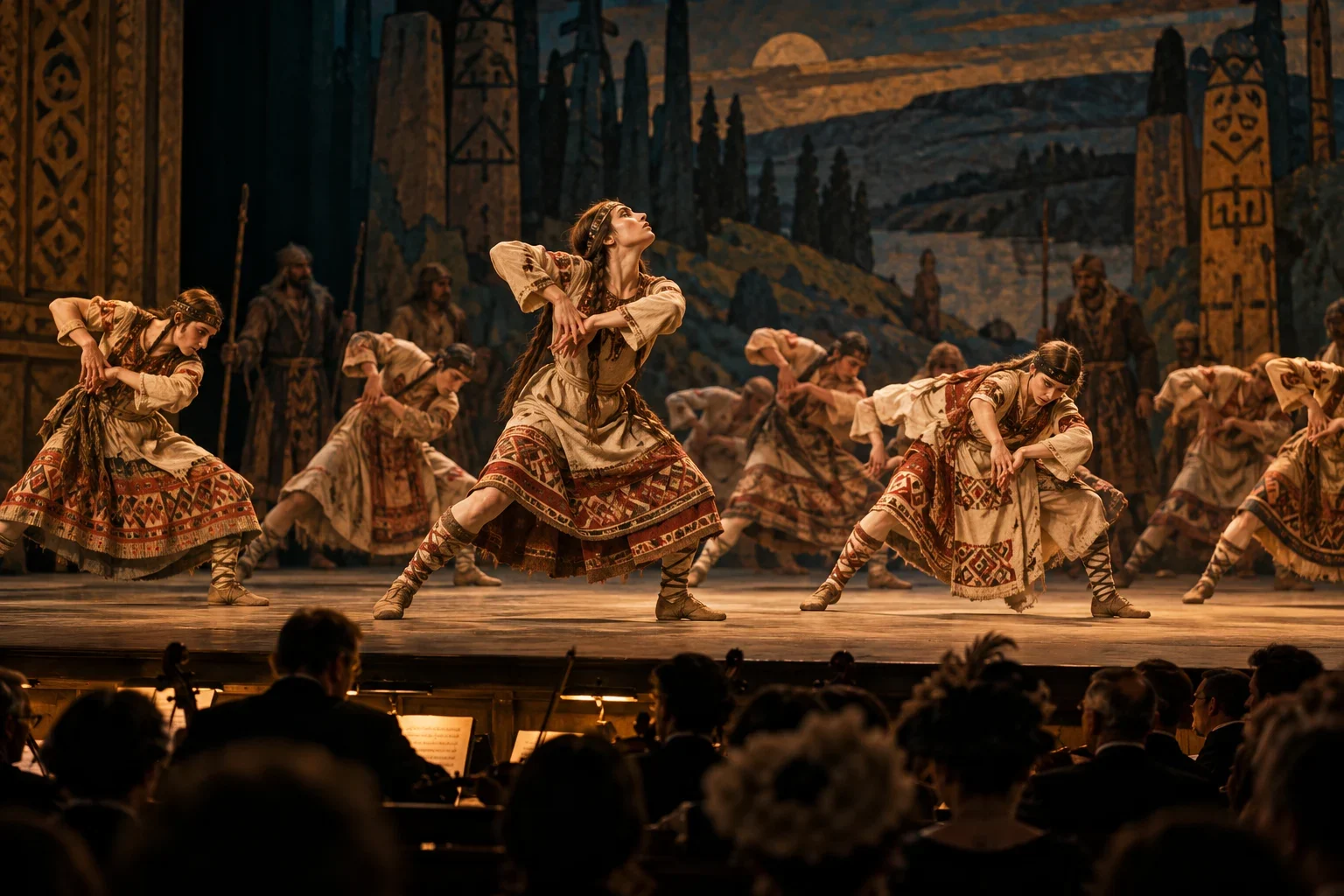
An imagined ritual on stage
The ballet presents an imagined pagan world culminating in the selection of a young woman who dances herself to death. Stravinsky developed its conception with artist and folklorist Nikolai Roerich, while Serge Diaghilev brought it to the stage through the Ballets Russes. Nijinsky’s choreography rejected many familiar signs of classical elegance. Bent bodies, turned-in feet and emphatic group movement gave the production a distinctive physical character. The work should be understood as a modern artistic construction of ritual, rather than a documentary reconstruction of a precisely established ancient ceremony.
Rhythm becomes a driving force
Stravinsky made rhythm and orchestral colour central to the ballet’s impact. The high opening bassoon melody offers a striking entry into a score filled with repeated patterns, shifting accents and forceful contrasts. Folk-derived material appears within unusual textures and harmonies, while changing metres complicate the relationship between an underlying pulse and the accents listeners expect. These features create momentum without relying on the smooth regularity associated with much earlier ballet music. Their interaction with the dancers’ grounded movements helps explain why this was a theatrical challenge as well as a musical one.
The disturbance and its reputation
The premiere produced loud hostility and argument, but the word “riot” needs care. Accounts and later retellings vary, and a noisy divided theatre audience is not automatically evidence for every dramatic detail attached to the legend. San Francisco Conservatory of Music’s discussion emphasizes that the choreography was probably central to the reaction, alongside cultural expectations surrounding the production. Reducing the episode to listeners simply rejecting unfamiliar notes misses that context. The enduring importance of the evening lies in the work’s challenge to conventions of music, movement and theatrical representation.
The Rite of Spring — Introduction (piano four hands)
ZOFO Duet; music by Igor Stravinsky
A later piano-four-hands performance of the opening of the ballet premiered that night. It is not a recording of the 1913 premiere.
Listen on SoundCloud ↗Follow the evidence.
- Indianapolis Symphony Orchestra: Stravinsky, The Rite of Spring ↗
- San Francisco Conservatory of Music: The story of the Rite of Spring premiere ↗
- Library of Congress: The Rite of Spring premiere ↗
AI-assisted writing, with institutional and primary sources. Illustration is a reconstruction, not an archival photograph. Published October 31, 2026; updated October 31, 2026. Our approach