The Wright brothers’ first flights: December 17, 1903
On December 17, 1903, Orville and Wilbur Wright made four powered flights at Kill Devil Hills, North Carolina. Orville’s first covered 120 feet in 12 seconds. Their achievement combined a pilot, engine power and sustained control in a heavier-than-air aircraft.
Four attempts, increasing distances
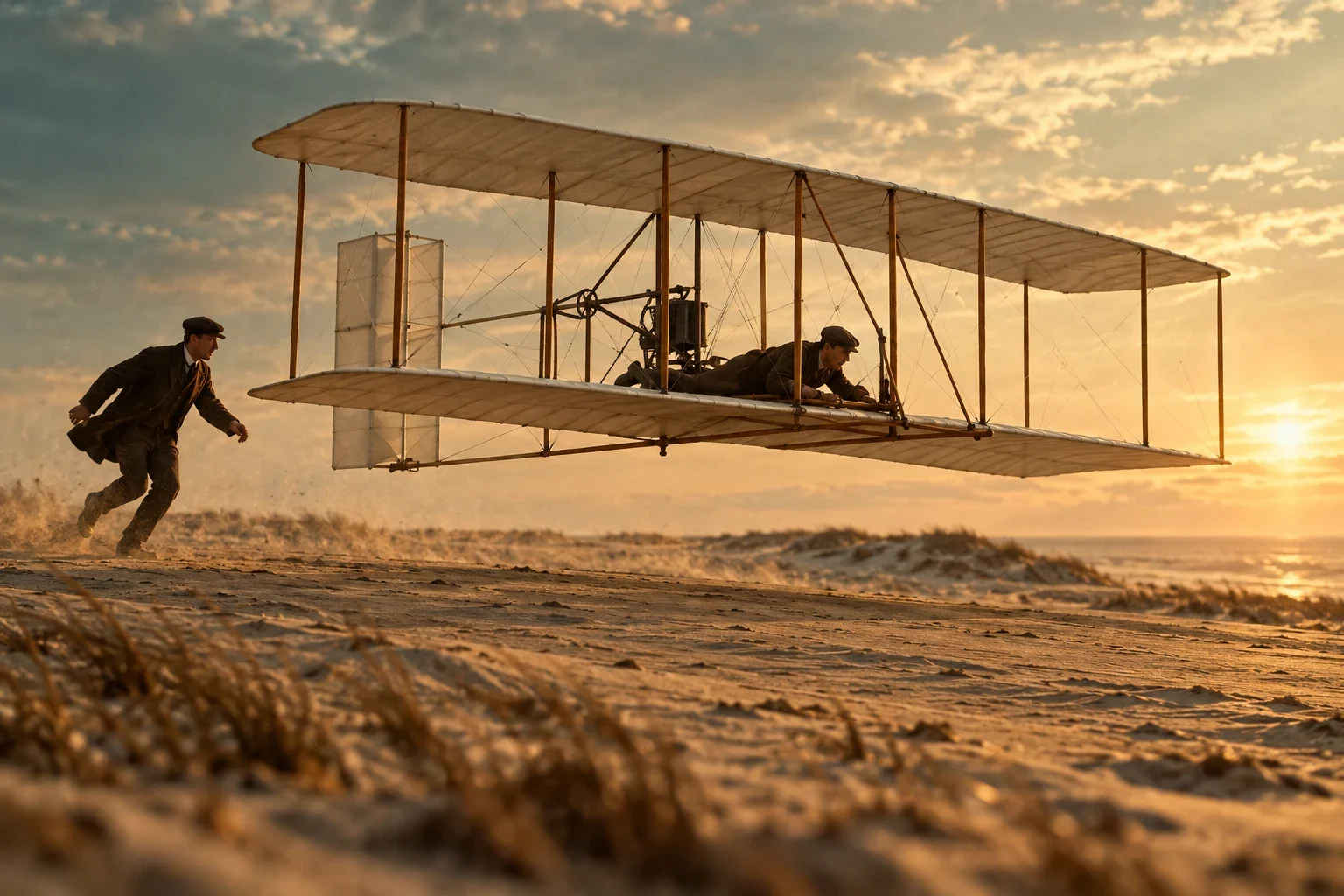
The brothers alternated at the controls throughout the day. Orville made the first successful flight at 10:35 a.m., with Wilbur running alongside as the Flyer left its launching rail. Three further flights followed as they gained experience handling the aircraft. The final flight, made by Wilbur, covered 852 feet in 59 seconds. These were brief journeys, but they demonstrated more than an isolated leap into the air. After the fourth landing, a gust overturned the aircraft and damaged it, bringing that day’s experiments to an end.
Solving the problem of control
The Wrights’ achievement depended on managing an aircraft in flight as well as generating enough lift and power. Their design combined an elevator for pitching the nose up or down, a movable rudder, and wing-warping to control lateral balance. This three-axis system grew from earlier experiments with kites and gliders. The Smithsonian describes the Flyer as the first powered, heavier-than-air aircraft to make a sustained, controlled flight with a pilot aboard. Those qualifications distinguish the achievement from balloons, unpowered gliders and earlier powered hops.
The evidence behind an iconic moment
The familiar photograph of the first flight was taken by John T. Daniels, a member of the nearby lifesaving station. Orville had prepared the camera, and Daniels operated it as the aircraft became airborne. The image captures one short stage in a longer experimental programme, rather than every aspect of the breakthrough. The brothers did not see the developed photograph until they returned to Dayton. Its survival gives the event an unusually powerful visual record, while the flight measurements and accounts explain what the image alone cannot establish.
The Entertainer — piano performance
Melanie Spanswick; music by Scott Joplin
A later piano performance of Joplin’s ragtime piece, published in 1902 just before the Wrights’ breakthrough. The composition evokes the period; this is not a recording made at Kitty Hawk.
Listen on SoundCloud ↗Follow the evidence.
- National Park Service: The First Flight ↗
- Smithsonian National Air and Space Museum: Researching the Wright Way ↗
- National Park Service: 12 Seconds that Changed the World ↗
AI-assisted writing, with institutional and primary sources. Illustration is a reconstruction, not an archival photograph. Published October 31, 2026; updated October 31, 2026. Our approach