Inauguration and construction of Christ the Redeemer in Rio
Christ the Redeemer was inaugurated above Rio de Janeiro on 12 October 1931. Its familiar silhouette combines religious imagery, reinforced-concrete engineering and a protective mosaic of soapstone tiles.
A monument above an existing destination
Corcovado was already a celebrated viewpoint before the statue transformed its summit. A railway opened in the nineteenth century, carrying visitors through the forest to views over Rio de Janeiro. The monument therefore occupied an established tourist landscape rather than creating access to an untouched peak. The mountain’s prominence helped the figure become visible across the city, while the railway provided a crucial route for the people and materials involved in construction. Tijuca National Park’s account
Concrete within, soapstone outside
Brazilian engineer Heitor da Silva Costa played a leading role in the project, with contributions from artist Carlos Oswald and sculptor Paul Landowski. The finished monument combined a reinforced-concrete structure with an exterior mosaic of small soapstone pieces. This distinction between structure and cladding explains how an apparently stone figure could support such widely extended arms. Construction at the summit involved transporting materials uphill and coordinating architectural, sculptural and engineering work. The São Paulo legislative archive’s history Brazil’s tourism ministry
The inauguration on 12 October 1931
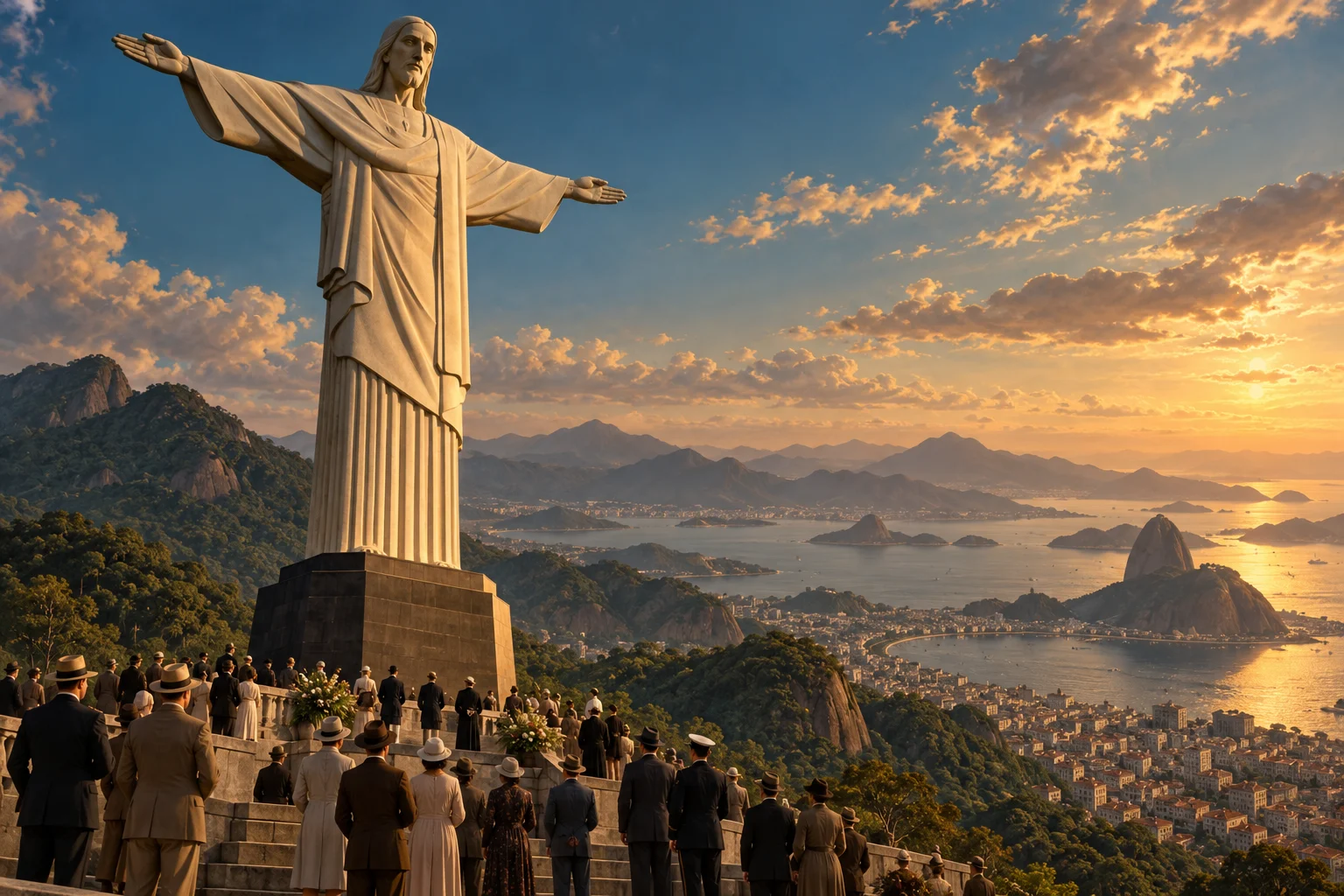
The inauguration took place on 12 October 1931, a date associated with Our Lady of Aparecida. Church and government representatives attended ceremonies at the summit, with special trains carrying invited guests and journalists up the mountain. The monument stood approximately 38 metres high including its pedestal. Its opening marked the completion of years of planning, fundraising and construction, bringing a large public religious image into a dramatically visible position above the national capital of the time. The inauguration record The ministry’s anniversary account
Religious meaning and civic identity
The statue expressed Catholic aspirations and also became a widely recognised image of Rio and Brazil. Those meanings should not be flattened into a claim that everyone supported the original project: contemporary religious objections are documented in the legislative archive’s account. Its later popularity as a landmark does not erase that history. The accompanying image is an interpretive view of the completed monument and period visitors; it does not reproduce the precise guest list, weather or staging of the inauguration ceremony. Historical context and objections
Corcovado
Beatriz Pessoa, voice; Zé Vieira, guitar
This later performance of Antônio Carlos Jobim’s Corcovado connects directly to the mountain overlooking Rio. It is a later bossa nova association, not music from the 1931 inauguration.
Listen on SoundCloud ↗Follow the evidence.
- São Paulo Legislative Assembly — Christ the Redeemer history ↗
- Brazilian Ministry of Tourism — Rio celebrates Christ the Redeemer ↗
- Tijuca National Park — Corcovado ↗
- Beatriz Pessoa and Zé Vieira — Corcovado ↗
AI-assisted writing, with institutional and primary sources. Illustration is a reconstruction, not an archival photograph. Published October 31, 2026; updated October 31, 2026. Our approach