Elm Farm Ollie’s flight and airborne milking demonstration
On 18 February 1930, a Guernsey cow flew to St. Louis, was milked aboard a Ford Trimotor, and supplied an unusual parachute delivery.
A new kind of transport
Commercial aviation in the late 1920s needed to demonstrate practical uses as well as excitement. The Ford Trimotor became an important passenger and transport aircraft, recognizable by its corrugated metal skin and three engines. Its history included airline services, sightseeing and exploratory flights. The Federal Aviation Administration’s history places an especially unconventional passenger among these milestones: a Missouri dairy cow. Commercial aircraft also had to win public confidence as tools for ordinary work. A dairy demonstration made that promise concrete, using a familiar farm animal to publicize unfamiliar transport. FAA aircraft history
The flight of 18 February
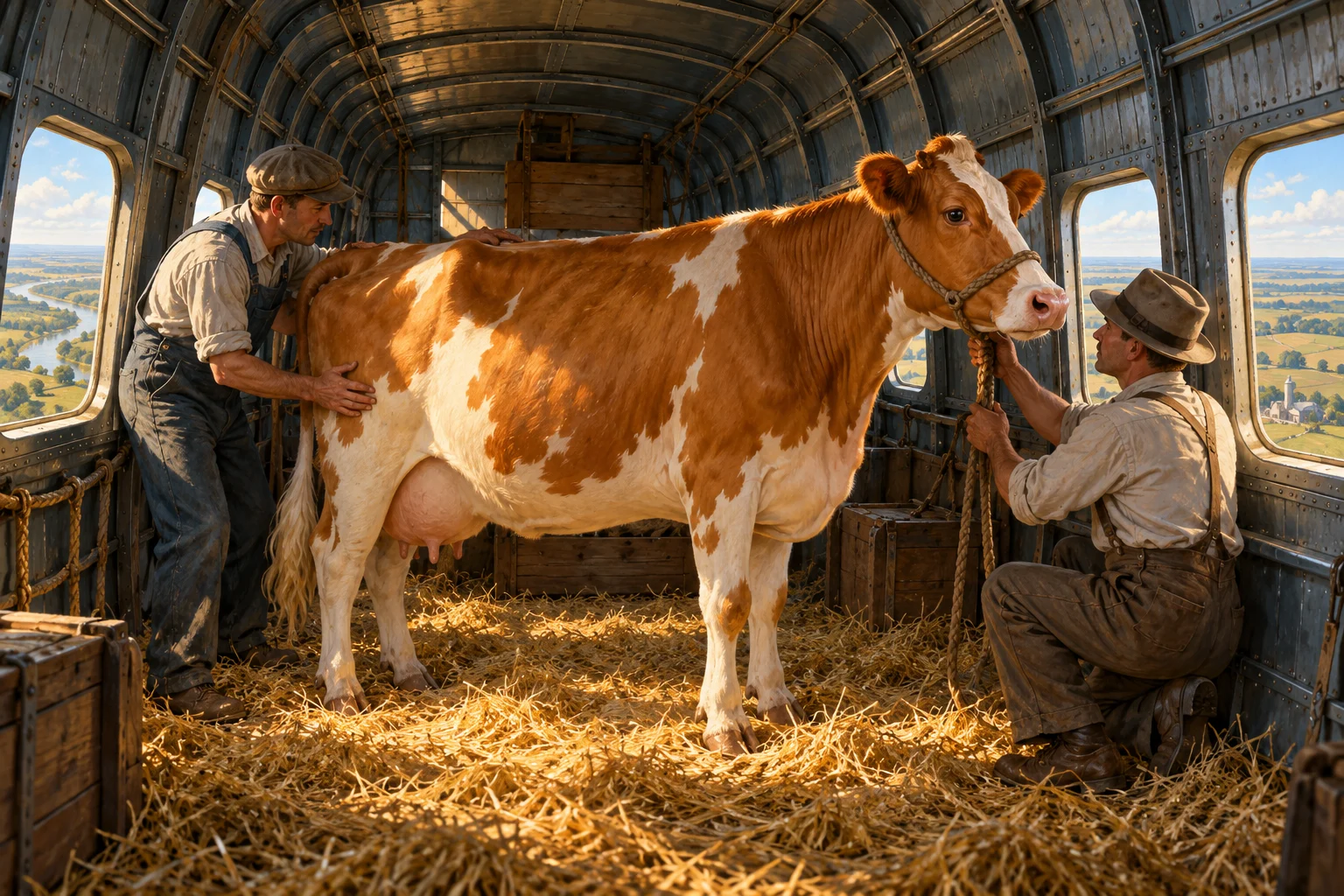
Elm Farm Ollie travelled from Bismarck, Missouri, to St. Louis on 18 February 1930 during the International Aircraft Exposition. The San Diego Air & Space Museum identifies her as the first cow to fly in an airplane and the first to be milked aboard one. The demonstration combined publicity with an opportunity to observe an animal’s response to flight. Her calm temperament helped explain her selection.
Milk with a parachute
Elsworth W. Bunce performed the milking. According to the museum’s account, Ollie produced 24 quarts during the journey. The milk was packed into paper cartons and parachuted to spectators below. This final delivery turned a transport demonstration into an unusually memorable advertising event: the aircraft carried both the producer and its fresh product. The spectacle made the dairy operation itself part of the aviation story. Museum account
A small story in aviation history
The FAA chronology independently records the flight and milking on the same date, anchoring the episode beyond later novelty retellings. Ollie’s journey also illustrates how early commercial aircraft acquired public familiarity through demonstrations that connected flying with ordinary work. Museum accounts preserve later commemorations and a rumour that Charles Lindbergh tasted her milk; that rumour is not established here. The accompanying cabin scene is an original historical illustration, not a surviving photograph of the flight.
St. louis blues - Stromboli Jazz Band
Stromboli Jazz Band
The band’s later performance of W. C. Handy’s 1914 standard connects with the flight’s destination and interwar jazz culture. It is not a recording from the exposition.
Listen on SoundCloud ↗Follow the evidence.
AI-assisted writing, with institutional and primary sources. Illustration is a reconstruction, not an archival photograph. Published October 31, 2026; updated October 31, 2026. Our approach