Gertrude Ederle swims the English Channel and breaks the record
Gertrude Ederle completed her English Channel crossing on 6 August 1926. Becoming the first woman to finish was only part of the achievement: her time also surpassed those of all five men who had previously succeeded.
An established swimmer takes a new challenge
Ederle brought substantial competitive experience to the Channel. At the 1924 Paris Olympics she won three medals, including relay gold. Distance swimming in open water nevertheless presented a different problem from a pool race. Currents, cold and rough conditions made simply reaching the opposite coast uncertain. Her unsuccessful attempt in 1925 also meant that the famous crossing was the result of preparation and persistence, rather than a first encounter with the challenge.
The crossing on 6 August
On 6 August 1926, Ederle swam from France to England and became the first woman to complete the English Channel crossing. Only five men had previously accomplished it. She finished in roughly fourteen and a half hours, improving on the previous best time by around two hours. This comparison was especially striking because many contemporary assumptions treated a feat of such endurance as beyond women’s capabilities. Ederle supplied a measurable response.
Fame and the details of the record
New York welcomed her home with a ticker-tape parade on 27 August. The city’s archives preserve records of the reception and describe the extraordinary public interest. Published accounts disagree over the precise minutes of her crossing: the Municipal Archives gives fourteen hours and thirty-one minutes, while an ISHOF retrospective gives thirty-nine minutes. The small discrepancy does not affect the date, her status as the first woman, or her decisive improvement on the existing men’s record.
Why the performance endured
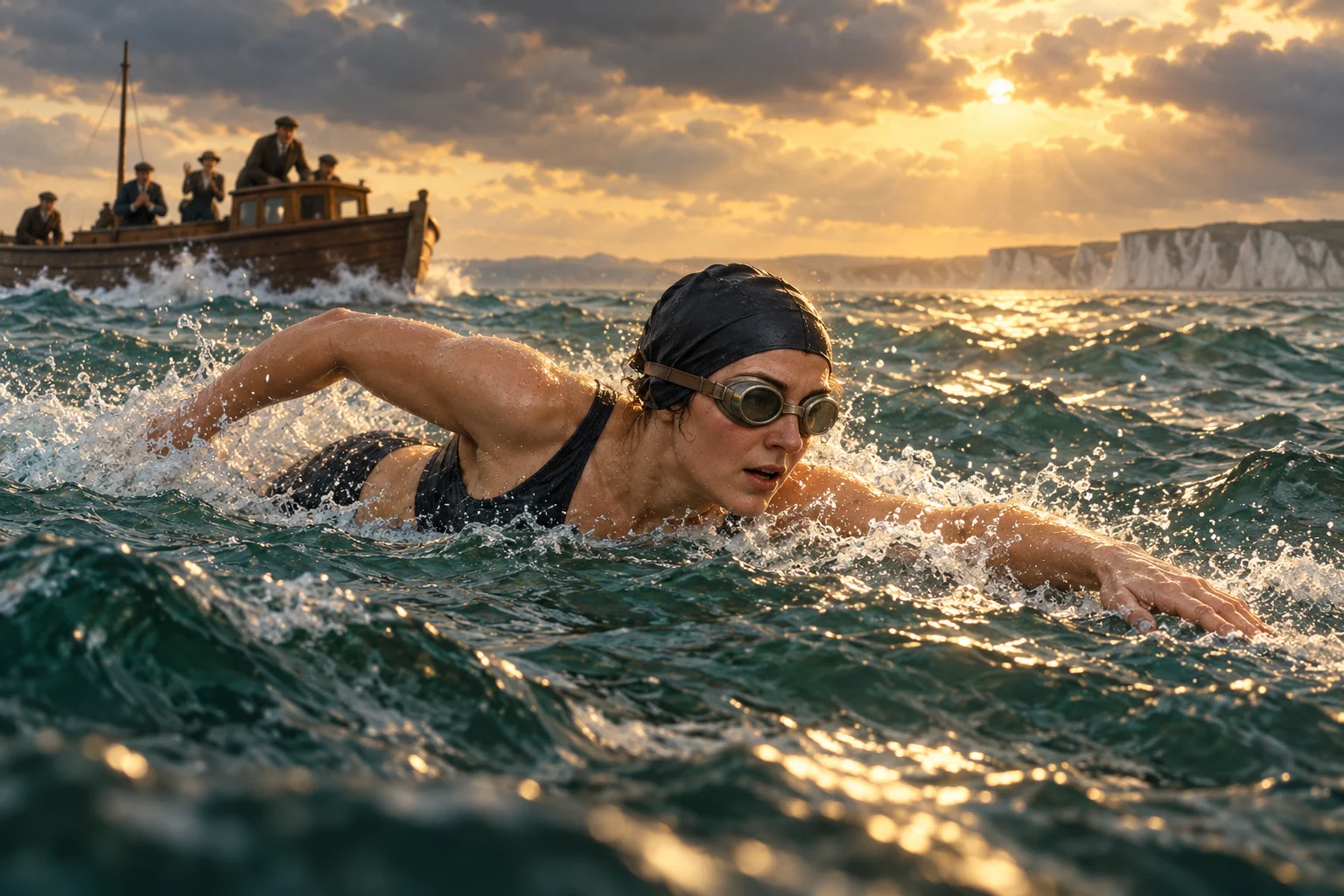
Ederle’s achievement joined the public spectacle of a sporting first to a result that could be directly compared with previous performances. It challenged expectations through speed as well as completion, and became a powerful example of women’s athletic capability. Her reputation therefore extends beyond a single line in a list of firsts. The illustration evokes the physical work of open-water swimming and a period support boat; it is not a photograph or a reconstruction of one verified stroke.
Yes, We Have No Bananas
The California Ramblers
This 1923 New York dance-band recording supplies the popular musical world of Ederle’s 1920s New York. The uploader identifies it as a recording of his grandfather’s band; it is not audio of her Channel swim.
Listen on SoundCloud ↗Follow the evidence.
- ISHOF: Countdown to the centenary of Ederle’s crossing ↗
- NYC Municipal Archives: Gertrude Ederle swims the Channel ↗
- ISHOF: Celebrating the 100th anniversary of Gertrude Ederle ↗
- The California Ramblers: Yes, We Have No Bananas, 1923 transfer ↗
AI-assisted writing, with institutional and primary sources. Illustration is a reconstruction, not an archival photograph. Published October 31, 2026; updated October 31, 2026. Our approach