Nellie Tayloe Ross wins Wyoming’s 1924 special election
On November 4, 1924, Wyoming voters elected Nellie Tayloe Ross to complete her late husband’s term. Her victory led to her becoming the first woman to serve as governor of a U.S. state, beginning in January 1925.
A vacancy and a decision
Governor William B. Ross died in October 1924, leaving an unfinished term and a sudden political vacancy. His widow, Nellie Tayloe Ross, faced both personal grief and an invitation to run for his office. The Wyoming State Historical Society’s account emphasizes that her decision involved ambition and political judgment, alongside the wish to continue her husband’s work. Treating her only as a ceremonial substitute misses the choice she made to seek authority herself.
The election on November 4
Ross won a special election on November 4, 1924. The vote authorized her to finish the remainder of William Ross’s term; marriage had not automatically transferred the governorship to her. The American Heritage Center clearly distinguishes that election from her inauguration on January 5, 1925. She then became the first woman to serve as an American state governor. The election date is therefore a biographical milestone with a direct institutional consequence.
Governing after a symbolic breakthrough
Holding office required more than becoming a first. Ross supported measures concerning agricultural assistance, education, taxation, banking and workers’ protection. A Republican-controlled legislature resisted much of her program. She lost her 1926 reelection campaign by a relatively narrow margin, but her public career continued. Her experience illustrates the difference between access to an office and the practical ability to secure legislative change once inside it. A political barrier could fall while other constraints remained.
A longer public career
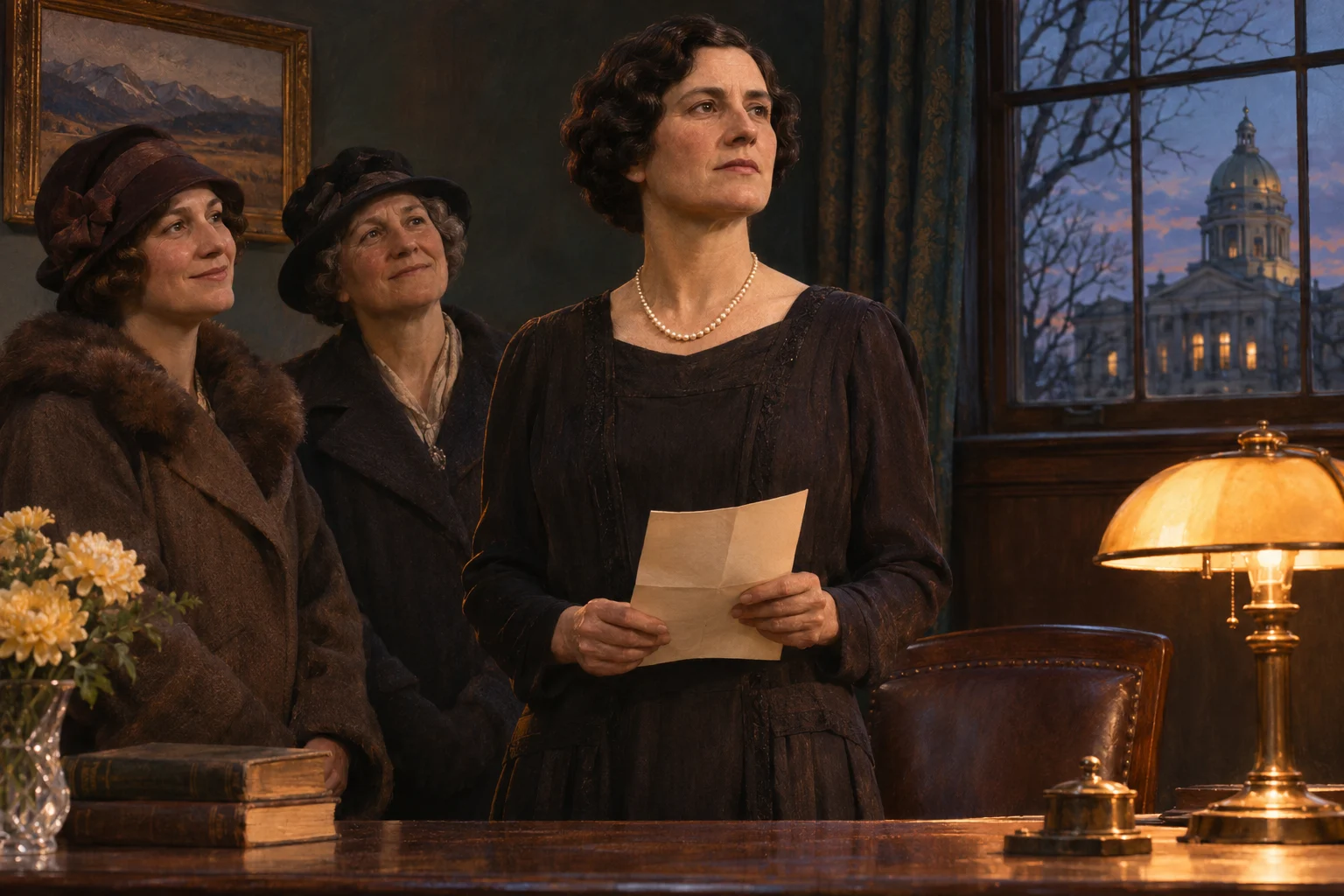
In 1933, Franklin D. Roosevelt appointed Ross director of the United States Mint. She remained there until 1953, a twenty-year tenure documented by the Mint’s own history. Her later work makes it particularly misleading to reduce her entire career to widowhood. The election-night illustration is interpretive and does not reproduce a documented gathering. The historical evidence establishes the vote, the unfinished term and her subsequent service, rather than the pictured room or companions.
Daughters of Freedom (chorus and orchestra)
Daniel Black — arrangement demonstration
Daniel Black’s modern arrangement demonstration of Edwin Christie’s suffragist march, prepared for the centenary of women’s voting rights in the United States. It recalls the movement preceding Ross’s election; it is not a 1924 campaign recording.
Listen on SoundCloud ↗Follow the evidence.
- American Heritage Center: Nellie Tayloe Ross ↗
- WyoHistory: The Ambition of Nellie Tayloe Ross ↗
- United States Mint: women directors ↗
- Daniel Black: Daughters of Freedom arrangement ↗
AI-assisted writing, with institutional and primary sources. Illustration is a reconstruction, not an archival photograph. Published November 4, 2026; updated November 4, 2026. Our approach