Rhapsody in Blue’s 1924 Premiere and Gershwin’s Cue to Whiteman
Rhapsody in Blue premiered in New York on 12 February 1924. One small passage in the orchestral score instructed conductor Paul Whiteman to wait for a nod from George Gershwin before bringing the band back in.
An experiment in modern music
Paul Whiteman’s concert at Aeolian Hall in New York was billed as an experiment in modern music. For George Gershwin, already active in musical theatre, it offered an opportunity to bring his ideas into a different concert setting. The commission developed under considerable time pressure. Gershwin created the composition while Ferde Grofé prepared its instrumentation for Whiteman’s band, making the premiere a collaboration between composer, arranger and performers. Gershwin estate
The performance on 12 February
The work’s first performance took place on 12 February 1924, with Gershwin playing the piano and Whiteman conducting. Ross Gorman’s opening clarinet gesture became one of its most recognizable features. The combination of a solo pianist, band colours and jazz-influenced writing challenged familiar boundaries between popular entertainment and the concert hall. It was not created by a lone composer working independently of performers: the particular musicians and Grofé’s arrangement helped give the piece its public form.
A gap preserved in the score
The Library of Congress describes a small solo section left blank as the manuscript passed through successive drafts. In Grofé’s final score, an instruction told Whiteman to wait for a nod. Gershwin could supply the passage at the piano and signal when the ensemble should return. This detail should not be expanded into the claim that the entire solo part was unwritten. The surviving evidence concerns a limited passage within an extensively composed work. Library of Congress
Music as a live exchange
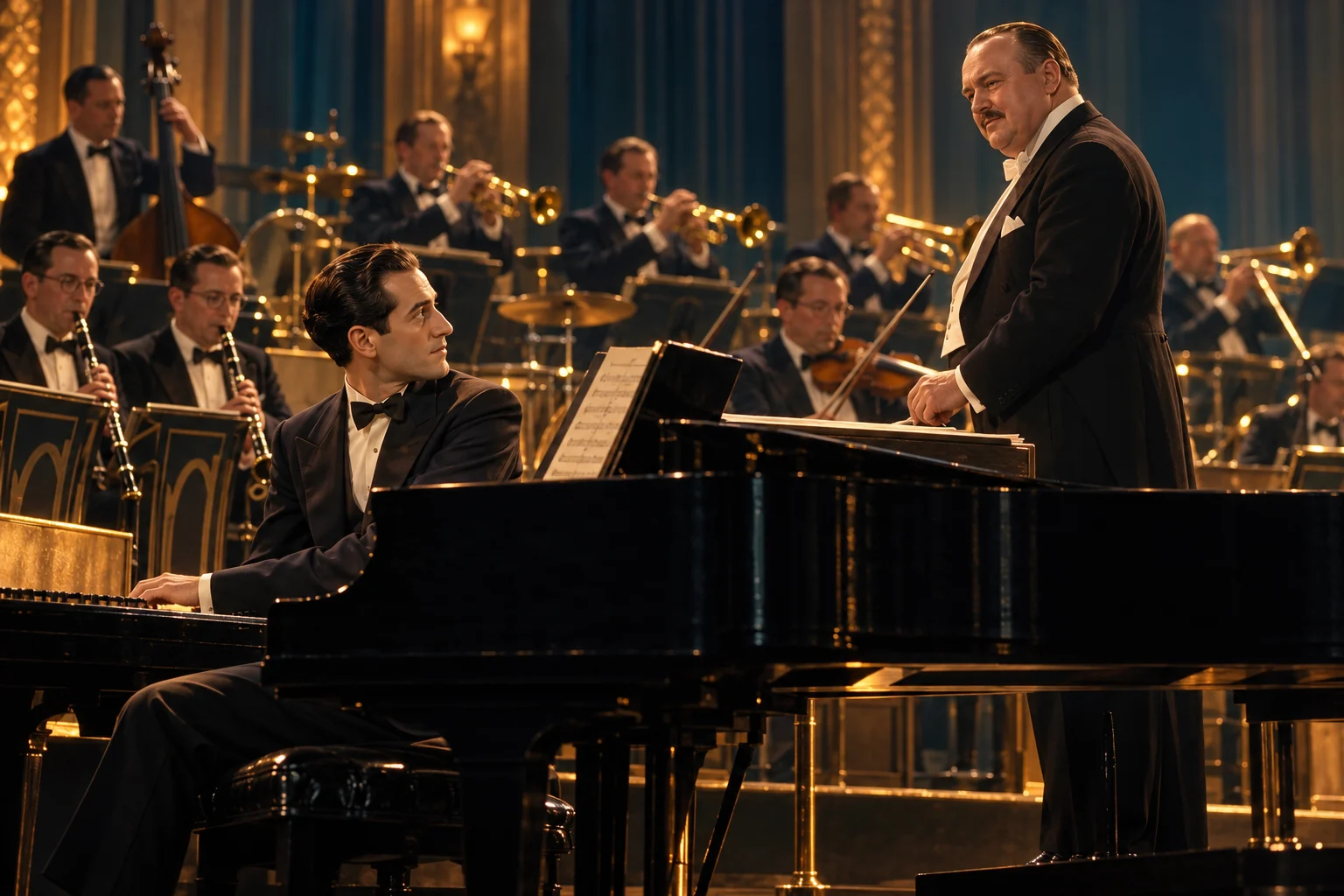
The cue captures something that a printed score can conceal: performance relies on people communicating in real time. A brief gesture can coordinate a roomful of musicians as effectively as a bar number. Later recordings make the composition widely available, but they cannot recover every decision Gershwin made at the premiere. The illustration imagines the pianist and conductor watching one another; it is not a record of a particular instant preserved by an eyewitness camera.
Rhapsody In Blue (Piano Solo)
Emmanuel Boyaud
Boyaud’s June 2016 solo-piano performance presents the work premiered on this date. It is a later interpretation, not a reconstruction of Gershwin’s partly improvised premiere or its original band arrangement.
Listen on SoundCloud ↗Follow the evidence.
- Gershwin estate: Rhapsody in Blue premiere ↗
- Library of Congress: the instruction to wait for a nod ↗
- Library of Congress: Rhapsody at its centenary ↗
AI-assisted writing, with institutional and primary sources. Illustration is a reconstruction, not an archival photograph. Published October 31, 2026; updated October 31, 2026. Our approach