The first step to Tutankhamun’s tomb is uncovered
On 4 November 1922, excavation in Egypt’s Valley of the Kings revealed a rock-cut step leading toward Tutankhamun’s tomb. The discovery began a sequence of clearance and investigation rather than an immediate encounter with the burial treasures.
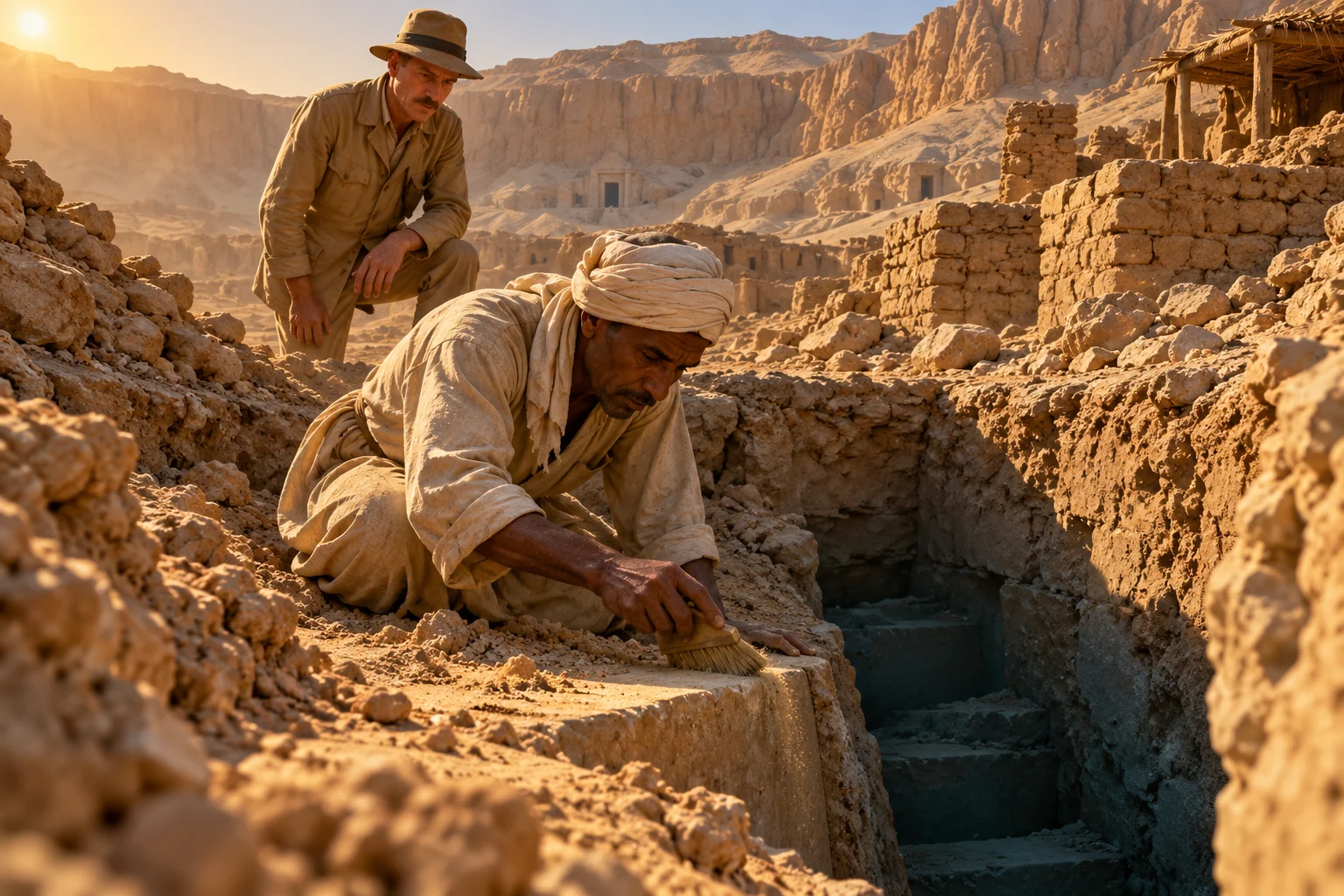
Searching beneath an older worksite
Howard Carter returned to Luxor in late October 1922 and resumed excavation in the Valley of the Kings at the beginning of November. The work focused near the tomb of Ramses VI, where ancient workers’ huts and accumulated material covered the ground. Clearing these remains was essential to understanding what lay underneath. On 4 November a portion of a step appeared, cut into the valley’s bedrock. It indicated a descending entrance rather than an isolated loose object. Oxford season chronology
A small architectural clue
Carter’s later lecture notes describe being informed by a member of his Egyptian staff that a step had been found while the huts were being removed. He went to inspect the exposed portion and recognized the beginning of a sunken staircase. This account is a useful corrective to images of an archaeologist personally spotting a golden object. Discovery depended on local workers’ excavation, observation and communication, as well as on the interpretation of the feature that had emerged. Carter’s notes
The tomb opened in stages
Further clearance revealed more of the staircase and a blocked doorway. The sequence did not run directly from the first step to an open burial chamber on the same afternoon. After Lord Carnarvon arrived later that month, work resumed through the entrance and rubble-filled passage. On 26 November Carter looked through a small opening into the antechamber. The burial chamber itself was opened in February 1923. Keeping these stages separate preserves both the chronology and the practical realities of excavation. Season record; 1922 diary
Evidence behind a famous discovery
The excavation’s notebooks, diaries, drawings, photographs and object records allow historians to reconstruct the work more carefully than a single dramatic discovery story permits. Carter’s recollections are also authored accounts, written from his own position within the expedition; their emphasis deserves scrutiny. The surviving note acknowledges an Egyptian staff member without identifying every worker involved. The accompanying illustration therefore depicts skilled excavation without claiming to identify the person who first exposed the step. It is a historical interpretation, not an archival photograph or additional evidence about that person’s identity. Lecture manuscript; archive diary
Ana Hawait - Sayed Darwish - Solo Oud
Mahmoud Desouki
Mahmoud Desouki performs a later oud interpretation of music by Sayed Darwish, an important Egyptian composer of the early twentieth century. It evokes Egypt’s contemporary musical world, not a performance documented at the excavation.
Listen on SoundCloud ↗Follow the evidence.
- Griffith Institute, Oxford: First excavation season ↗
- Howard Carter: Lecture notes on the first step ↗
- Howard Carter’s diary for 1922 ↗
- SoundCloud: Ana Hawait - Sayed Darwish - Solo Oud ↗
AI-assisted writing, with institutional and primary sources. Illustration is a reconstruction, not an archival photograph. Published October 31, 2026; updated October 31, 2026. Our approach