Kid Auto Races at Venice and the Tramp’s screen debut
Released on 7 February 1914, Kid Auto Races at Venice introduced Charlie Chaplin’s Tramp to audiences. Its small comic premise involved a spectator who persistently placed himself between a camera and a children’s race.
A character reaches the screen
On 7 February 1914, cinema audiences first encountered Charlie Chaplin's Tramp in Kid Auto Races at Venice. The release began the screen life of a character whose visual identity would travel across national and linguistic boundaries. The BFI connects that character to Chaplin's earlier theatrical experience in London's entertainment districts, where pantomime, circus and music-hall comedy offered ways to make personality visible through movement.
A film about being filmed
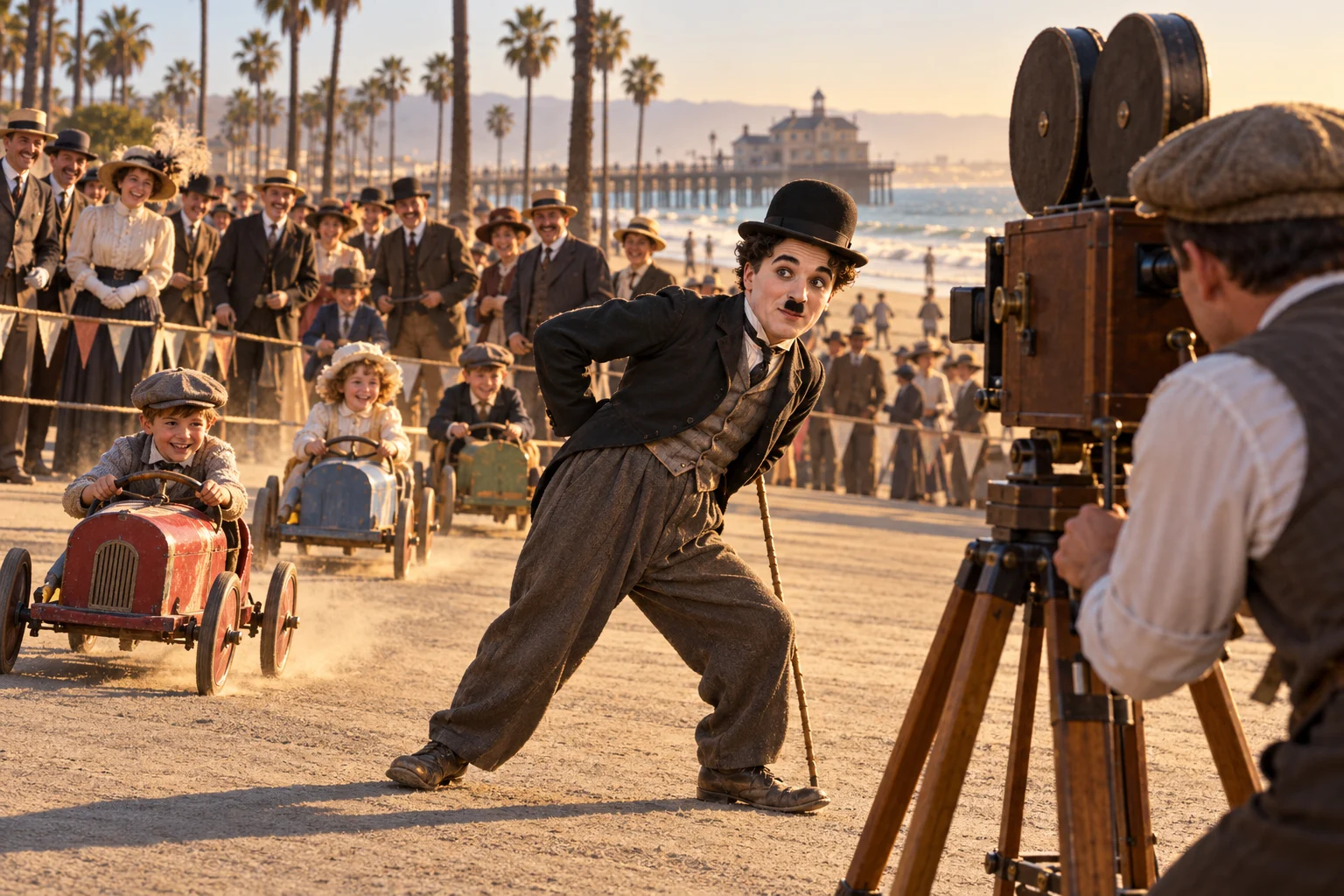
The situation is deliberately simple. A motion-picture crew wants to record a children's race, while the Tramp keeps inserting himself into the view. Being pushed away only encourages further attempts. There is no complicated mystery to explain his behaviour: he wants attention. The official Chaplin archive identifies the location as the Pushmobile Parade held in Venice, California, on 11 January 1914. That filming date is distinct from the February release.
The audience inside the picture
The short preserves more than a rehearsed confrontation between performers. Spectators at the actual race watch the strange figure and gradually become amused. Their reactions create another layer of comedy: the audience watching the film can also watch people discovering the comedian. The archive describes the production as improvised, but its often-repeated claim of a forty-five-minute shoot is presented as an allegation rather than a securely measured production record.
First released, rather than first conceived
The release sequence needs care. The costume had been devised for Mabel's Strange Predicament, which reached audiences after Kid Auto Races. The Public Domain Review distinguishes making a character from introducing it publicly. The mismatched clothes and insistent gestures already suggest an outsider claiming space through performance. The accompanying illustration interprets the camera-and-spectator encounter; it is a newly made historical scene, not a recovered production photograph. The short also makes filmmaking itself part of the entertainment: the camera is both the means of showing the comedy and the object that the character wants to conquer. That double role remains immediately recognisable to audiences accustomed to taking pictures.
Maple Leaf Rag
Gabriel Latiş
Gabriel Latiş's later piano performance of Joplin's rag evokes the lively accompaniment associated with silent-film exhibition. It is a period musical association, not a documented score for this 1914 release.
Listen on SoundCloud ↗Follow the evidence.
- Charlie Chaplin official archive: Kid Auto Races at Venice ↗
- BFI: The centenary of Chaplin’s Tramp ↗
- The Public Domain Review: Kid Auto Races at Venice ↗
AI-assisted writing, with institutional and primary sources. Illustration is a reconstruction, not an archival photograph. Published October 31, 2026; updated October 31, 2026. Our approach