Arthur Wynne’s first newspaper crossword appears in 1913
Arthur Wynne’s puzzle appeared in the New York World on 21 December 1913. Its hollow diamond and lack of black squares look different from many familiar modern crosswords.
A Sunday entertainment page
Newspapers offered readers more than reports of current events. Word games, acrostics and other amusements already had a place in their pages. Arthur Wynne’s contribution to the New York World entered that existing culture of printed entertainment. His puzzle appeared in the Sunday Fun section, where readers could encounter an unfamiliar game alongside other leisure material. It was an experiment within a familiar format, requiring paper, attention and a willingness to try the new arrangement.
The puzzle on 21 December
The issue dated 21 December 1913 carried Wynne’s word-cross. The Library of Congress reproduces the page and identifies it as the puzzle commonly credited with beginning the newspaper crossword tradition. Guinness World Records likewise dates the first crossword to that issue. “First” is best understood in this conventional historical sense: earlier word games existed, but this publication supplied a recognisable starting point for the form that later spread through newspapers and dedicated puzzle books. Library of Congress: word-cross, crosswords and acrostics.
A grid with a different shape
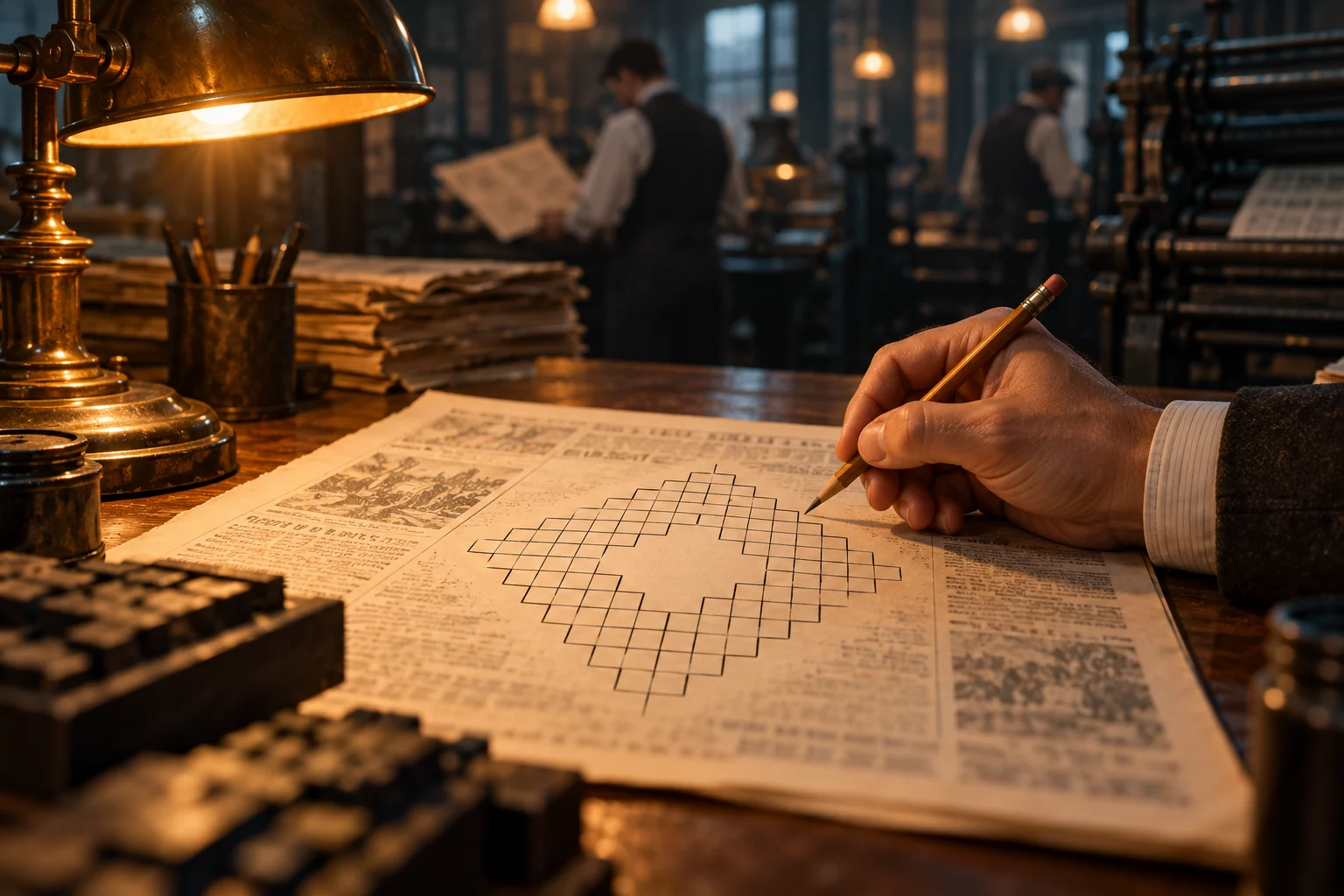
Wynne used a diamond-shaped arrangement surrounding an empty centre. The grid contained no blacked-out squares, and the clues were straightforward rather than cryptic. Intersections still mattered: a letter supplied by one solution could help with another. That interdependence is the mechanism that makes a crossword more than a list of separate riddles. Later grids could alter their outlines and use blocked cells while preserving the basic interaction between a clue, an answer and neighbouring words. Guinness World Records: first crossword puzzle.
A lasting printed habit
Crosswords spread through American newspapers, becoming a durable form of everyday recreation. The original page shows how a familiar pastime can begin in a layout that seems unusual to later users. Its historical interest lies in both continuity and difference: the intersecting answers remain recognisable, while the diamond belongs to a less standardised moment. The illustration interprets the early puzzle’s geometry and a period workplace. Its blank cells and indistinct surrounding print are not a facsimile of the published newspaper.
Maple Leaf Rag
Ryo Fukaura
UCL’s later recording of Fukaura playing Scott Joplin’s 1899 rag evokes American musical culture before the 1913 puzzle. It is a modern performance, not audio associated with Wynne or the newspaper issue.
Listen on SoundCloud ↗Follow the evidence.
- Library of Congress: word-cross, crosswords and acrostics ↗
- Guinness World Records: first crossword puzzle ↗
AI-assisted writing, with institutional and primary sources. Illustration is a reconstruction, not an archival photograph. Published October 31, 2026; updated October 31, 2026. Our approach