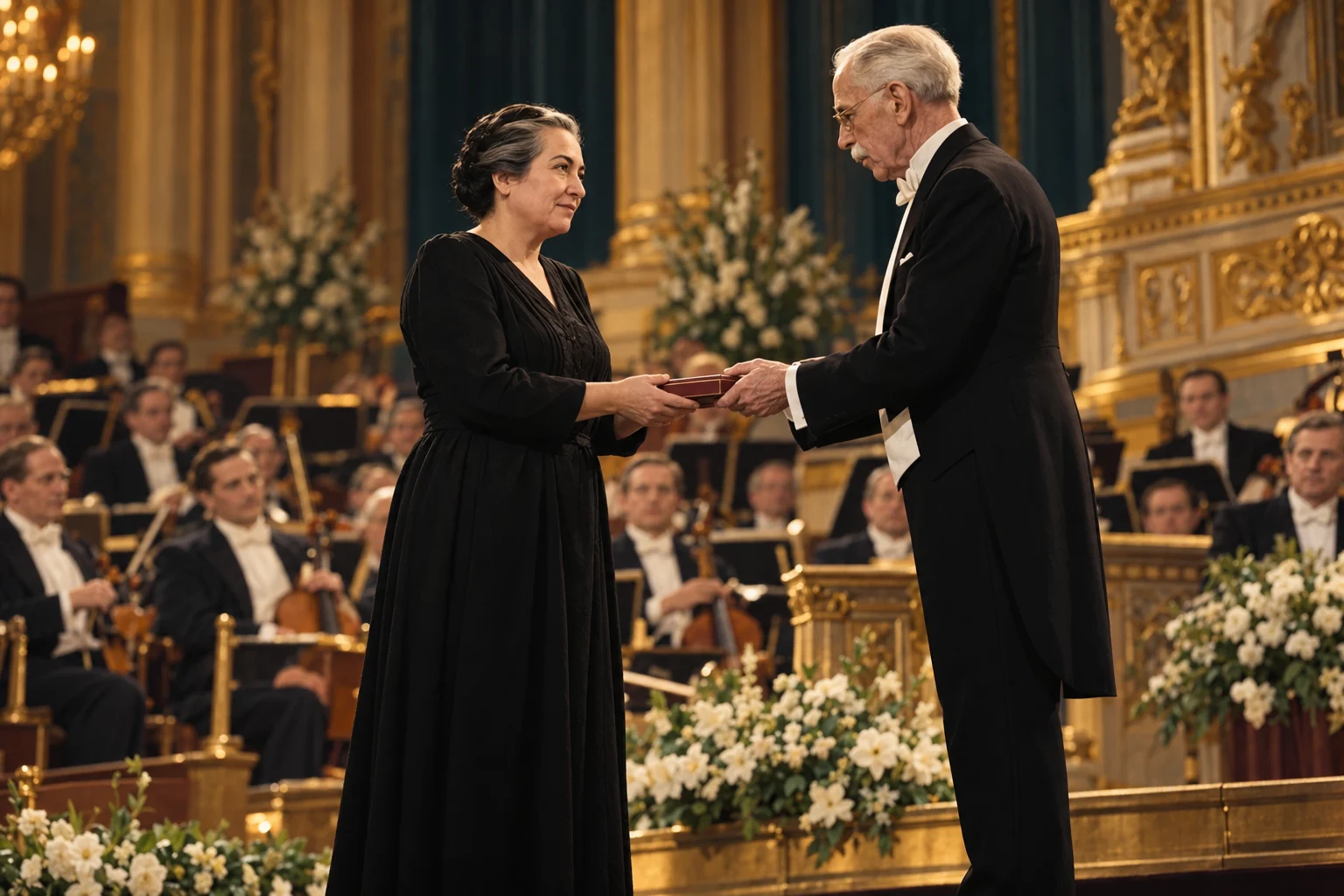
Rabindranath Tagore’s Nobel announcement and English Gitanjali
The literature Nobel announced on 13 November 1913 brought worldwide attention to Tagore, whose own English translations had helped his Bengali poetry travel.

An established Bengali voice
Rabindranath Tagore’s international breakthrough followed an extensive literary life in Bengali. The English Gitanjali presented readers with prose translations made by the author from his own language. Its title, Song Offerings, introduced devotional writing concerned with nature, work, longing and the relationship between the human and the divine. Translation changed the audience able to encounter this work without replacing its Bengali origins. Gitanjali, primary text
The announcement of 13 November
The Scottish Centre of Tagore Studies dates the announcement of the 1913 Nobel Prize in Literature to 13 November. It traces how news reached readers far beyond India and Europe, including through Australian newspapers. Tagore became the first non-European literature laureate. The date marks the announcement, rather than an assertion that he personally attended an award ceremony or immediately received the news in Bengal. Centre’s study of newspaper reception
The author as translator
The English volume explicitly identifies its pieces as the author’s translations from Bengali. W. B. Yeats supplied an introduction and described the strong response the poems provoked among readers around him. This combination of self-translation, literary introductions and publication networks helped a poet already admired at home gain a new readership. The book was therefore both a literary work and a meeting point between different reading communities. The English text also adopted a prose form, changing how the poems appeared on the page as well as the language in which they reached readers.
Recognition and selective reception
The Centre’s newspaper research shows that English-language readers were discussing Gitanjali before the Nobel announcement. The prize amplified an existing interest. These reports also reveal the filters through which overseas audiences encountered Tagore, often emphasizing spirituality or treating him as an exotic representative of India. Such responses should be distinguished from the full range of his writing. His achievement demonstrates the power of translation while reminding readers that international fame can simplify an author’s identity. The accompanying veranda portrait is an original illustration, not a photograph of the announcement.
Ekla Cholo Re (Jodi Tor Dak Shune) - Amitabh Bachchan
Amitabh Bachchan
Bachchan’s later film performance of a Tagore song connects with the laureate’s continuing musical legacy. This is a modern adaptation, not a performance from the Nobel announcement.
Listen on SoundCloud ↗Follow the evidence.
- Scottish Centre of Tagore Studies: Australian reception and Nobel announcement ↗
- Gitanjali: author’s English translations and Yeats’s introduction ↗
AI-assisted writing, with institutional and primary sources. Illustration is a reconstruction, not an archival photograph. Published October 31, 2026; updated October 31, 2026. Our approach