Hiram Bingham reaches Machu Picchu with local guidance in 1911
On 24 July 1911, local guidance brought Hiram Bingham to Machu Picchu. His subsequent publications gave the Inca site international visibility, but the history is better understood as an encounter between existing local knowledge and a visiting research expedition.
An expedition looking for another place
Hiram Bingham led a Yale-sponsored expedition in the Peruvian Andes in 1911. He was interested in locating Vilcabamba, associated with the final independent Inca rulers. On 24 July he investigated reports of ruins above the Urubamba valley. The ascent brought him into a landscape of steep slopes, cloud forest and remarkable stone construction. His expectations shaped the interpretations he would later attach to what he encountered, but they did not make those interpretations correct.
The people who knew the way
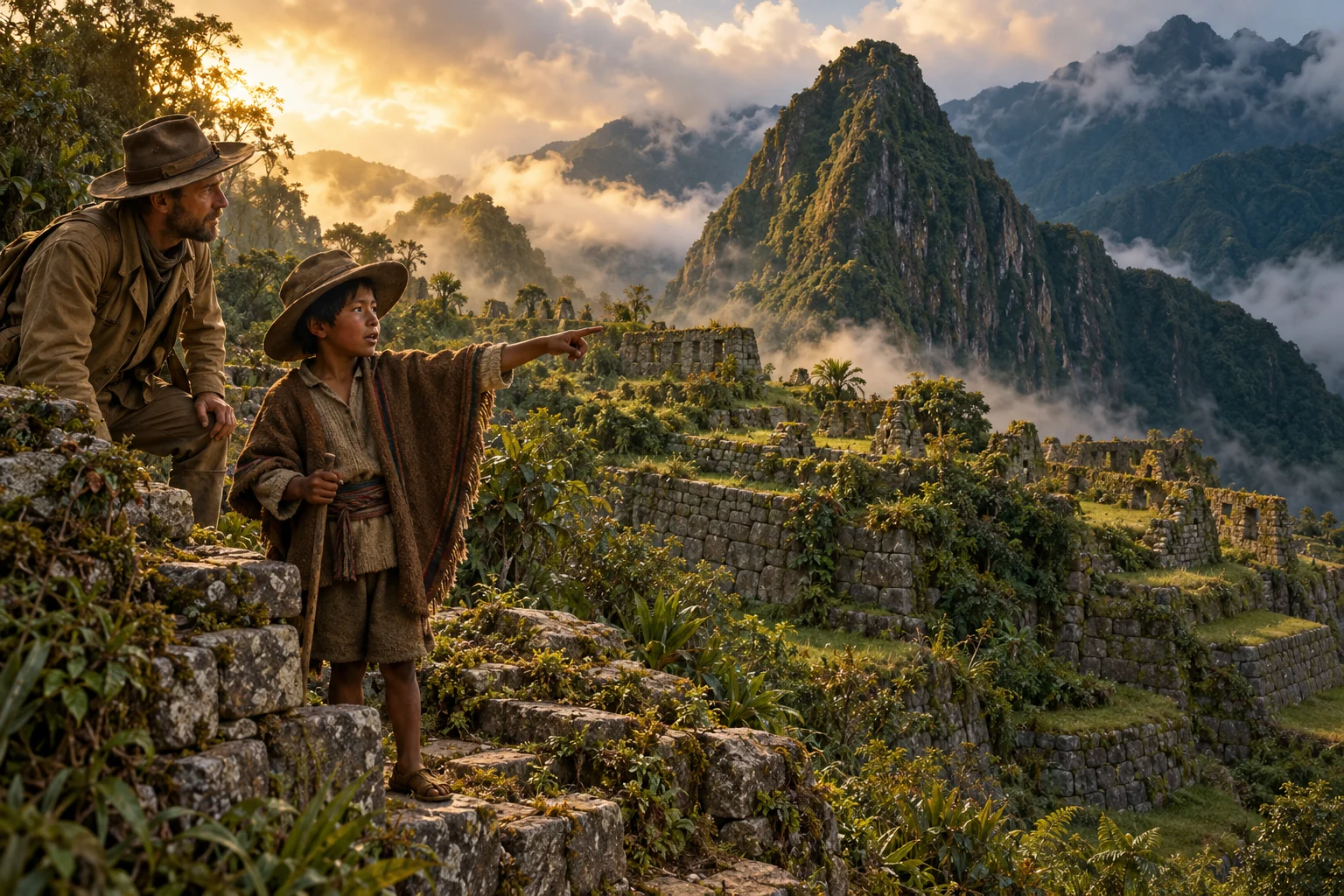
National Geographic’s account describes local farmers directing Bingham onward and a small boy leading him among the ruins. Their presence changes the meaning of the familiar discovery story. Machu Picchu had not vanished from everybody’s knowledge. Bingham’s arrival mattered because his expedition and publications carried news of the site to distant audiences. Recognising that contribution does not require treating the local inhabitants as absent from the history or as people awaiting an outsider to identify their landscape.
Revising the lost-city interpretation
Bingham believed Machu Picchu was the lost stronghold he sought. Later research separated it from Vilcabamba and challenged other claims, including the idea of a community overwhelmingly composed of religious women. Reanalysis of human remains and other evidence supported a more varied population. A widely supported interpretation identifies the site as a royal estate, although details of its uses remain debated. This is a useful example of archaeology correcting a dramatic story rather than merely illustrating it.
A cultural landscape, not just a ruin
UNESCO recognises Machu Picchu as both cultural and natural heritage. Its terraces, stone buildings and paths occupy a mountain environment roughly 2,430 metres above sea level. Their relationship to the terrain is part of the site’s significance. The date of Bingham’s visit belongs to the modern history of that much older landscape. The illustration gives a local guide visual prominence; its faces, gestures and precise view are interpretive choices rather than a recovered photograph from 24 July.
El Condor Pasa (siku and quena)
Quoc-Huy Nguyen Dinh
The performer’s later panpipe and quena interpretation of the well-known Andean work provides a Peruvian cultural connection. The composition dates from 1913; this is not Inca-period music or a recording from Bingham’s 1911 visit.
Listen on SoundCloud ↗Follow the evidence.
- National Geographic: Machu Picchu and Bingham’s arrival ↗
- Yale Alumni Magazine: Rediscovering Machu Picchu ↗
- UNESCO: Historic Sanctuary of Machu Picchu ↗
- Quoc-Huy: El Condor Pasa, siku and quena ↗
AI-assisted writing, with institutional and primary sources. Illustration is a reconstruction, not an archival photograph. Published October 31, 2026; updated October 31, 2026. Our approach