Santos-Dumont’s Eiffel Tower circuit for the Deutsch Prize
On 19 October 1901, Brazilian aviator Alberto Santos-Dumont completed a flight from Saint-Cloud around the Eiffel Tower and back in his No. 6 airship. The thirty-minute prize challenge tested whether a balloon could navigate a practical return route.
A destination and a way home
Ballooning could carry people aloft, but a journey controlled by the wind was different from transport directed by a pilot. The Deutsch Prize turned that distinction into a public challenge. An aviator had to leave Saint-Cloud, round the Eiffel Tower and return within thirty minutes. The course was roughly eleven kilometres. The tower supplied an unmistakable turning point, while the return leg required the machine to do more than drift conveniently in one direction. FAI-hosted history
The flight on 19 October
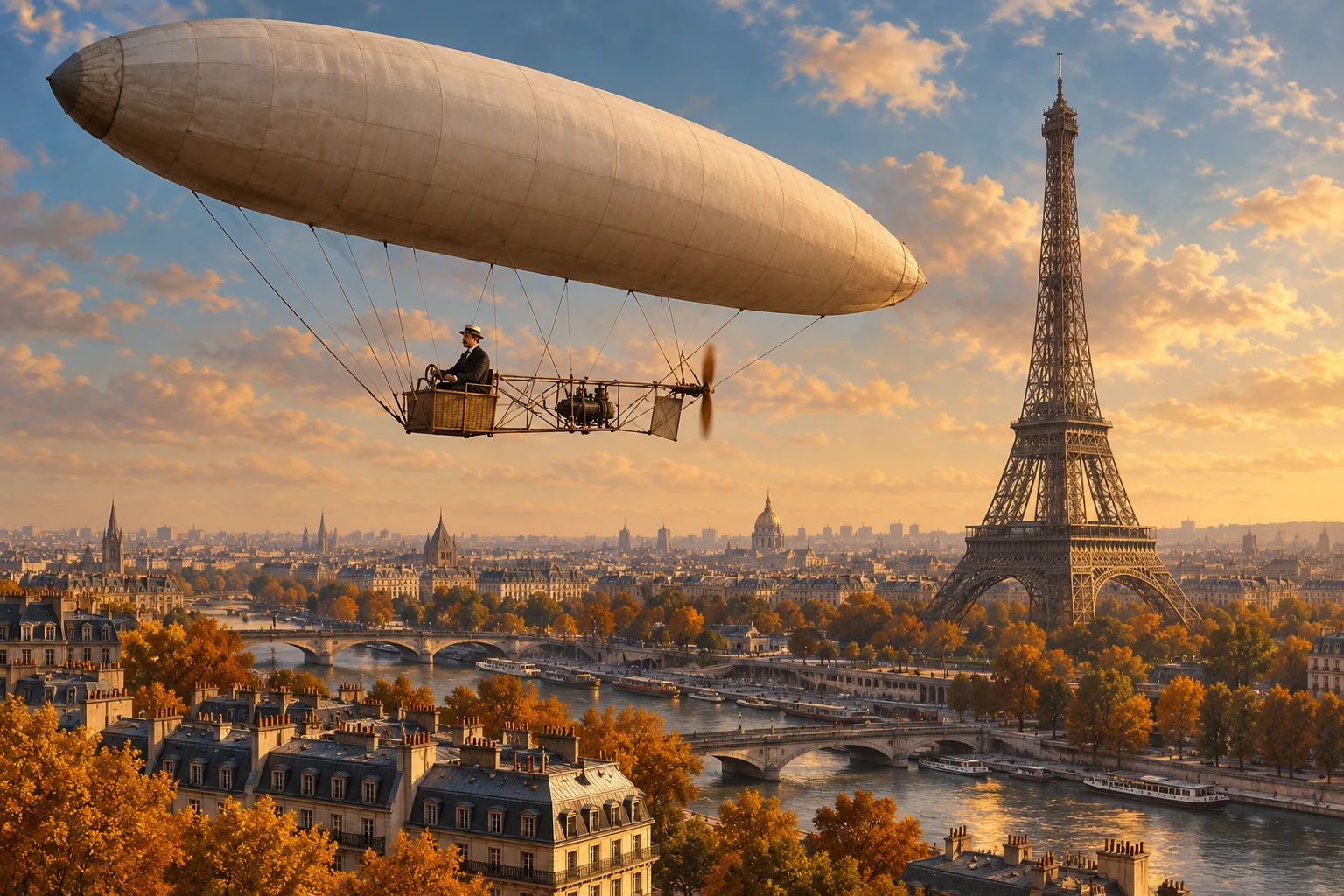
Alberto Santos-Dumont, a Brazilian working in Paris, attempted the circuit in his No. 6 airship on 19 October 1901. Its gas-filled envelope supplied lift, while an engine and propeller supplied motion under the pilot’s control. Earlier trials had exposed the difficulties of maintaining the envelope’s shape and steering reliably. On this occasion he rounded the tower and returned to the starting area, attracting intense public and press attention to a practical demonstration of navigable lighter-than-air flight. APS account
Why the stopwatch became controversial
The successful circuit did not produce an immediate unanimous verdict. A contemporary New York Times report dated from Paris on 19 October described disagreement over the elapsed time and eligibility for the prize. Different accounts distinguish the return over the finish from the completion of landing or securing the airship. The award was ultimately made, but describing the result as an entirely uncontested sub-thirty-minute performance conceals that dispute. The documented date of the flight itself is not in doubt. Contemporary report
A public experiment in controlled flight
Santos-Dumont’s achievement belonged to the history of airships, rather than being an airplane flight. Hydrogen buoyancy and engine propulsion performed different jobs, and successful control required both to work with steering and a light structure. The experiment helped make aviation visible as a problem of travelling somewhere and returning, not simply rising into the air. Its urban setting also made an engineering test into a spectacle. The illustration interprets the airship and Paris skyline; it does not reproduce a photograph or establish the exact viewpoint of a spectator. FAI history; flight context
Brejeiro (Ernesto Nazareth)
Scott Kirby
Scott Kirby’s later piano performance of Nazareth’s 1893 Brazilian composition connects with Santos-Dumont’s Brazilian background and the period of the flight. It is not music recorded at the Paris event.
Listen on SoundCloud ↗Follow the evidence.
- FAI-hosted Brazilian science ministry history of Santos-Dumont ↗
- American Physical Society: Santos-Dumont and the Eiffel Tower ↗
- The New York Times, 20 October 1901: contemporary report ↗
- SoundCloud: Brejeiro (Ernesto Nazareth) ↗
AI-assisted writing, with institutional and primary sources. Illustration is a reconstruction, not an archival photograph. Published October 31, 2026; updated October 31, 2026. Our approach