Umeko Tsuda opens Joshi Eigaku Juku in Tokyo
On 14 September 1900, Umeko Tsuda opened the women's school that became Tsuda University. Her opening address connected rigorous English study with professional opportunity, individual attention and a broad education.
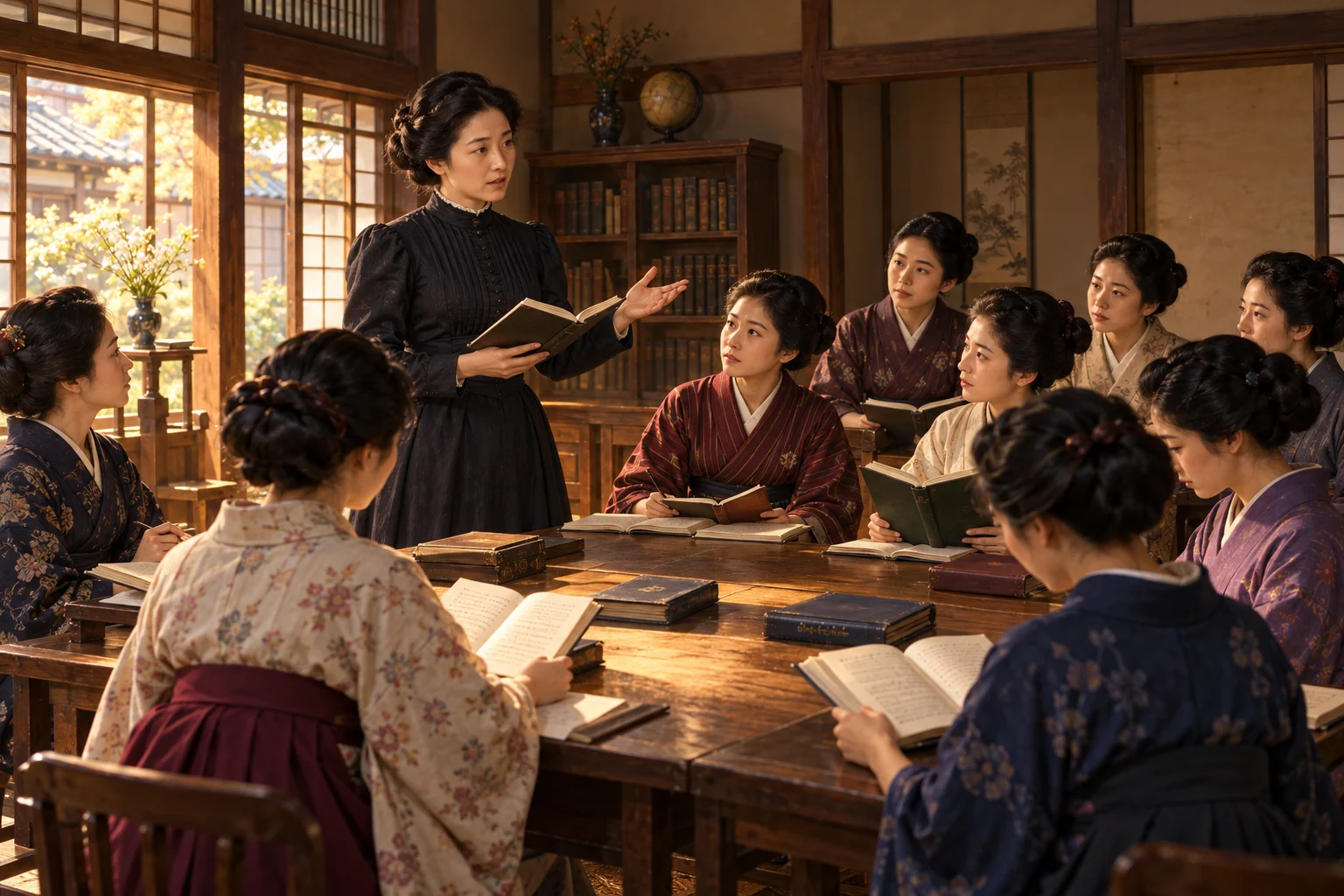
Education across the Pacific
Umeko Tsuda's educational project grew from experience in two countries. In 1871 she left Japan as the youngest of five girls sent to study in the United States. She later returned to America to study at Bryn Mawr College. These experiences informed her determination to expand opportunities for Japanese women. The university's history presents her goal as developing women able to exercise their abilities alongside men, rather than treating advanced study as merely a social accomplishment.
The opening ceremony
Joshi Eigaku Juku held its opening ceremony in Tokyo's Ichibanchō district on 14 September 1900. The original intake numbered ten students, including women who came from outside Tokyo. Tsuda's collaborators included Alice Bacon, Sutematsu Ōyama and Shigeko Uryū. The school's beginnings were modest, but they depended on a network of educational experience and personal support. A university account of its early locations distinguishes the September ceremony from the administrative application and permission granted earlier that summer.
A practical professional route
Tsuda's opening address identified four connected priorities: capable teachers and motivated students, attention to individual students through small classes, the preparation of English teachers for professional work, and specialist knowledge supported by broad learning. The university's 2015 annual report records both the exact ceremony date and these principles. English teaching offered a concrete occupational aim. At the same time, Tsuda's emphasis on an all-round education resisted reducing students to a single technical qualification.
From small school to university
The institution moved as it expanded. Its first graduation ceremony took place in 1903, and in 1905 it gained authorization allowing qualifying graduates to obtain English-teaching credentials without the usual examination. The school later took Tsuda's name; university status followed in 1948. That sequence matters: the institution opened in 1900 was a pioneering private women's school, not already the modern university. The illustration imagines its intimate learning environment and does not claim to reproduce the opening ceremony or an archival classroom photograph.
SAKURA SAKURA Cherry Blossoms (Japanese Traditional KOTO & BEAT)
YY: Asuka, koto; Wocasi, production
YY's modern arrangement places the traditional Japanese melody in a contemporary setting. It supplies Japanese cultural context and was not performed at Tsuda's 1900 ceremony.
Listen on SoundCloud ↗Follow the evidence.
- Tsuda University: 2015 annual report, founding principles ↗
- Tsuda University: History ↗
- Tsuda University magazine: Places connected with Umeko Tsuda ↗
- Tsuda University: Institutional milestones ↗
AI-assisted writing, with institutional and primary sources. Illustration is a reconstruction, not an archival photograph. Published October 31, 2026; updated October 31, 2026. Our approach