The Kiss in the Tunnel and its 1899 film insert
George Albert Smith’s The Kiss in the Tunnel was designed to enliven railway footage with a studio scene of two passengers kissing. Its commercial use shows exhibitors helping create continuity between separately filmed views.
Railways as an early screen attraction
Early filmmakers found railway travel especially suited to a medium built around movement. Cameras mounted on trains produced journeys in which spectators seemed to glide along the track themselves. These views became known as phantom rides because the vehicle carrying the camera could disappear from the picture. The BFI’s history of train films describes a popular form that could offer both scenic travel and the excitement of rapid motion.
A separate scene with a practical use
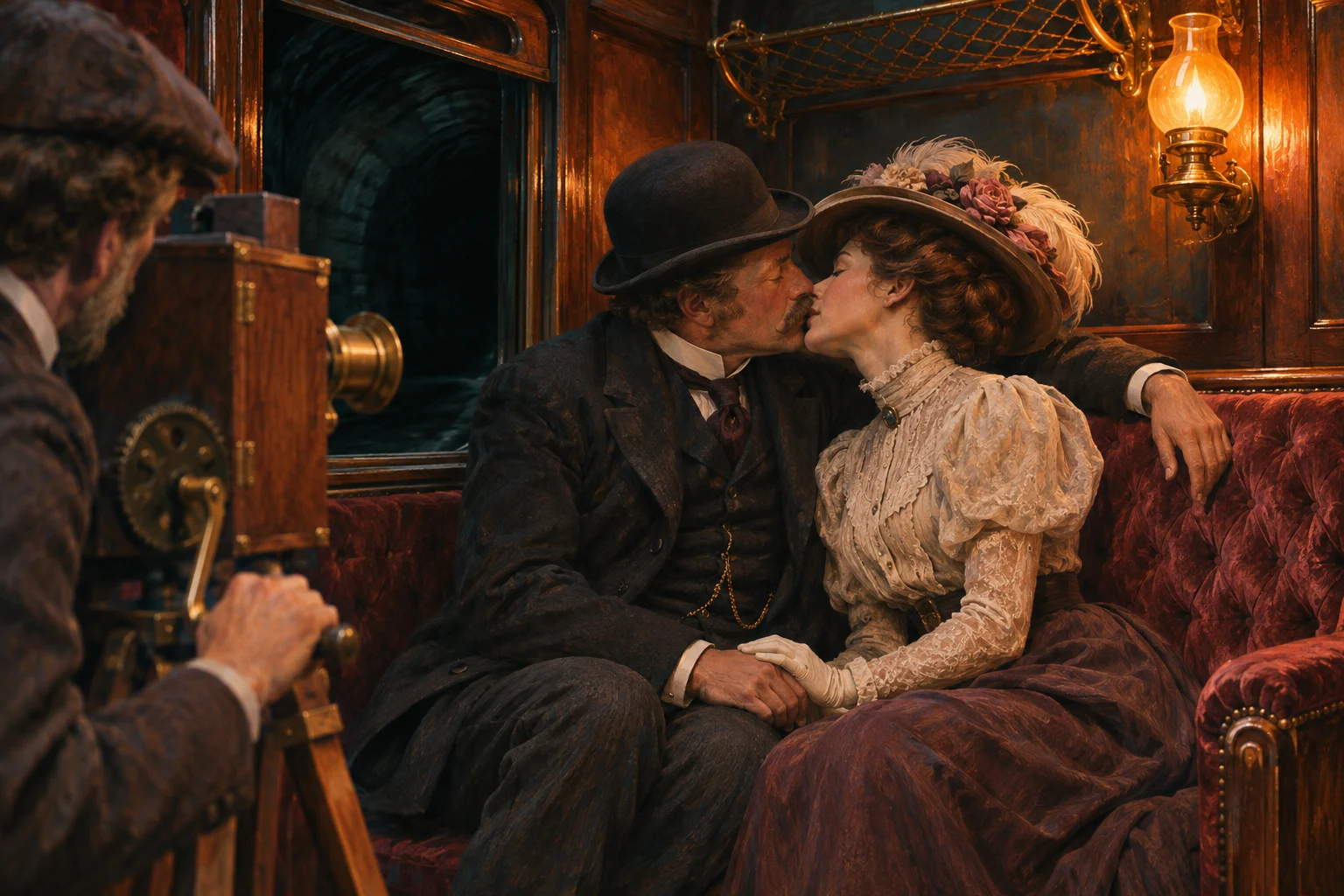
In 1899, George Albert Smith made a staged railway-compartment scene featuring a couple taking advantage of a tunnel to kiss. The BFI identifies the performers as Smith and his wife, the actress Laura Bayley. The joke depends on an everyday assumption: darkness briefly makes private behavior possible in public. The audience, however, is allowed to see the supposedly hidden encounter. It is a knowingly theatrical scene, rather than candid footage of travelers.
An exhibitor could assemble the journey
The important commercial detail is that the carriage scene could be sold separately. The Warwick Trading Company offered it to exhibitors who already owned footage taken from a moving train. They could insert the kiss between views entering and emerging from a tunnel. Screen Archive South East explains this arrangement and identifies Cecil Hepworth’s railway material in the surviving assembly. The finished experience could therefore combine work by different filmmakers, joined at the point of exhibition.
Continuity without a single continuous shot
The assembled sequence invites viewers to understand the carriage and track views as parts of one journey. That connection exists in the arrangement of shots, rather than in an uninterrupted recording. The film is an early example of narrative editing, not a defensible claim to cinema’s first kiss or the invention of all editing. Only the year is used here because no verified release day is established by the cited archival accounts. The accompanying studio illustration is a modern interpretation.
The Honeysuckle and the Bee (1901)
Sousa’s Band
A band recording from 1901 supplies near-contemporary popular entertainment context for this playful 1899 silent film. It is a later recording, not an original synchronized score or documented accompaniment to Smith’s film.
Listen on SoundCloud ↗Follow the evidence.
- Screen Archive South East: The Kiss in the Tunnel ↗
- BFI Replay: Smith’s The Kiss in the Tunnel ↗
- BFI: Victorian phantom rides ↗
- Sousa’s Band: The Honeysuckle and the Bee, 1901 ↗
AI-assisted writing, with institutional and primary sources. Illustration is a reconstruction, not an archival photograph. Published November 4, 2026; updated November 4, 2026. Our approach