Alphonse Mucha’s 1898 JOB Cigarette-Paper Poster
Mucha’s 1898 advertisement for JOB cigarette papers turned an everyday purchase into an elaborate decorative image. Its flowing hair and ornamental composition exemplify the meeting of Art Nouveau and commercial graphic design.
A commercial commission
In 1898 Alphonse Mucha produced a large color lithograph for JOB, the cigarette-paper trademark of the Joseph Bardou Company. The design was printed in Paris by F. Champenois. Les Arts Décoratifs identifies the surviving work as both a commercial advertisement and a graphic poster. This was an image intended to sell a manufactured product, even though its decorative ambition could make it look more like an independent work of art. Their scale also changed an ordinary purchase into a conspicuous presence in the shared urban streetscape.
The woman and the design
The female figure occupies the center of the composition, surrounded by an extraordinary mass of curling hair. The Mucha Foundation notes that such stylized locks were compared to macaroni or vermicelli. Their curves help bind the figure to the surrounding decoration. A clasp based on the JOB monogram also turns branding into part of the costume. The product name and the figure belong to one designed visual system rather than separate layers.
Printing art for the street
Color lithography helped posters spread across European cities during the 1890s. It enabled designers and printers to multiply richly colored images for public display. Mucha was particularly successful in this medium, and his exclusive arrangement with Champenois began in 1896. Their work included advertisements, calendars and decorative panels. The 1898 JOB design therefore belonged to an established commercial partnership rather than an isolated experiment with a new printing technique.
Dating and interpretation
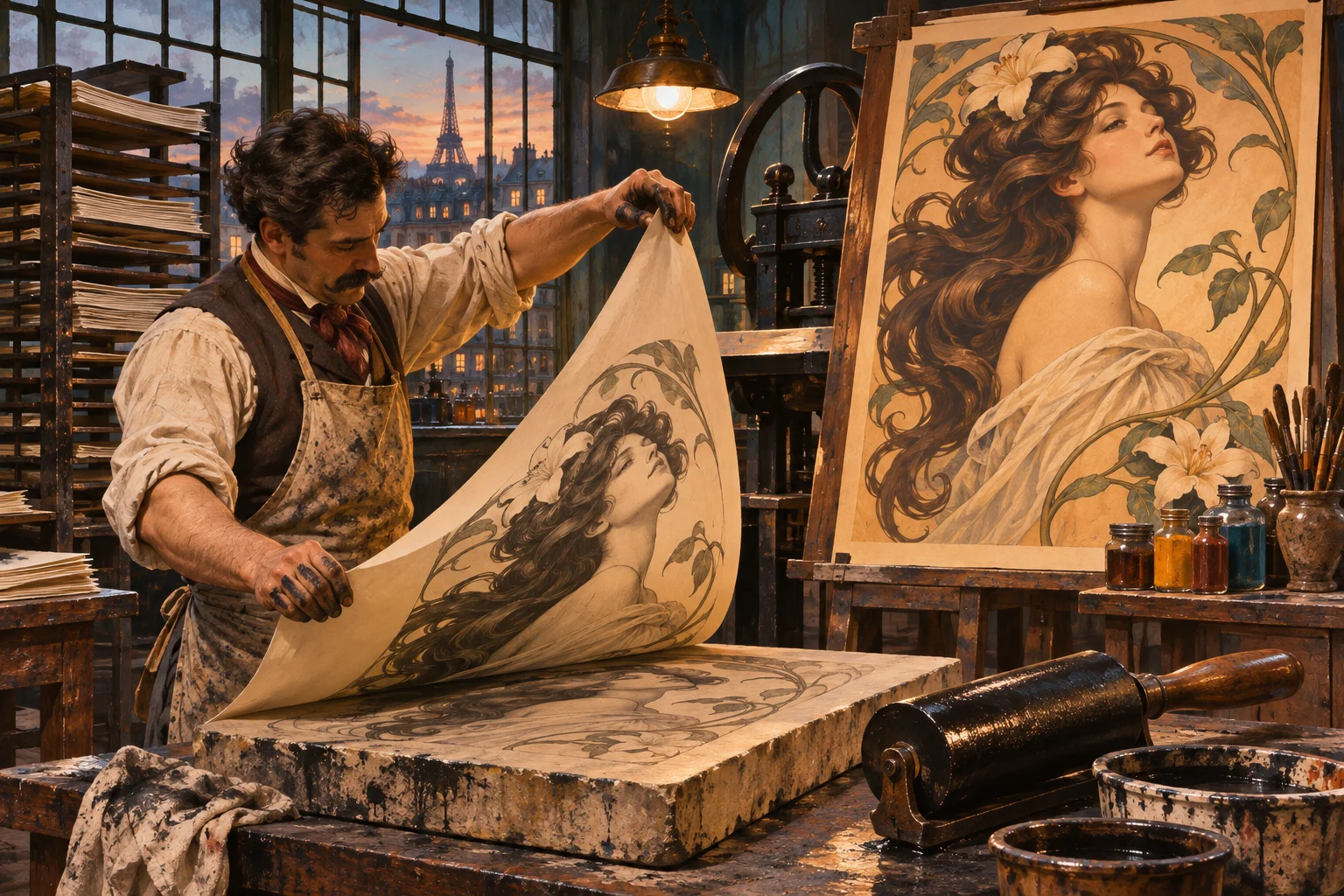
Mucha made another well-known JOB poster in 1896; the two designs should not be treated as a single event. The Foundation and the Paris museum independently identify the later design with 1898, without establishing a particular production day. Its historical interest lies in the resources of fine decorative design being applied to a small packet of paper. The accompanying workshop illustration is an interpretation, with branding omitted, rather than a reproduction of the actual poster or a documented printing session.
Debussy Reverie David DeLucia, Piano
David DeLucia, piano
A modern piano performance of Debussy’s Rêverie evokes the French artistic world around the turn of the twentieth century. It was not commissioned for Mucha’s poster.
Listen on SoundCloud ↗Follow the evidence.
- Les Arts Décoratifs: JOB, 1898 ↗
- Mucha Foundation: JOB poster, 1898 ↗
- Mucha Foundation: the development of poster art ↗
- Attached recording on SoundCloud ↗
AI-assisted writing, with institutional and primary sources. Illustration is a reconstruction, not an archival photograph. Published November 6, 2026; updated November 6, 2026. Our approach