Julia Morgan enters the École des Beaux-Arts architecture programme in 1898
Julia Morgan’s admission to architectural study at the École des Beaux-Arts in 1898 opened a prestigious training route previously closed to women. Her later career joined engineering knowledge, design skill and persistent professional independence.
An ambition shaped by available training
Julia Morgan wanted to become an architect, but her initial university education was in civil engineering at Berkeley. The distinction matters: training opportunities were shaped by the institutions available to her, not simply by personal preference. Bernard Maybeck encouraged her to study in Paris. The École des Beaux-Arts offered an influential architectural education, and gaining access to it could support a future practice in the United States as well as a command of architectural representation.
Admission in 1898
Morgan arrived in Paris in 1896 and prepared for the demanding entrance process. In 1898 she became the first woman accepted into the architecture programme, a milestone documented by Cal Poly, which preserves her papers. The Beverly Willis Architecture Foundation biography distinguishes her successful examination in October from enrolment in November. A year-only date describes the admission milestone without inventing one day for those related steps.
Beyond admission to professional practice
Morgan completed her studies in 1902 and returned to California. She subsequently obtained a state architecture licence and established her own practice in 1904. Her projects ranged across houses and larger institutional commissions, with women’s organizations among her important clients. The foundation’s archive profile places the Paris education within this longer career. Admission was an opening rather than the end of the story: qualifications still had to be turned into employment, commissions and authority over building work.
An archive of ability and persistence
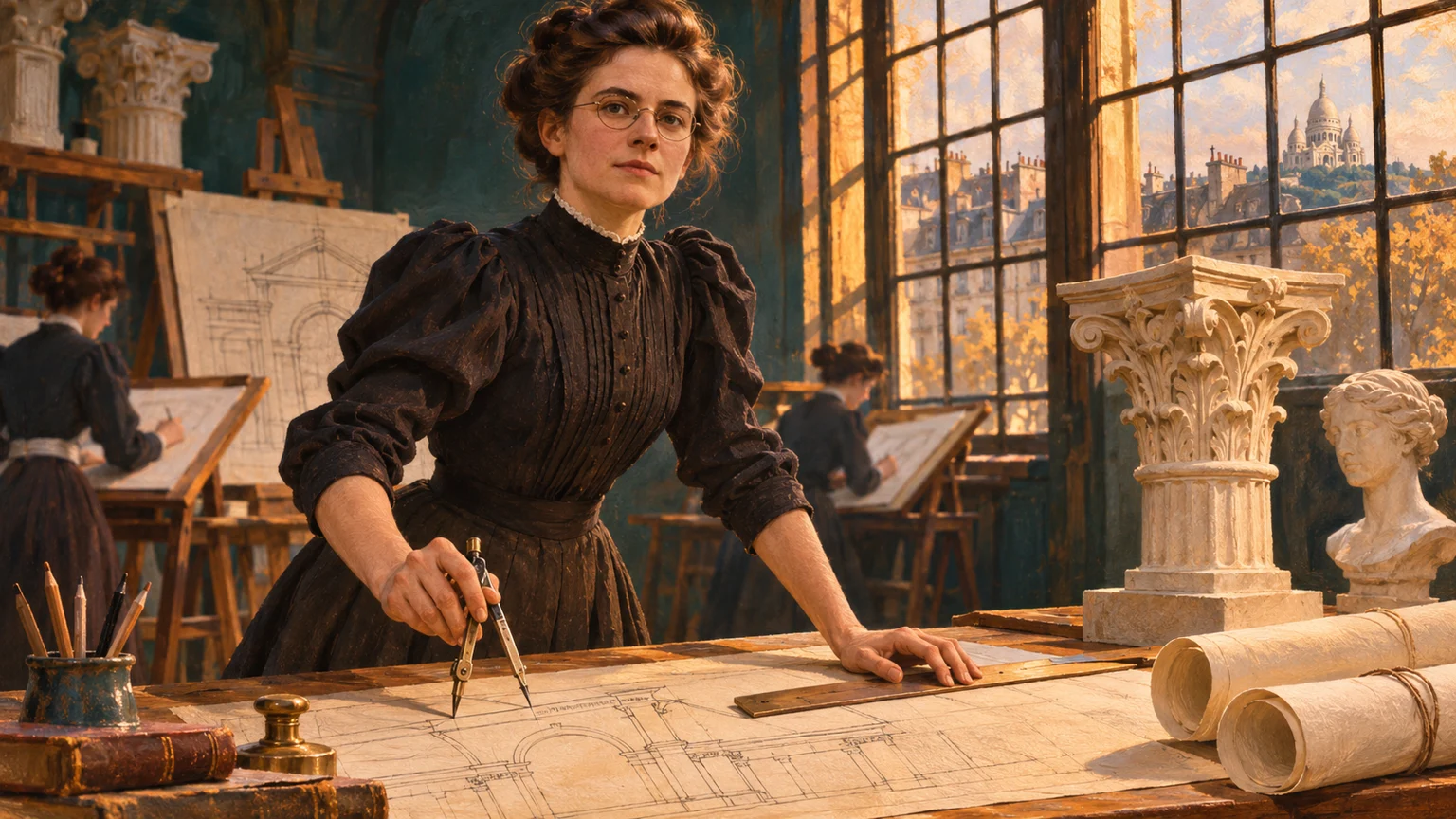
Cal Poly’s collection preserves drawings, correspondence and other materials from Morgan’s professional life. Such evidence helps replace a simple story about an exceptional individual with a fuller view of sustained work, technical judgement and relationships with clients. Her achievement also makes an institutional barrier visible: talented women needed access to training as well as the ability to succeed within it. The illustration interprets Morgan at a drafting table; the room, pose and particular drawing are not presented as a documented scene from her admission.
Debussy: Arabesque No.1 in E major
Ryo Fukaura, piano
UCL’s later performance of Debussy’s circa-1891 piano work evokes the French artistic setting of Morgan’s Paris studies. It is cultural context, not evidence of her musical tastes or an admission-day performance.
Listen on SoundCloud ↗Follow the evidence.
- Cal Poly: Julia Morgan exhibition and archive ↗
- Beverly Willis Architecture Foundation: Julia Morgan biography ↗
- BWAF Dynamic National Archive: Morgan ↗
- SoundCloud: Debussy: Arabesque No.1 in E major ↗
AI-assisted writing, with institutional and primary sources. Illustration is a reconstruction, not an archival photograph. Published November 3, 2026; updated November 3, 2026. Our approach