Strauss’s Don Quixote premieres in Cologne in 1898
Richard Strauss’s Don Quixote received its first performance in Cologne on March 8, 1898. Solo instruments act as recurring characters, while orchestral variations turn episodes from Cervantes’s novel into a story told without words.
From a novel to an orchestral work
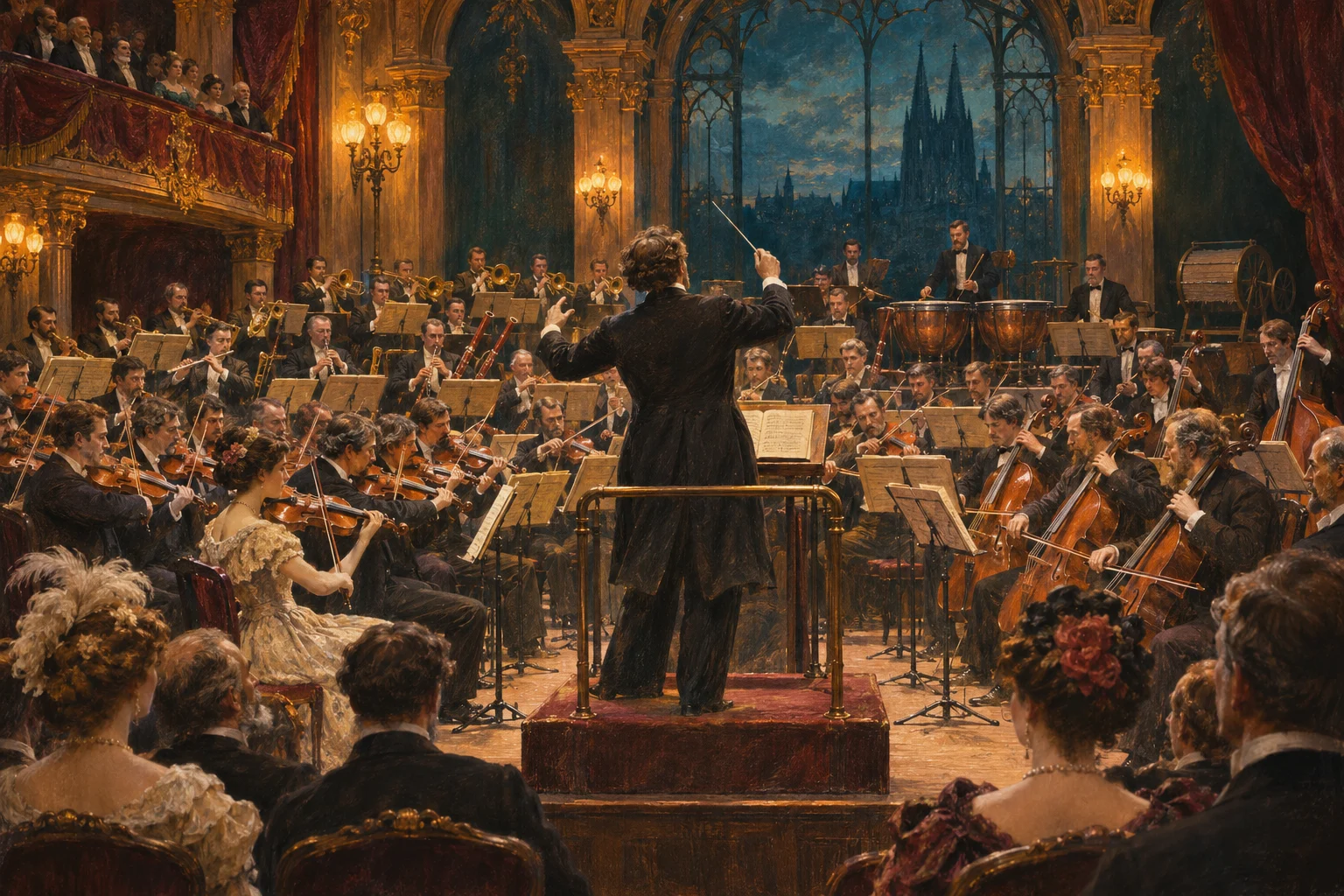
Richard Strauss completed Don Quixote in 1897, drawing on Miguel de Cervantes’s story of an idealistic knight and his companion Sancho Panza. The work received its first performance on March 8, 1898, with Cologne’s Gürzenich Orchestra conducted by Franz Wüllner. Hyperion’s work commentary documents the date and the score’s development. Strauss used the framework of variations to link contrasting adventures, rather than attempting to illustrate every episode of the long novel.
Characters carried by instrumental color
The solo cello principally represents Don Quixote, while the viola becomes strongly associated with Sancho Panza. Other instruments also contribute to their characterization, so these assignments are not completely exclusive. The Los Angeles Philharmonic’s notes describe Sancho’s initial appearance in bass clarinet and tenor tuba before the solo viola takes over. Listeners can follow recognizable personalities as the surrounding musical circumstances change. Timbre becomes part of the narrative, not simply an attractive surface.
Adventures change the musical situation
The score includes windmills mistaken for giants, a flock of sheep imagined as an army and an airborne journey suggested with a wind machine. Its effects can be comic, noisy or unexpectedly tender. The Berliner Philharmoniker’s commentary emphasizes that variation concerns changing dramatic expression as much as altering a melody’s notes. The same central character can therefore sound confident, bewildered or vulnerable without a spoken explanation.
The later performance heard here
The attached recording is a complete later performance by the Boston Philharmonic Youth Orchestra in Bern during its 2015 European tour. The orchestra’s tour archive identifies Benjamin Zander as conductor and Jonah Ellsworth and Gerald Karni as the featured string soloists. It is not evidence of how the 1898 premiere sounded in every detail. The illustration likewise evokes a period concert setting rather than claiming to reproduce a documented view of the original stage.
Strauss: Don Quixote, Op. 35 — complete Bern performance
Boston Philharmonic Youth Orchestra; Benjamin Zander
The complete work first performed on March 8, 1898, heard here in the orchestra’s later Bern performance from June 2015. The attachment presents the actual musical writing discussed in the question; it is not a recording of the premiere.
Listen on SoundCloud ↗Follow the evidence.
- Hyperion: Don Quixote, premiere and musical characters ↗
- Los Angeles Philharmonic: Don Quixote program notes ↗
- Berliner Philharmoniker: Don Quixote program note ↗
- Boston Philharmonic: 2015 tour repertoire and performers ↗
- Boston Philharmonic Youth Orchestra: complete Bern performance ↗
AI-assisted writing, with institutional and primary sources. Illustration is a reconstruction, not an archival photograph. Published November 4, 2026; updated November 4, 2026. Our approach