Joe Darling’s direct-hit Test six at Adelaide in 1898
On January 14, 1898, Joe Darling reached his century against England with a hit that left the ground. The stroke is recognized as the first six in Test cricket scored directly from the bat without assistance from overthrows, under a different boundary convention from today’s.
Adelaide at the start of a Test
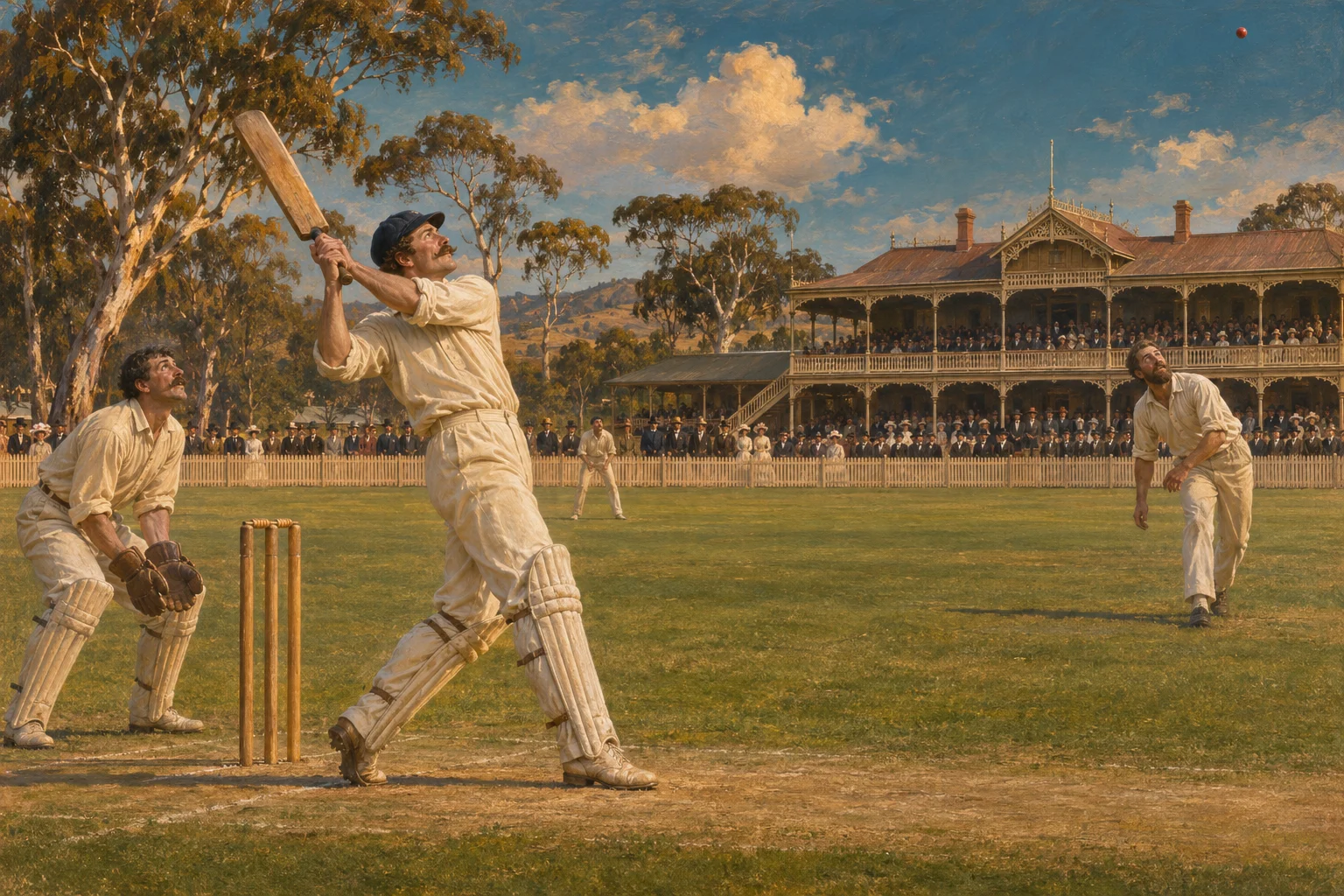
Australia and England began the third Test of their series at Adelaide Oval on January 14, 1898. Australia won the toss and batted first. Joe Darling, a left-handed South Australian, had already toured England and was developing the batting reputation that would precede his later captaincy. He opened with Charles McLeod and shared a substantial partnership with Clem Hill. A contemporary report describes the two South Australians mastering the visiting bowling for much of the afternoon. Darling was unbeaten on 178 at the close, placing his century and its remarkable scoring stroke on that opening day.
The boundary distinction
Darling reached his hundred with a six. The historical distinction is important: under the convention used at the ground then, simply sending the ball beyond the playing boundary was not enough for that award. The hit had to leave the ground. The match archive identifies it as the first six in Test cricket achieved directly from a bat stroke without the help of overthrows. That qualification avoids confusing a large hit with other ways a team could accumulate six runs from a delivery. It also shows why applying present-day scoring assumptions to an old scorecard can be misleading.
An innings within a larger result
Darling was dismissed early on the following day without adding to his 178. Australia eventually made 573. England replied with 278 and, after being required to follow on, 282. Australia won by an innings and thirteen runs. The contemporary report praised the Australian batting and the later bowling of Charles McLeod and Monty Noble. The famous stroke was therefore part of a dominant team performance, rather than an isolated exhibition outside a competitive match.
How the evidence fits together
The modern match record supplies the scoring convention, while Cricket Australia confirms the century reached with a six. The period report independently places Darling’s entire 178 on the opening day. Minor differences in intermediate team totals do not alter that chronology. Old records should be read with attention to their conventions and wording. The illustration recreates late Victorian cricket equipment and atmosphere; it does not establish the ball’s exact trajectory, field placement or the appearance of every spectator.
Waltzing Matilda — Solo Guitar
Dustin JW
A later solo-guitar arrangement of the Australian bush ballad supplies a cultural connection to Darling’s Australia. It is contextual music, not a performance documented at the Adelaide match.
Listen on SoundCloud ↗Follow the evidence.
- ESPNcricinfo archive: Adelaide Test scorecard and milestone notes ↗
- Cricket, January 27, 1898: Contemporary Adelaide match report, page 3 ↗
- Cricket Australia: Joe Darling’s player history ↗
- National Portrait Gallery: Joseph Darling ↗
- SoundCloud: Dustin JW’s solo-guitar performance ↗
AI-assisted writing, with institutional and primary sources. Illustration is a reconstruction, not an archival photograph. Published November 7, 2026; updated November 7, 2026. Our approach