The Vanishing Lady: Méliès’s skeleton substitution in 1896
In The Vanishing Lady, made in 1896, Georges Méliès adapted a stage illusion for film. Jehanne d’Alcy disappears from a chair, a skeleton appears in her place, and she returns, demonstrating how interrupting the camera could transform a theatrical trick.
A familiar illusion meets the camera
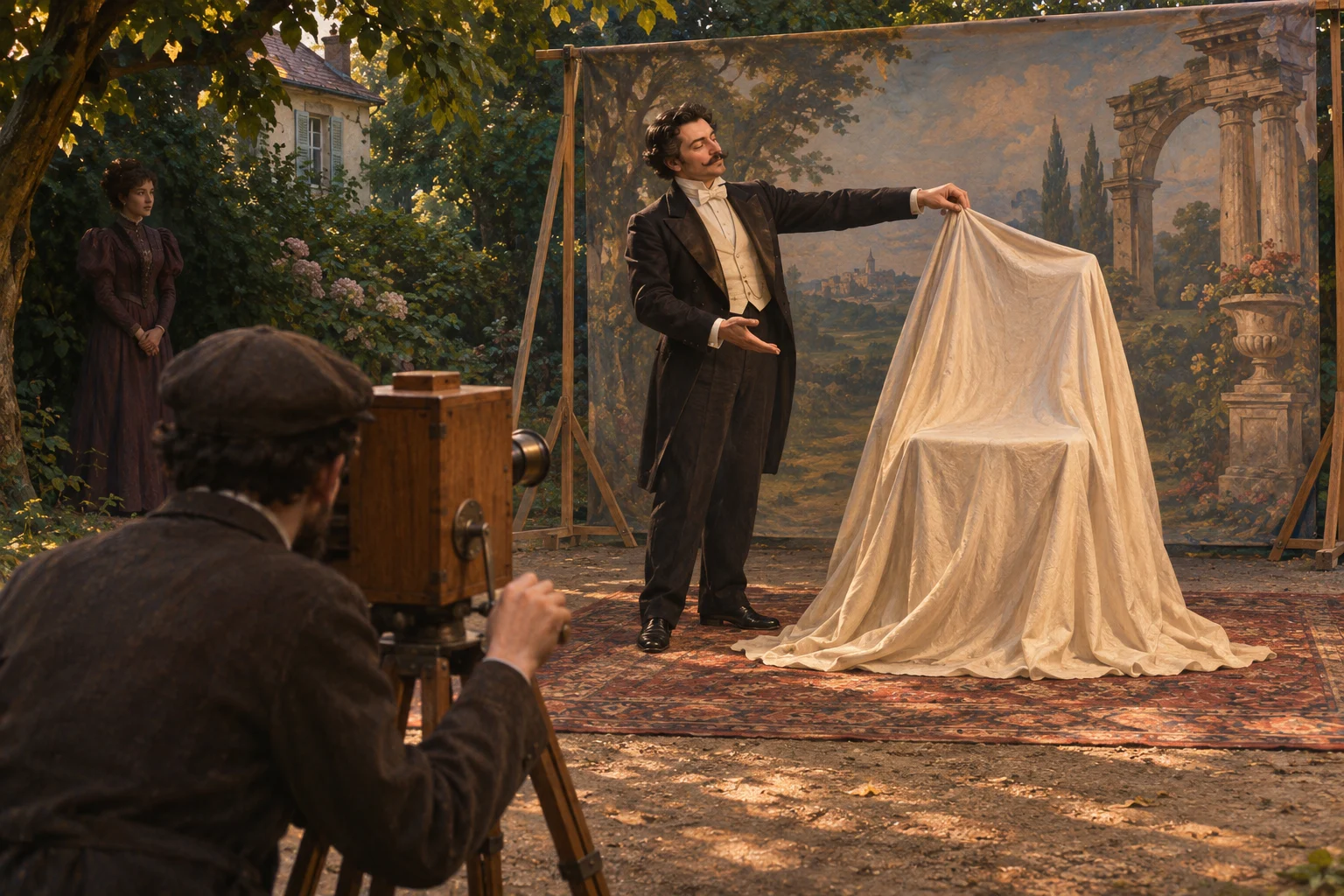
Georges Méliès brought the experience of a magician and theatre proprietor to early filmmaking. In 1896, he made the short film known in English as The Vanishing Lady and in French as Escamotage d’une dame chez Robert-Houdin. He appears as the conjurer, with Jehanne d’Alcy as his assistant. The performance begins from a recognizable stage situation: a woman sits on a chair and is covered with a cloth. The audience expects a disappearance, but film allows the effect to move beyond the practical machinery of a live theatre.
An interruption the audience cannot see
The essential device is an interruption of filming while the camera remains in the same position. A performer or object can be removed or replaced before photography resumes. When the resulting images are shown in sequence, the gap in recording becomes an apparently instantaneous change. Eye Filmmuseum explains the disappearance through precisely this sequence of stopping, removing the woman and restarting. The camera’s fixed viewpoint is crucial because it helps preserve the surrounding scene across the interruption. A discontinuity in production can thus appear as continuity during projection.
The skeleton in the chair
Méliès added a further surprise: a skeleton appears where the woman had been, before she returns. La Cinémathèque française connects the film with Buatier de Kolta’s stage illusion, which relied on a concealed escape through a trapdoor. The film version replaced that physical escape problem with a photographic transformation. It was made in the garden of Méliès’s Montreuil house, before his later glass studio. The performance’s compactness also mattered; a short strip of film could contain several clear visual reversals.
An early trick, rather than an unqualified first
The film is an important surviving example of Méliès’s developing style, combining pantomime, theatrical scenery and photographic manipulation. Broad claims that one person invented all screen effects obscure the work of other early experimenters. Accounts of a camera jam inspiring Méliès’s discovery also derive from retrospective stories. The documented film and its visible transformations provide stronger evidence. The accompanying illustration imagines the outdoor production setting; it is not a still from the surviving film.
Offenbach: Can-Can, solo piano arrangement
Himoyuki Sanada
Sanada’s later piano arrangement evokes the lively nineteenth-century French theatrical world from which Méliès emerged. It is contextual accompaniment, not a surviving original score or an authenticated accompaniment for this silent film.
Listen on SoundCloud ↗Follow the evidence.
- La Cinémathèque française: Film and historical commentary ↗
- Eye Filmmuseum: The Vanishing Lady and its camera trick ↗
- BFI: Méliès’s autobiographical account and its context ↗
- SoundCloud: Himoyuki Sanada’s piano arrangement ↗
AI-assisted writing, with institutional and primary sources. Illustration is a reconstruction, not an archival photograph. Published November 7, 2026; updated November 7, 2026. Our approach