Abraham Lincoln Wins the Presidential Election of 1860
On November 6, 1860, Abraham Lincoln won the election that made him president-elect of the United States. His victory transformed the life of a Springfield lawyer and intensified the national crisis over slavery and the Union.
From Springfield to national attention
Abraham Lincoln had built a legal career and a family life in Springfield, Illinois, before becoming a national political figure. He had served in the Illinois legislature and the United States House of Representatives. His debates with Stephen A. Douglas during the unsuccessful 1858 Senate campaign brought him wider attention. Two years later, Republican delegates selected him as their candidate for president, and his Springfield home became a focus of public interest. The distinction between victory and inauguration is essential to understanding the crisis that followed the vote.
The election of November 6
The presidential contest held on November 6, 1860 had four leading candidates: Lincoln, Douglas, John C. Breckinridge and John Bell. The split between northern and southern Democrats reflected the depth of disagreement over slavery. Lincoln won the election with roughly forty percent of the popular vote. That result is a reminder that the presidency is decided through the Electoral College, rather than by requiring an outright national popular-vote majority.
Victory before taking office
Election day did not make Lincoln the sitting president immediately. He remained president-elect until his inauguration in March 1861. During that interval, southern states began seceding to protect slavery, creating a crisis for the incoming administration. The Republican platform opposed the expansion of slavery into new territories. It did not amount to the immediate nationwide abolition that some later accounts mistakenly read backward into the election itself. Emancipation developed through the subsequent conflict.
A biographical turning point
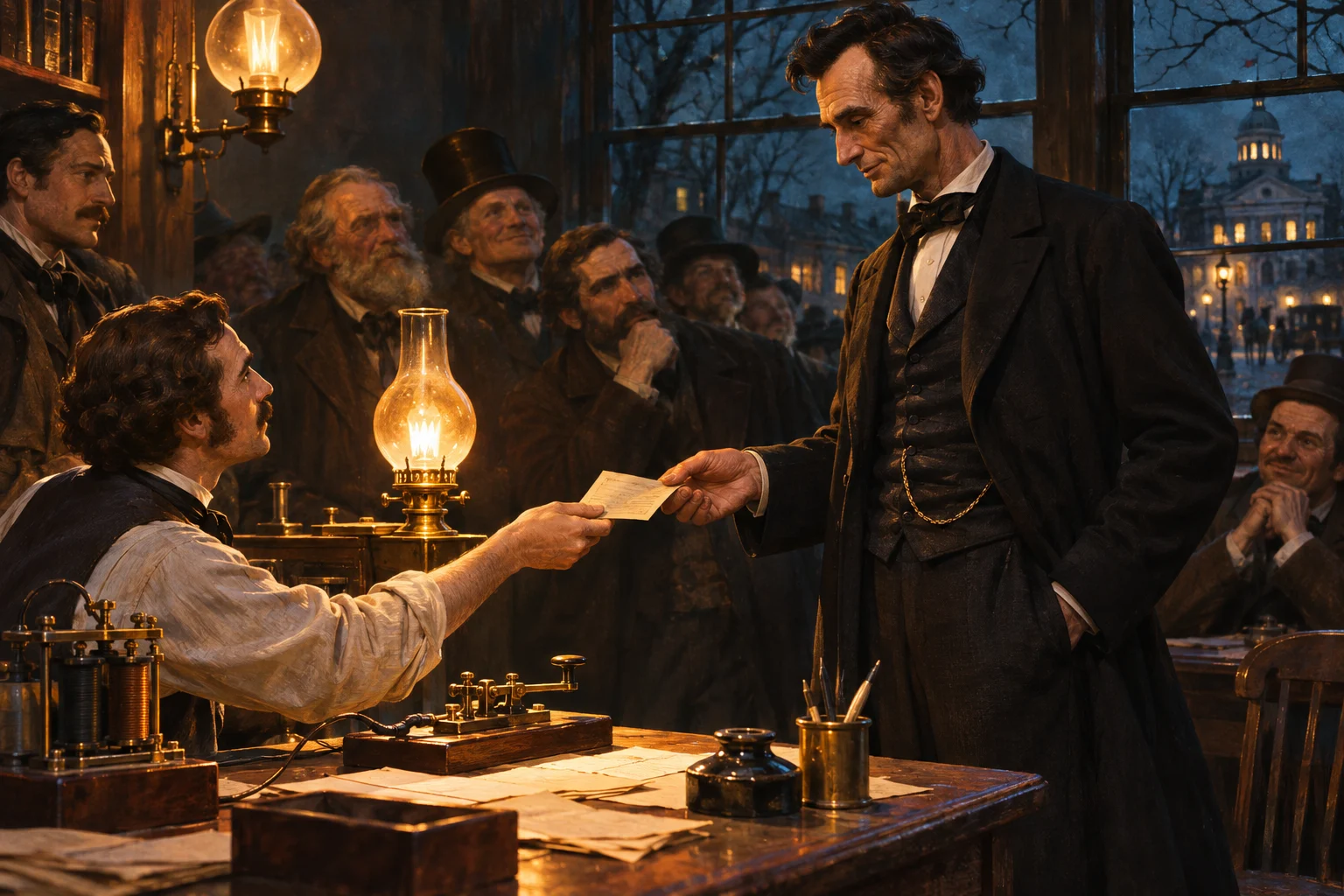
For Lincoln, the result meant leaving a long-established household and professional community for national executive responsibility. His Springfield years help explain why the milestone was more than the appearance of a new face in Washington: the election elevated a lawyer whose political experience had grown through local institutions, national argument and party organization. The illustration imagines the atmosphere of receiving election news; its people, room arrangement and particular telegram are not presented as a surviving visual record.
Hard Times, Come Again No More
Tripp Hunt
A modern performance of Stephen Foster’s 1854 song supplies American musical context from the election era. It is not a recording from election night.
Listen on SoundCloud ↗Follow the evidence.
- National Park Service: Lincoln’s Springfield life and election ↗
- National Park Service: the elections of 1860 and 1864 ↗
- Attached recording on SoundCloud ↗
AI-assisted writing, with institutional and primary sources. Illustration is a reconstruction, not an archival photograph. Published November 6, 2026; updated November 6, 2026. Our approach