Beethoven’s Eroica public premiere and the horn trio in its scherzo
Beethoven’s Third Symphony received its public premiere in Vienna on April 7, 1805. Its expanded scale and adventurous orchestration included a scherzo trio that placed three horns in the foreground, giving the movement a distinctive change of character.
From private performances to a public concert
Beethoven’s Third Symphony was heard publicly at the Theater an der Wien on April 7, 1805, under the composer’s direction. This was not the first occasion on which musicians had played it. Prince Lobkowitz’s patronage had supported private performances and rehearsals before the public concert. That distinction matters: the public premiere marks a change in audience and circulation, rather than the work’s first sound of any kind. The symphony developed across several years of sketches and revisions and became one of the clearest statements of Beethoven’s growing ambition for the orchestral form.
A scherzo with room to change character
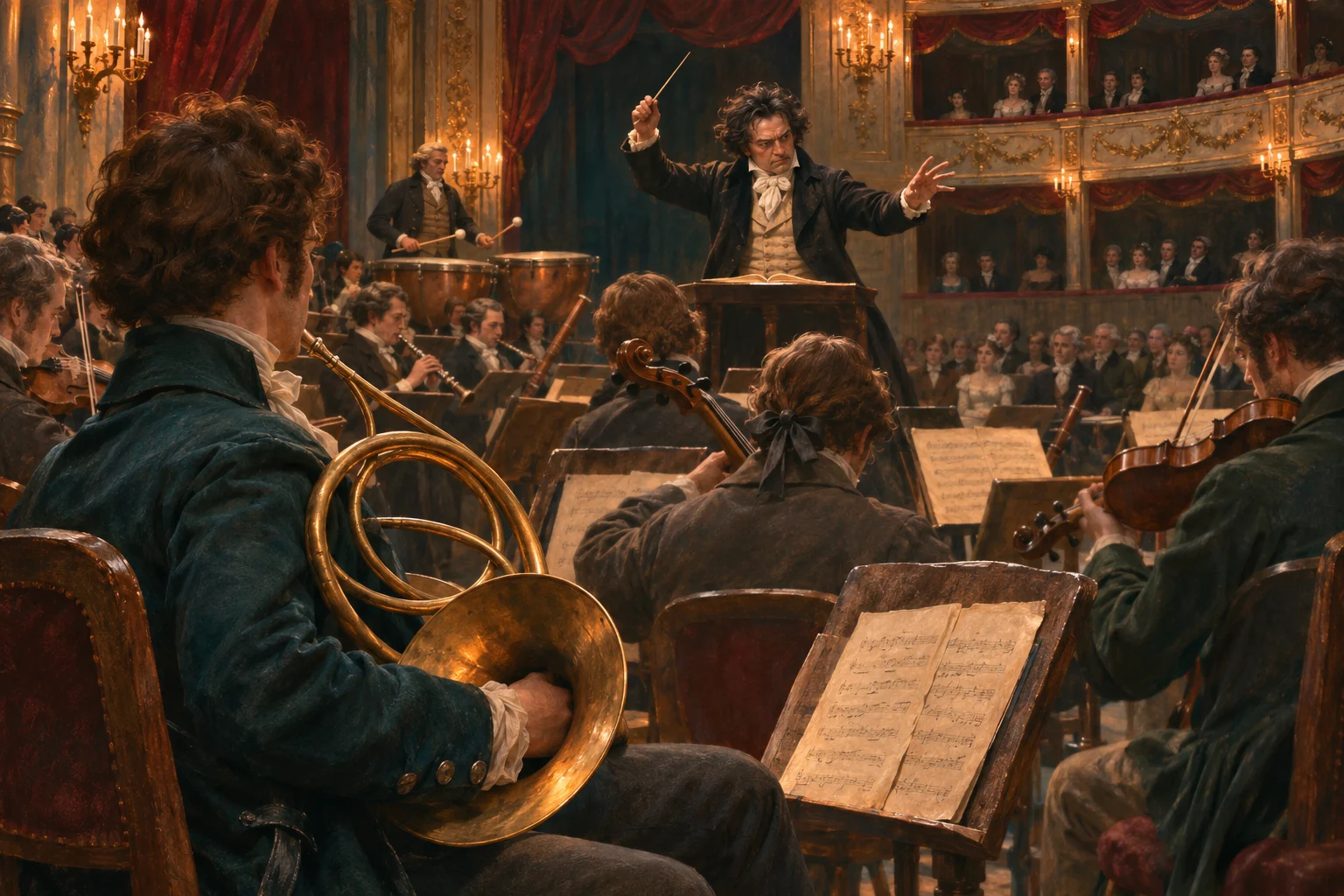
The third movement is a scherzo with a contrasting trio section. Its quick, initially quiet motion creates an atmosphere different from the preceding funeral march. In the central trio, broad horn calls bring a striking alteration of color and gesture. Beethoven scored the symphony for three horns, alongside paired woodwinds, two trumpets, timpani and strings. The horn writing lets listeners hear orchestration as part of the movement’s structure: a change in the instruments carrying the music can be as meaningful as a new melody. The Los Angeles Philharmonic’s account describes the trio as a display piece for the horns.
Heroism and interpretation
The symphony’s familiar nickname, Eroica, belongs to a complicated history of dedications and interpretations. Beethoven initially associated the work with Bonaparte, then withdrew that designation. Stories about his reactions circulated through pupils and later witnesses, and their precise wording should not be treated as a transcript. The music’s scale and emotional range are firmer evidence than a single dramatic anecdote. Its four movements encompass forceful argument, mourning, fleet motion and an extensive finale.
The attached performance
The recording here is the complete third movement performed by the New Zealand Symphony Orchestra, conducted by Antoni Witt, in Wellington in 2011. Radio New Zealand Concert made the live recording, which the orchestra uploaded with permission. It offers a later performance of the score, not sound from the premiere. The illustration likewise evokes an early nineteenth-century orchestral setting without claiming to document the original concert.
Beethoven: Symphony No. 3 ‘Eroica’, third movement
New Zealand Symphony Orchestra; Antoni Witt
The orchestra’s complete third movement, recorded live by Radio New Zealand Concert in Wellington on May 21, 2011, presents music from the symphony publicly premiered on this historical date. Its central trio provides the passage used in the listening question.
Listen on SoundCloud ↗Follow the evidence.
- Berliner Philharmoniker: Eroica programme note ↗
- Los Angeles Philharmonic: Eroica orchestration and analysis ↗
- NZSO: Complete third movement, recording credits ↗
AI-assisted writing, with institutional and primary sources. Illustration is a reconstruction, not an archival photograph. Published November 7, 2026; updated November 7, 2026. Our approach