Mansa Musa’s 1324 Visit to Cairo and the Value of Gold
Mansa Musa passed through Cairo in 1324 during his pilgrimage toward Mecca. Al-Umari’s later account describes lavish gifts and spending that reportedly lowered gold’s local value, revealing the reach of medieval West African wealth.
A journey through an interconnected Africa
Mansa Musa ruled the West African empire of Mali, whose position connected gold-producing regions, the Niger River and routes across the Sahara. His pilgrimage toward Mecca brought him to Cairo in 1324. This was travel along established networks, not an isolated encounter between previously disconnected worlds. Northbound routes linked Saharan towns to Mediterranean exchange, while routes east connected with wider commercial and religious journeys. The same networks carried enslaved people as well as goods, and Musa’s entourage included enslaved attendants; royal splendor should not obscure that coerced labor. The trading world.
What al-Umari recorded
The scholar al-Umari reached Cairo after Musa’s visit and gathered accounts from people who remembered it. In the selection reproduced by Boston University, an official recalls negotiations over Musa’s audience with Egypt’s sultan and the exchange of elaborate gifts. The account also describes abundant gold given to officeholders and spent in the city. Al-Umari connects that influx with a reduction in the gold-to-silver exchange value. The historical account.
A striking report, with limits
The central claim is a report in a medieval narrative, rather than a complete set of market statistics. Its detail makes it valuable, but its explanation should not automatically become a claim that one visitor destroyed Egypt’s economy. Nor can spectacular descriptions establish a reliable modern ranking of Musa’s personal fortune. What the account securely shows is the impression his entourage made and the way observers connected West African gold with changes in local exchange.
Wealth, diplomacy and memory
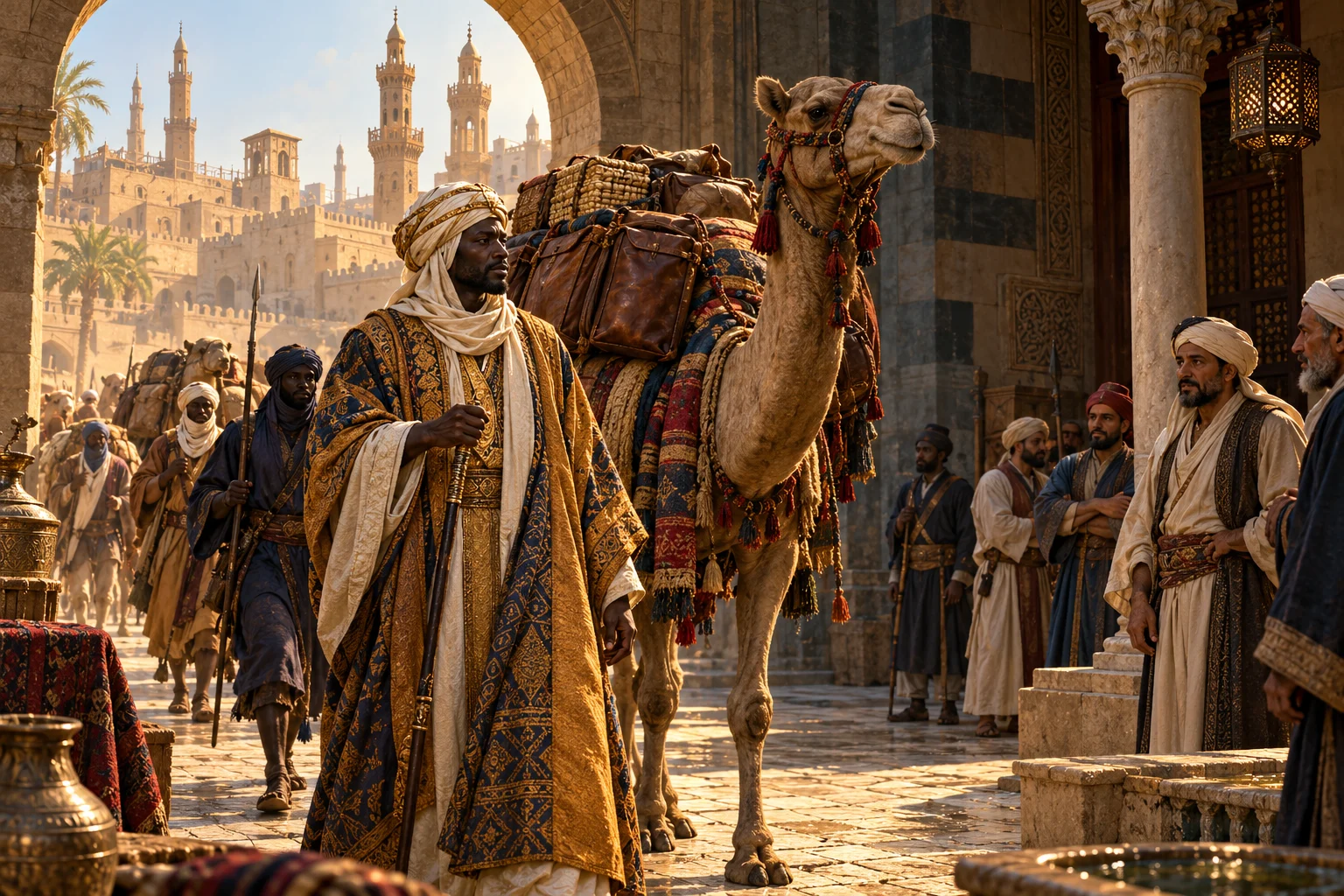
The pilgrimage combined religious purpose with encounters that displayed Mali’s power. Northwestern’s exhibition places Musa’s Cairo reception within that broader journey and describes the luxurious clothing, horses and other honors he received. Such exchanges involved prestige as well as material value. The journey continued beyond the year of the Cairo visit; 1324 here dates that stop, not every stage of the pilgrimage. The illustration is an interpretation of the caravan’s setting, without claiming a contemporary portrait of Musa. Journey and reception.
Sutukung Kumbu Sora / Solo
Alhaji Bai Konte and Dembo Konte
This performance comes from the 1979 album Gambian Griot Kora Duets. Its West African jali tradition offers a later regional connection to the preservation of history; it is not music documented on Musa’s pilgrimage or a medieval recording.
Listen on SoundCloud ↗Follow the evidence.
- Boston University: Kingdom of Mali, al-Umari’s account ↗
- Northwestern: Mansa Musa’s hajj to Mecca ↗
- Northwestern: medieval trans-Saharan exchange ↗
AI-assisted writing, with institutional and primary sources. Illustration is a reconstruction, not an archival photograph. Published November 1, 2026; updated November 1, 2026. Our approach