Hubble researchers report a decagon around Saturn’s south pole in 2026
A report released on 2 September 2026 described a ten-sided atmospheric wave near Saturn’s south pole. The evolving pattern offered a striking southern comparison with the planet’s long-known northern hexagon.
A surprising pattern in the weather
On 2 September 2026, the Hubble team reported a large ten-sided wave encircling Saturn’s south pole. A decagon is an unexpected shape to encounter in the clouds of a giant planet. The feature was compared with the familiar six-sided pattern at Saturn’s north pole. These are atmospheric structures, not solid edges or formations on a surface. The ESA/Hubble release framed the southern discovery as an evolving phenomenon requiring further investigation.
Several years behind one announcement
The release date is the historical event used here; it is not the date on which the pattern first appeared. Researchers examined observations reaching back to 2023, alongside images from ground-based observers. Hubble’s continuing Outer Planet Atmospheres Legacy programme supplied repeated views. The NASA report explains how observations gathered at different times helped distinguish a developing structure from a single unusual-looking image. Monitoring made the change recognizable. Saturn’s changing seasons had also improved the view of its southern polar region from Earth.
Why a planet can have corners
Saturn is a gas giant with powerful winds and a deep atmosphere. Its clouds trace moving gases rather than a fixed landscape. The newly reported wave sits within a jet stream and is visible at different atmospheric levels. NASA’s Saturn overview provides the broader setting of a rapidly rotating planet with strong winds and changing seasons. A polygonal wave can therefore be a property of fluid motion, even though the familiar word decagon sounds like a rigid geometrical object.
Questions that remained open
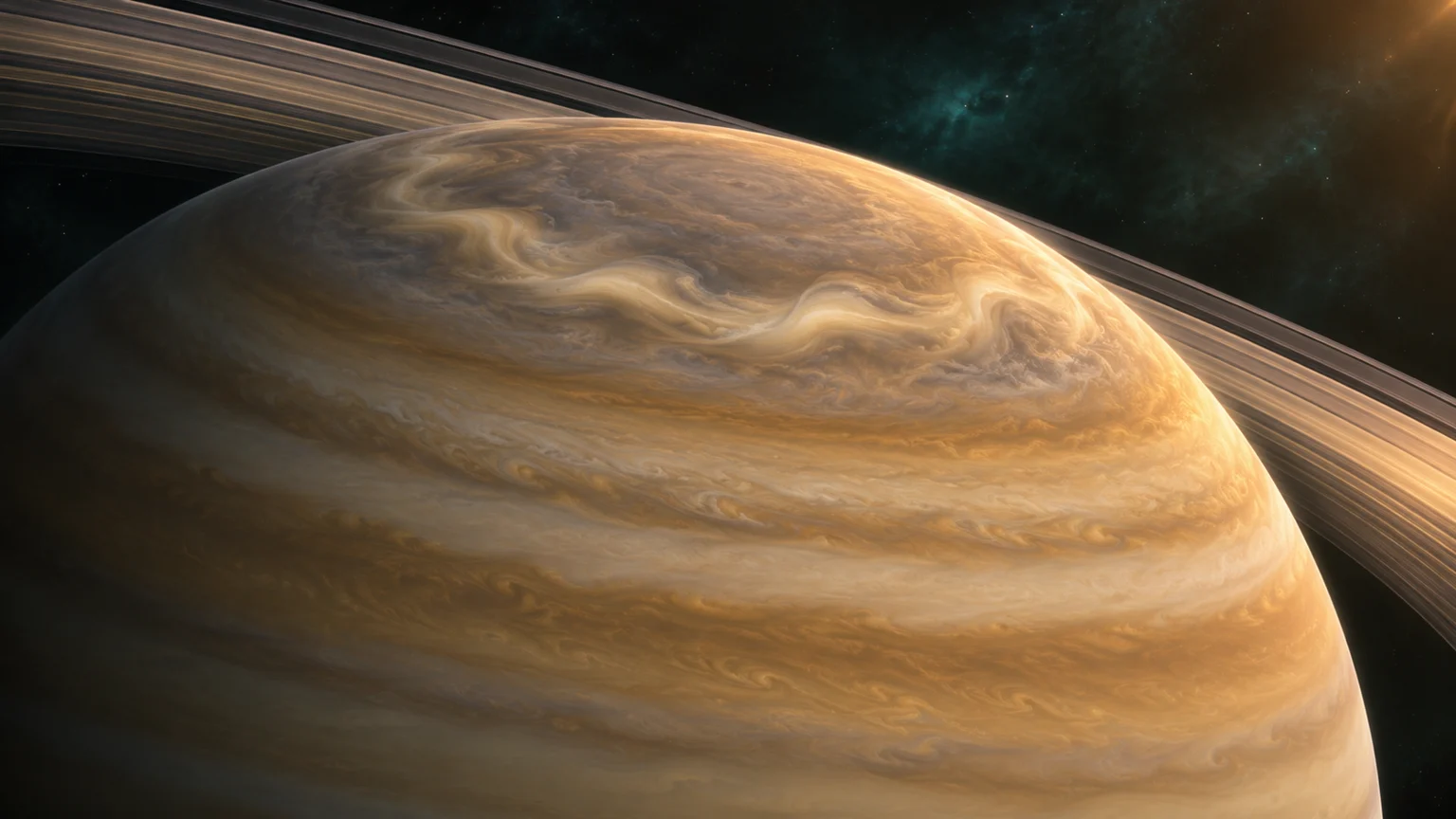
At announcement, researchers did not know exactly why the southern feature had formed recently or how long it would persist. Further observations and modelling were needed to compare it with the more enduring northern hexagon. Reporting those limits is part of explaining the discovery, rather than weakening it. The illustration interprets Saturn’s atmospheric bands and polar region. Its lighting, colours and viewing angle are artistic choices; it is neither a telescope exposure nor a measurement of the wave’s precise outline.
Saturn from The Planets by Gustav Holst
Oberlin Orchestra
The uploader identifies this as the Oberlin Orchestra live at Finney Chapel on 31 October 1990. Holst’s Saturn provides a direct planetary theme; it predates and does not describe the 2026 atmospheric discovery.
Listen on SoundCloud ↗Follow the evidence.
- ESA/Hubble: southern decagon announcement ↗
- NASA: Hubble tracks Saturn’s southern decagon ↗
- NASA: Saturn facts ↗
- SoundCloud: Saturn from The Planets by Gustav Holst ↗
AI-assisted writing, with institutional and primary sources. Illustration is a reconstruction, not an archival photograph. Published November 3, 2026; updated November 3, 2026. Our approach