Dune: Part Two’s 2024 release and infrared arena photography
Released in North America on March 1, 2024, Dune: Part Two gave Giedi Prime a distinctive monochrome appearance through near-infrared photography. The technique changed how skin, costumes and sets registered on camera.
A release date and a visual decision
Dune: Part Two reached North American theaters on March 1, 2024, following an international rollout beginning earlier that week. The date is specified in Warner Bros. Pictures’ release announcement. Among the film’s major visual departures was the arena sequence on Giedi Prime. Its pale faces and stark contrasts were designed to make the setting feel physically different from the other worlds in the story.
Recording beyond human vision
Director Denis Villeneuve and cinematographer Greig Fraser used infrared photography to create this effect. The relevant light is near infrared, beyond the red end of the visible spectrum. This differs from thermal imaging, which is associated with detecting emitted heat. The camera’s altered response meant that simply judging costumes by eye was insufficient. The resulting monochrome look arose from what the camera recorded, rather than merely removing color from ordinary footage at the end of production.
When black cloth stopped behaving alike
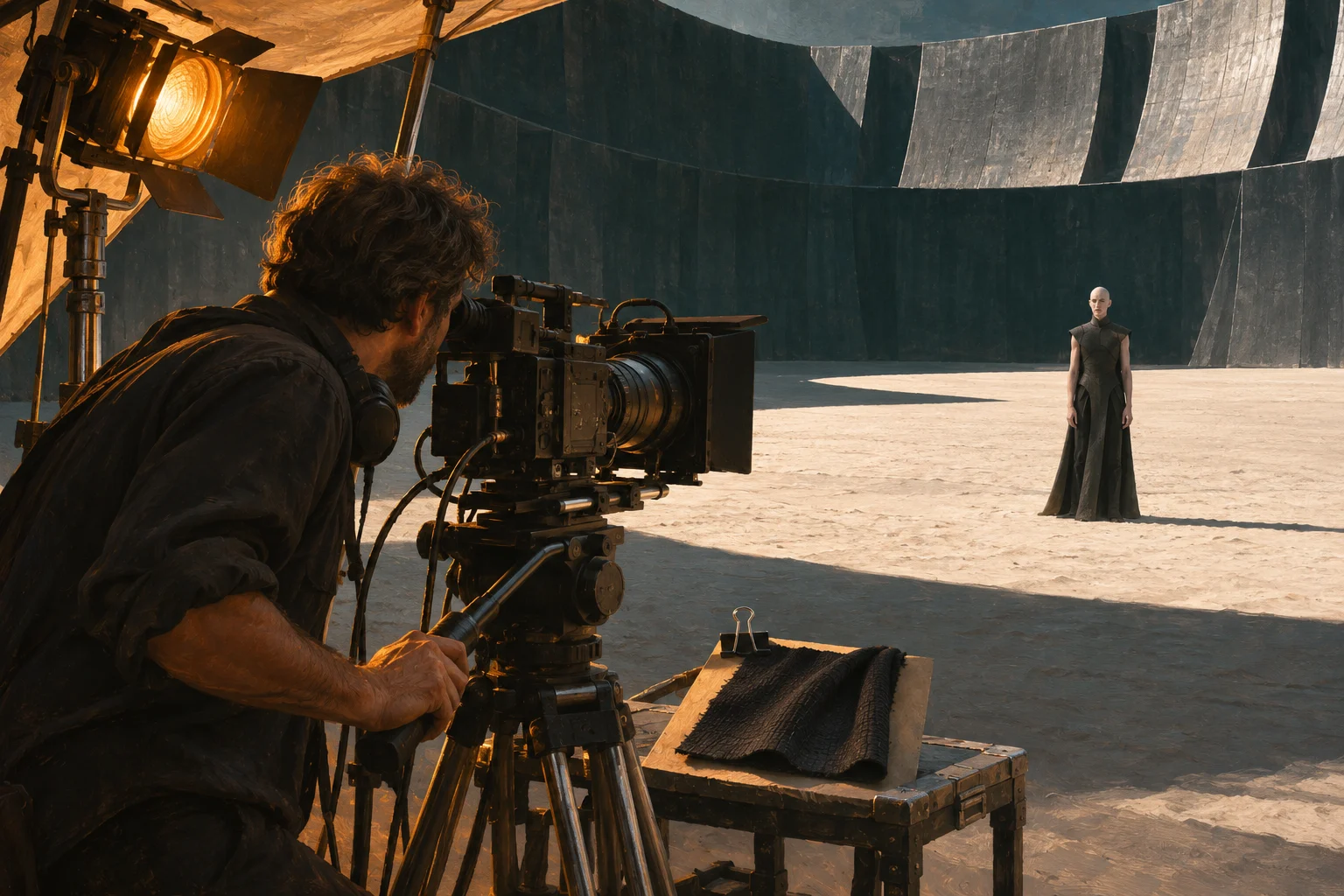
Visual-effects supervisor Paul Lambert described tests in which two black T-shirts looked different through the modified cameras: one remained dark while the other became light. Costumes therefore had to be tested under the intended photographic conditions. The Motion Picture Association interview also explains how the crew worked with the strong contrast of white sand and outdoor shadows in Budapest. Material choices, photography and visual effects were closely connected parts of the finished image.
A collaboration across departments
The American Society of Cinematographers documents the wider camera and lens strategy behind the production. This example shows why cinematography affects design decisions before editing begins: a material’s visible color does not fully describe its photographic behavior. The March release is the event dated here, rather than a claim that the sequence was filmed that day. The accompanying illustration depicts an imagined camera test, not an archival view of the actual production.
A Time of Quiet Between the Storms — Dune: Part Two cover
Antonio Eggert
Antonio Eggert’s later cover of Hans Zimmer’s music for this film provides a direct connection to the released work. It is a cover recording, not the original soundtrack performance or music recorded at the arena shoot.
Listen on SoundCloud ↗Follow the evidence.
- Warner Bros. Pictures: February 2024 release announcement ↗
- Motion Picture Association: Paul Lambert on infrared photography ↗
- American Society of Cinematographers: expanding the view for Dune: Part Two ↗
- Antonio Eggert: A Time of Quiet Between the Storms cover ↗
AI-assisted writing, with institutional and primary sources. Illustration is a reconstruction, not an archival photograph. Published November 4, 2026; updated November 4, 2026. Our approach