WHO Recommends the R21/Matrix-M Malaria Vaccine
On 2 October 2023, WHO recommended a second malaria vaccine for children. R21/Matrix-M offered an important practical advance: another product that could help meet demand for protection in malaria-endemic countries.
A second recommendation
The World Health Organization announced its recommendation of R21/Matrix-M on 2 October 2023. It followed advice from WHO’s immunisation and malaria policy advisory groups. The vaccine was intended to prevent malaria in children, a population bearing a heavy share of the disease’s burden in Africa. It joined RTS,S/AS01, recommended in 2021. The milestone concerned a global public-health recommendation, not the first administration of a dose or the beginning of vaccination in every eligible country. WHO announcement
Why another product mattered
WHO reported that demand for malaria vaccines greatly exceeded the available supply of RTS,S. A second recommended product could therefore expand access rather than simply compete for an already well-served market. Oxford University described production capacity established by the Serum Institute of India and the prospect of manufacturing at substantial scale. The practical chain runs from research and clinical evidence to manufacture, procurement and delivery. A successful product has limited impact if too few doses reach children. Oxford’s account of development and production
Evidence from African trial sites
Oxford’s contemporary release described a large clinical trial involving 4,800 children at sites in Burkina Faso, Kenya, Mali and Tanzania. The research included places with strongly seasonal malaria and places with more continuous transmission. Results therefore had to be interpreted in relation to local conditions, vaccination schedules and follow-up periods. The announcement also noted continuing research and review. These details make the achievement more informative than a single headline percentage detached from the circumstances in which it was measured. Trial context
One tool within a wider system
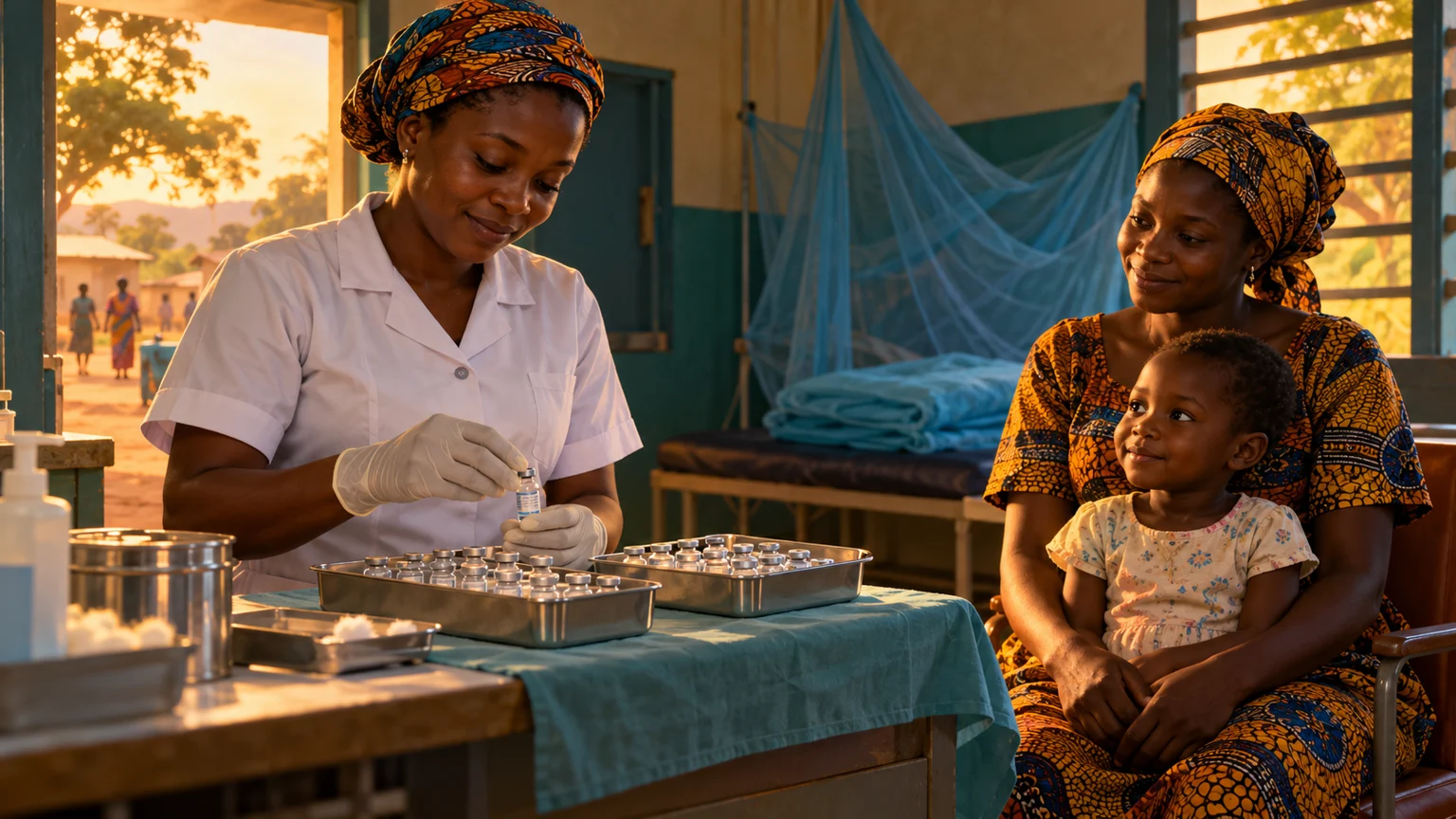
WHO did not report a head-to-head trial establishing that one recommended malaria vaccine was better than the other. Countries would need to consider supply, affordability and programme requirements. Vaccination also complemented other measures, including insecticide-treated bed nets; it did not eliminate the need for them. Recommendation and eventual protection were linked by funding, health services and delivery. The illustration represents that public-health setting conceptually and should not be read as a photograph of a rollout on the announcement date. Limits and implementation
Jarabi Ida Verstraten
Ida Verstraten, with Peter van Horik
Ida Verstraten plays kora with Peter van Horik on balaphone in a modern performance of Manding repertoire. Its West African musical context connects with the vaccine’s research sites in Mali and Burkina Faso; it is not campaign audio.
Listen on SoundCloud ↗Follow the evidence.
- WHO: Recommendation of R21/Matrix-M, 2 October 2023 ↗
- University of Oxford: R21 receives WHO recommendation ↗
AI-assisted writing, with institutional and primary sources. Illustration is a reconstruction, not an archival photograph. Published October 31, 2026; updated October 31, 2026. Our approach