Webb’s WASP-96 b Atmospheric Spectrum Release
Webb’s 12 July 2022 science release included a spectrum of WASP-96 b. Its water signature demonstrated how astronomers can investigate an unseen atmosphere by measuring starlight that passes through it.
A release beyond beautiful pictures
On 12 July 2022, the James Webb Space Telescope’s first science presentation included measurements of WASP-96 b, a planet around a distant Sun-like star. Alongside striking astronomical images, this result took the form of a spectrum: measurements of brightness at different wavelengths. NASA’s account identified a clear signature of water in the atmosphere, with evidence for haze and clouds. The release demonstrated an important capability of the international NASA, ESA and CSA observatory. NASA release
The star supplies the light
WASP-96 b periodically crosses in front of its star as viewed from Earth. During this transit, some starlight filters through the planet’s outer atmosphere. Molecules absorb particular wavelengths, making those parts of the incoming light slightly fainter. Comparing filtered and unfiltered starlight produces a transmission spectrum. The technique does not collect a sample of alien air or resolve individual clouds. It uses tiny changes in light to infer atmospheric composition from far away. ESA explanation
Why this world was useful
The planet lies roughly 1,150 light-years away in the constellation Phoenix. It is larger in diameter than Jupiter but has less than half Jupiter’s mass, making it unusually puffy. Its orbit takes about three and a half Earth days, and its temperature exceeds 500 degrees Celsius. A large atmosphere and frequent transits made it a useful demonstration target. Webb’s NIRISS instrument observed the system for 6.4 hours on 21 June; July’s date marks the public release. Observation details
Water is not a biosignature by itself
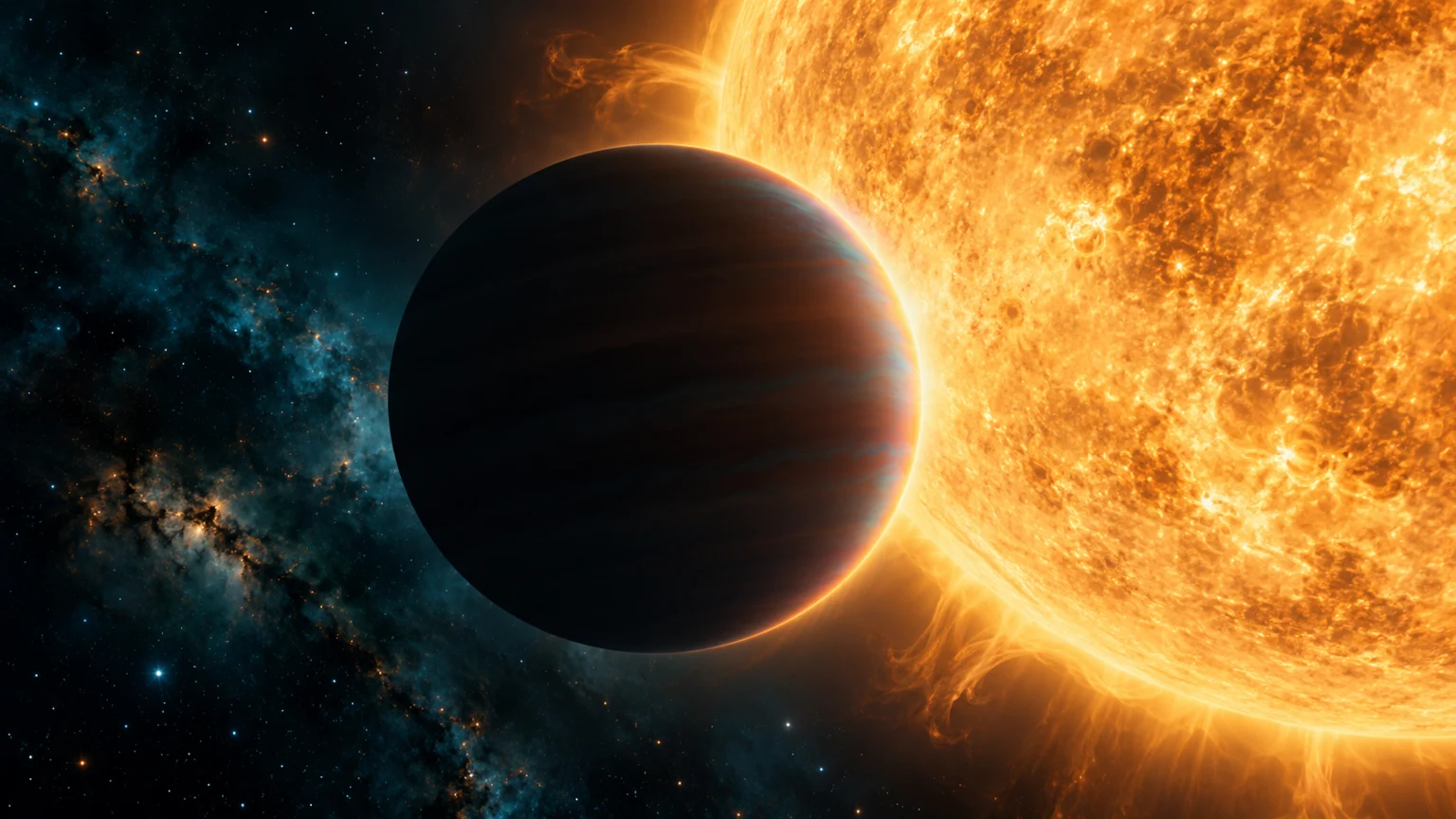
The result did not establish that WASP-96 b has a habitable surface, liquid oceans or organisms. Water vapour can exist in environments unsuitable for life, including extremely hot gas giants. Hubble had already detected water in other exoplanet atmospheres, so this was not humanity’s first detection of such water. Its significance lay in Webb’s detailed infrared measurements and the scientific possibilities they opened. The illustration is an imagined view of a transit, not an actual resolved portrait. Scientific context
Celestial (CC-BY)
Scott Buckley
Buckley’s orchestral and electronic composition supplies a thematic connection to celestial exploration. It is a separate artistic recording, not audio from Webb or the 2022 announcement.
Listen on SoundCloud ↗Follow the evidence.
AI-assisted writing, with institutional and primary sources. Illustration is a reconstruction, not an archival photograph. Published October 31, 2026; updated October 31, 2026. Our approach