Tu Youyou’s artemisinin research receives Nobel recognition
The Nobel medicine announcement on 5 October 2015 recognised Tu Youyou’s discovery of artemisinin. Her work combined historical Chinese medical literature with extraction experiments, purification and testing to develop an important antimalarial drug.
The announcement in Stockholm
On 5 October 2015, the Nobel medicine prize was announced for discoveries that transformed the treatment of parasitic diseases. Tu Youyou was recognised for artemisinin and malaria therapy. The other recipients, William C. Campbell and Satoshi Ōmura, were recognised for work leading to treatments against roundworm infections. These were related public-health achievements but different discoveries. The announcement was international recognition of earlier research, not the date on which Tu first found an active plant extract. Contemporary scientific-society report
Why a promising plant was not enough
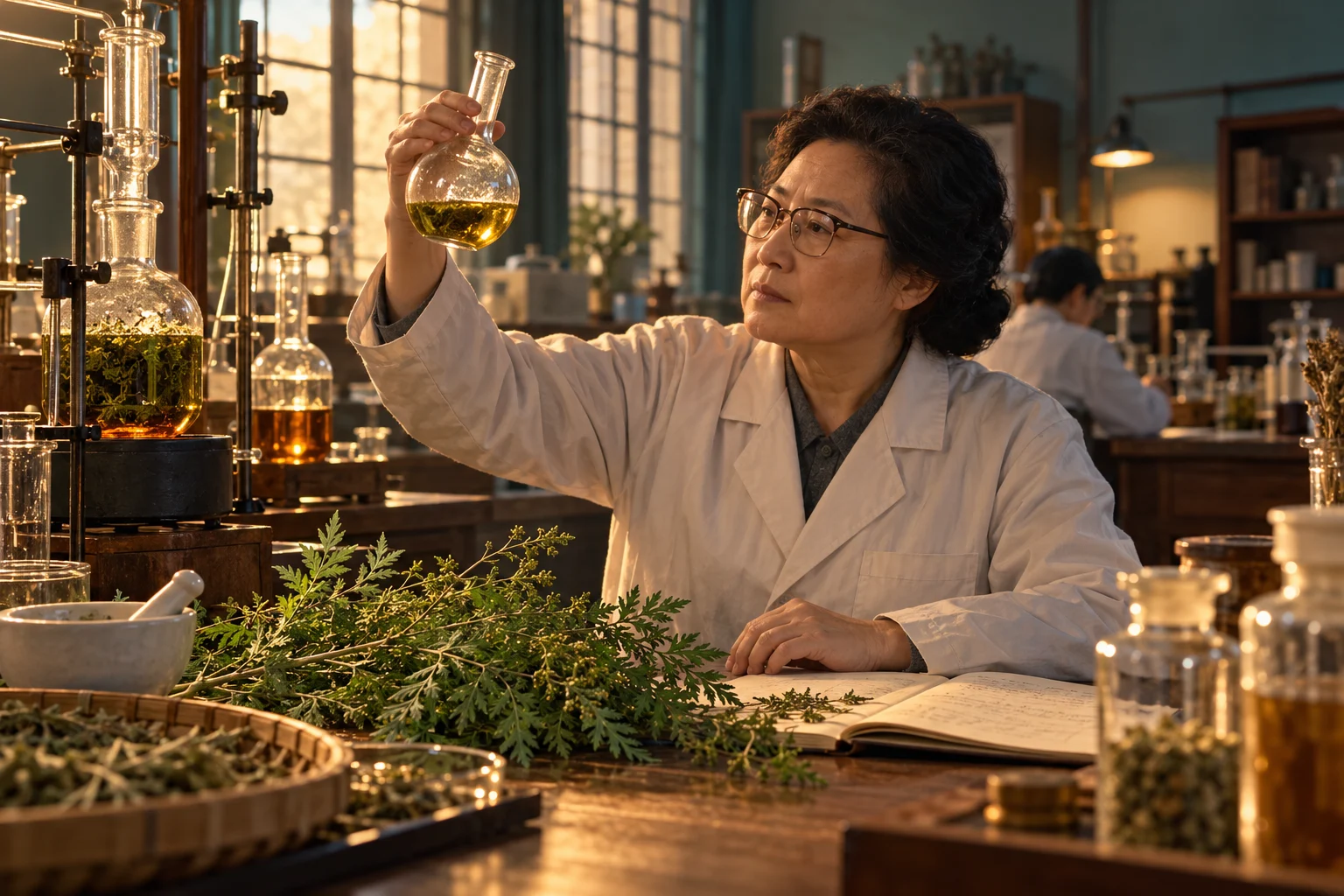
Tu’s team investigated traditional medical recipes while searching for new antimalarial compounds. Sweet wormwood, Artemisia annua, showed promise, but early results were inconsistent. Reading an old preparation method encouraged her to reconsider high-temperature extraction. She developed a cooler process using ether and separated an inactive, harmful acidic fraction. The important advance was therefore more than selecting a plant: it involved changing how useful material was obtained and testing whether that material reliably affected malaria parasites. Lasker research account
From an extract to a medicine
Malaria is caused by Plasmodium parasites, not by a virus or a roundworm. Identifying an effective substance required further work to isolate the active compound, investigate its structure and establish clinical usefulness. A WHO-hosted technical review describes the wider scientific effort that followed the initial extracts, including the development of artemisinin derivatives. The distinction between a raw plant preparation and a standardized pharmaceutical matters: their composition, dosing and evidence cannot simply be treated as interchangeable. Technical review
What this history teaches
The discovery illustrates a productive relationship between inherited knowledge and experimental science. Historical writing supplied a lead; laboratory methods and repeated tests determined what could be made into a useful medicine. Tu led important work within a larger collaborative research programme, so recognition of her contribution need not erase colleagues. The illustration depicts the research context in an imagined earlier laboratory. It does not portray the Nobel announcement in 2015 or claim to document the exact appearance of any experiment. Lasker Foundation; research development
Mo Li Hua
Qian Yi, Li Sun and Liang Wu
This later Carnegie Hall performance of a traditional Chinese song connects with Tu’s Chinese cultural setting. It is a cultural accompaniment, not music documented at her laboratory or the Nobel announcement.
Listen on SoundCloud ↗Follow the evidence.
- The Physiological Society: The 2015 Nobel Prize ↗
- Lasker Foundation: Artemisinin therapy for malaria ↗
- WHO-hosted technical review of non-pharmaceutical Artemisia ↗
- SoundCloud: Mo Li Hua ↗
AI-assisted writing, with institutional and primary sources. Illustration is a reconstruction, not an archival photograph. Published October 31, 2026; updated October 31, 2026. Our approach