India’s Mars Orbiter Mission Enters Martian Orbit
India’s Mars Orbiter Mission entered orbit around Mars on 24 September 2014. A carefully timed engine firing converted an interplanetary arrival into an orbiting mission, demonstrating a central principle of spacecraft navigation: arrival can require braking.
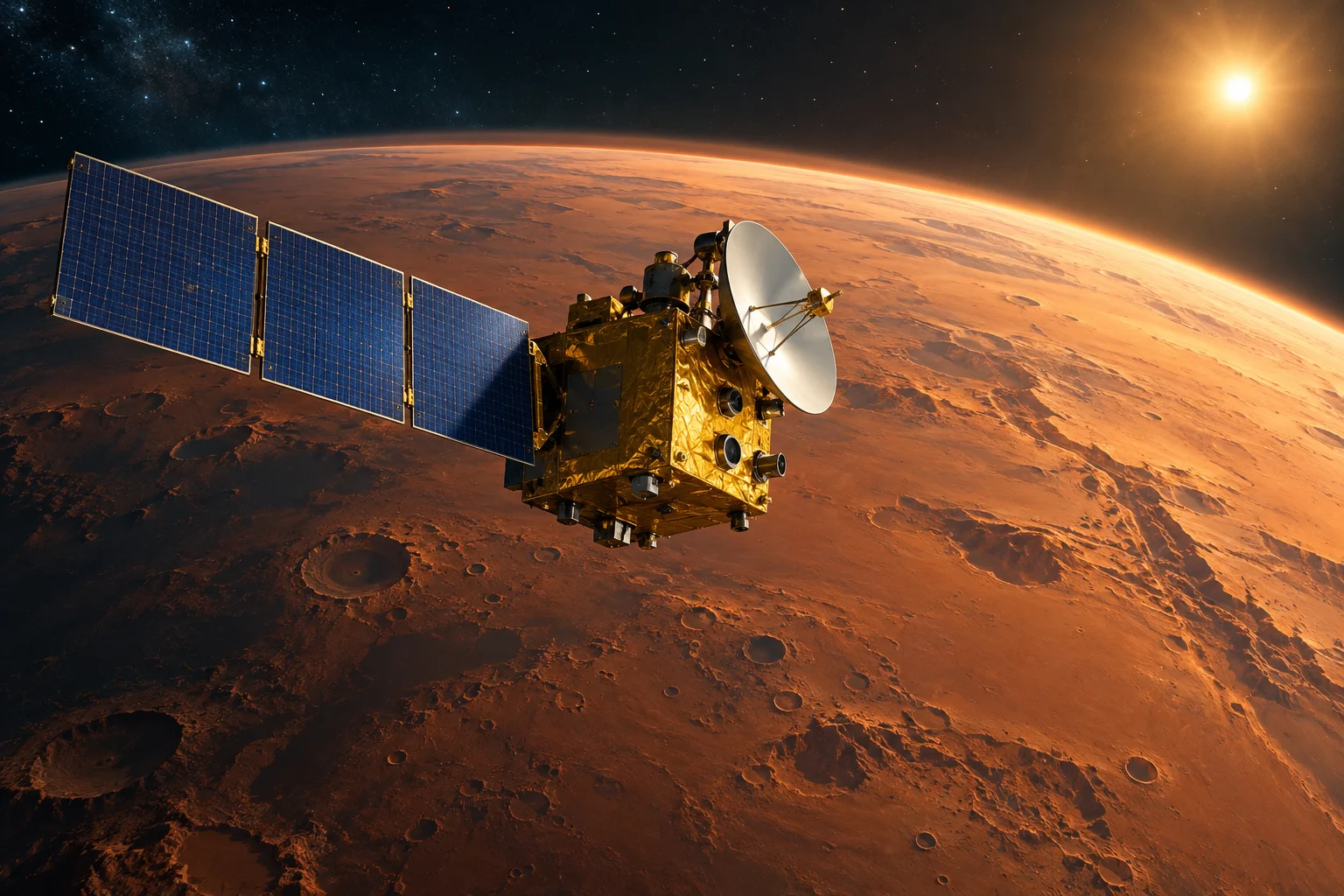
The journey to Mars
India launched the Mars Orbiter Mission in November 2013. After leaving Earth orbit, the spacecraft followed an interplanetary trajectory that brought it towards Mars. Reaching the right location was only part of the task. It also needed the right speed and direction relative to the planet. The mission was designed primarily to demonstrate technologies needed for interplanetary operations, while carrying instruments for observations of the Martian surface and atmosphere.
The insertion on 24 September
The spacecraft fired its 440-newton main engine together with eight smaller engines on the morning of 24 September 2014 in India. The government’s account records the operation and the resulting elongated orbit. This date marks successful orbit insertion, rather than launch or a landing. No part of the mission required the spacecraft to settle onto the Martian surface: it was built to conduct its work from above.
Why an engine burn can be a brake
An engine does not automatically make a spacecraft move faster along its existing path. Its effect depends on the direction of thrust. By reducing its arrival speed relative to Mars, the orbiter could be captured into a bound path around the planet. Too much remaining speed would have carried it past. ISRO’s illustrated mission account explains this relationship between the arrival manoeuvre and capture. The operation required navigation and propulsion to work together.
What orbit made possible
The successful arrival made ISRO the fourth space agency to place a spacecraft in Mars orbit. The orbiter’s five instruments subsequently investigated atmospheric and surface features, while its camera supplied views of the planet. An ISRO retrospective describes scientific results and the engineering experience gained over the mission. Those later findings should be distinguished from the arrival-day achievement. The image is an interpretive spacecraft view, not a photograph taken by an accompanying observer.
Mars, Bringer of War — Gustav Holst
RoyalDukeJam
RoyalDukeJam’s independent digital rendition of Holst’s Mars connects to the destination through the planet’s musical namesake. It is not Indian mission audio or music recorded during orbit insertion.
Listen on SoundCloud ↗Follow the evidence.
- Government of India: Mars orbit insertion operation ↗
- ISRO: Mission history and scientific results ↗
- ISRO: Illustrated book on the Mars Orbiter Mission ↗
- Mars: RoyalDukeJam recording ↗
AI-assisted writing, with institutional and primary sources. Illustration is a reconstruction, not an archival photograph. Published October 31, 2026; updated October 31, 2026. Our approach