The First Public Cultivated-Beef Burger Tasting in London
On 5 August 2013, a London presentation put cultivated beef into a frying pan and before food tasters. Mark Post’s Maastricht team demonstrated animal muscle grown from cells, in a prototype whose development cost dwarfed any ordinary lunch.
From tissue culture to food
The research asked whether animal muscle cells could be grown outside an animal and assembled into meat. This differed from making a plant-based burger that imitated beef. The starting material was animal cells, supplied with conditions and nutrients that allowed them to multiply and develop. Maastricht University’s later account of the process explains the link between laboratory cell culture and the much harder ambition of producing food at scale.
The London demonstration
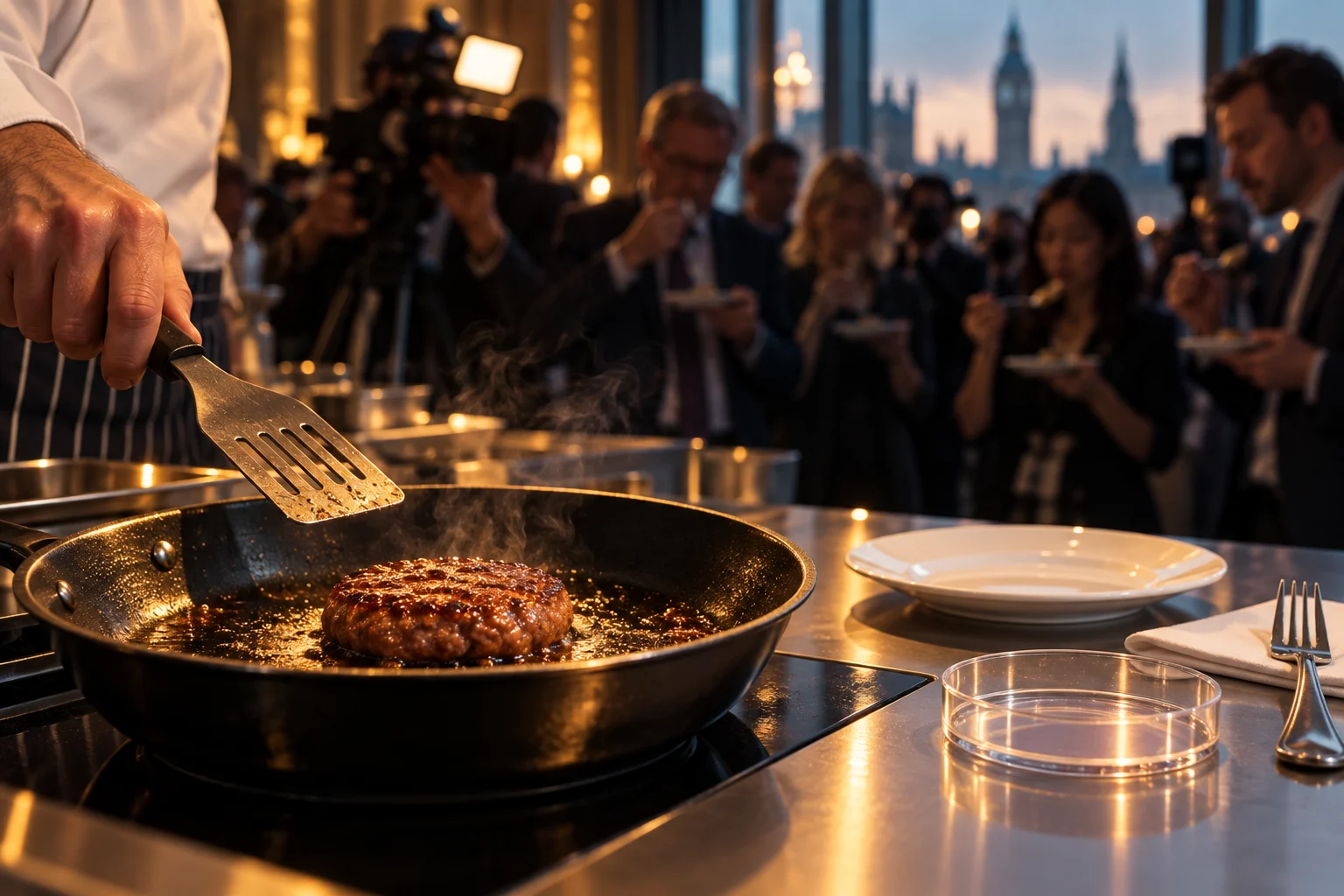
On 5 August 2013, Mark Post and collaborators presented the cultivated-beef burger in London. A chef cooked it and food experts tasted it in front of journalists. The team’s anniversary account confirms the exact unveiling date. It was a public prototype, rather than a product entering ordinary restaurant service. The scene made an abstract biotechnology process immediately understandable: something previously associated with culture dishes had become a recognisable item of food.
An expensive and imperfect mouthful
The prototype required development spending measured in hundreds of thousands of euros. That figure should not be confused with a normal menu price or the eventual manufacturing cost of every future burger. Tasters recognised a meat-like result but found it dry. The Maastricht university newspaper’s retrospective also distinguishes the public event from earlier private testing. The demonstration was a milestone in visibility, not the first occasion on which anyone had tasted the team’s work.
A beginning for further engineering
The London event helped attract attention and investment, but showing that a burger could be made did not settle the questions of affordability, texture, growth media or large-scale production. These remained engineering and research problems. Later company accounts describe subsequent improvements; those should not be projected backwards onto the 2013 patty. The accompanying cooking scene is an interpretive illustration of the public demonstration, rather than a photograph of its venue, equipment or individual tasters.
Food Glorious Food
Cast of Oliver! at Eltham Hill School
A later school-cast performance of Lionel Bart’s song connects the tasting to food and London’s theatrical culture. It is a thematic pairing, not music performed at the scientific demonstration.
Listen on SoundCloud ↗Follow the evidence.
- Mosa Meat: Anniversary of the 5 August 2013 unveiling ↗
- Observant, Maastricht university newspaper: The 2013 burger ↗
- Maastricht University: Culturing cells and scaling production ↗
- Food Glorious Food: School cast recording ↗
AI-assisted writing, with institutional and primary sources. Illustration is a reconstruction, not an archival photograph. Published October 31, 2026; updated October 31, 2026. Our approach