Launch of NASA’s Solar-Powered Juno Mission to Jupiter
NASA launched Juno on 5 August 2011 to investigate Jupiter. Its three large solar wings embodied a key design challenge: supplying enough electricity at a planet where sunlight is far weaker than near Earth.
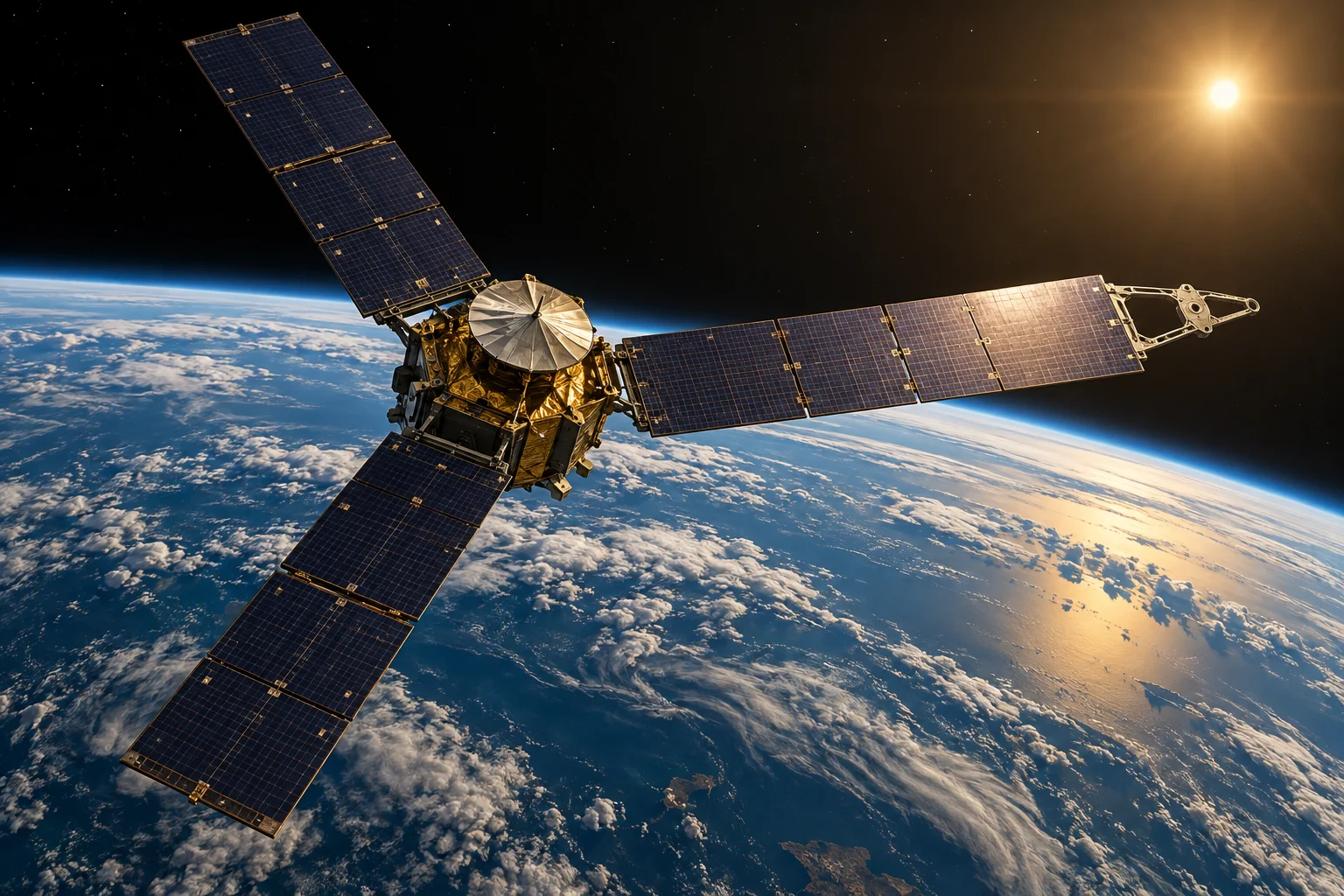
Leaving Florida
An Atlas V rocket carried Juno away from Cape Canaveral on 5 August 2011. The spacecraft began a journey lasting almost five years before reaching Jupiter. Its destination would take it beyond the region where solar power had normally supplied planetary orbiters. The NASA mission overview distinguishes the launch from the later arrival. The illustration shows the deployed spacecraft near Earth, rather than implying that Jupiter was already close when the mission began.
The challenge of a distant Sun
Jupiter lies roughly five times farther from the Sun than Earth. Because sunlight spreads over an increasing area, its intensity there is about one twenty-fifth of that near Earth. A panel that produces ample electricity at home therefore supplies much less at Jupiter. Juno carried three long solar arrays and relied on efficient systems to make that weaker energy supply useful. JPL’s explanation connects the spacecraft’s unusually broad shape directly to this engineering problem.
Electricity, not sailing
Solar cells convert incoming light into electrical power for spacecraft systems. Their role should not be confused with a solar sail, which uses pressure from light to produce thrust. Juno’s route also required propulsion and a gravity assist at Earth. The panels did not replace those navigational tools. Improved solar-cell performance, low power demands and mission planning that limited time in Jupiter’s shadow helped make the design practical. The launch therefore carried a carefully coordinated energy system, not merely an oversized set of familiar rooftop panels.
Looking beneath the clouds
Juno’s science programme sought to understand Jupiter’s atmosphere, interior, gravity and magnetic field, and thereby the planet’s formation. Solar electricity supported the instruments that investigated those questions. The engineering choice also demonstrated that a mission to this distant environment could use sunlight rather than the nuclear power sources used by earlier visitors. That distinction concerns power generation, not an absence of radiation hazards around Jupiter. The image is an interpretive spacecraft illustration, not a camera view taken from another vehicle.
Jupiter from The Planets
Oberlin Orchestra, live recording uploaded by Robert Ponto
Holst’s Jupiter supplies a musical link to Juno’s destination. This performance was recorded at Oberlin’s Finney Chapel on 31 October 1990, long before the spacecraft’s launch.
Listen on SoundCloud ↗Follow the evidence.
- NASA Science: Juno launch and mission design ↗
- NASA JPL: Solar power at Jupiter ↗
- Jupiter: Oberlin Orchestra live recording details ↗
AI-assisted writing, with institutional and primary sources. Illustration is a reconstruction, not an archival photograph. Published October 31, 2026; updated October 31, 2026. Our approach