The 2010 Graphene Nobel Announcement and the Adhesive-Tape Method
On 5 October 2010, Manchester physicists Andre Geim and Konstantin Novoselov were named physics Nobel laureates for graphene experiments. Their earlier isolation technique used an astonishingly familiar tool: ordinary adhesive tape.
An announcement, not a discovery day
The University of Manchester announced the physics Nobel honour on 5 October 2010. Andre Geim and Konstantin Novoselov had already spent years investigating graphene and publishing its properties. Their isolation work dated to 2004. Keeping those milestones separate matters: the date here marks international recognition of the research, rather than the first time a carbon sheet was peeled from graphite. The university’s contemporary announcement makes that sequence clear.
Peeling a familiar material
Graphite consists of stacked carbon layers. The Manchester researchers used adhesive tape to separate progressively thinner flakes until individual layers could be studied. This mechanical exfoliation method sounds like a stationery experiment because an everyday material really was involved. Yet finding, identifying and investigating the tiny flakes demanded careful laboratory work. The university’s history of the method places the tape technique within a wider culture of exploratory experiments.
Why one layer was different
Graphene is a sheet of carbon atoms arranged in a hexagonal network. A single layer provided a way to investigate electronic behaviour in an exceptionally thin material, while its strength, flexibility and conductivity suggested practical possibilities. The importance lay in preparing and characterising usable samples, not simply giving a name to the layers inside graphite. The Nobel recognition reflected the unusual physical system opened to experiment and the research that followed from it.
The surviving tools
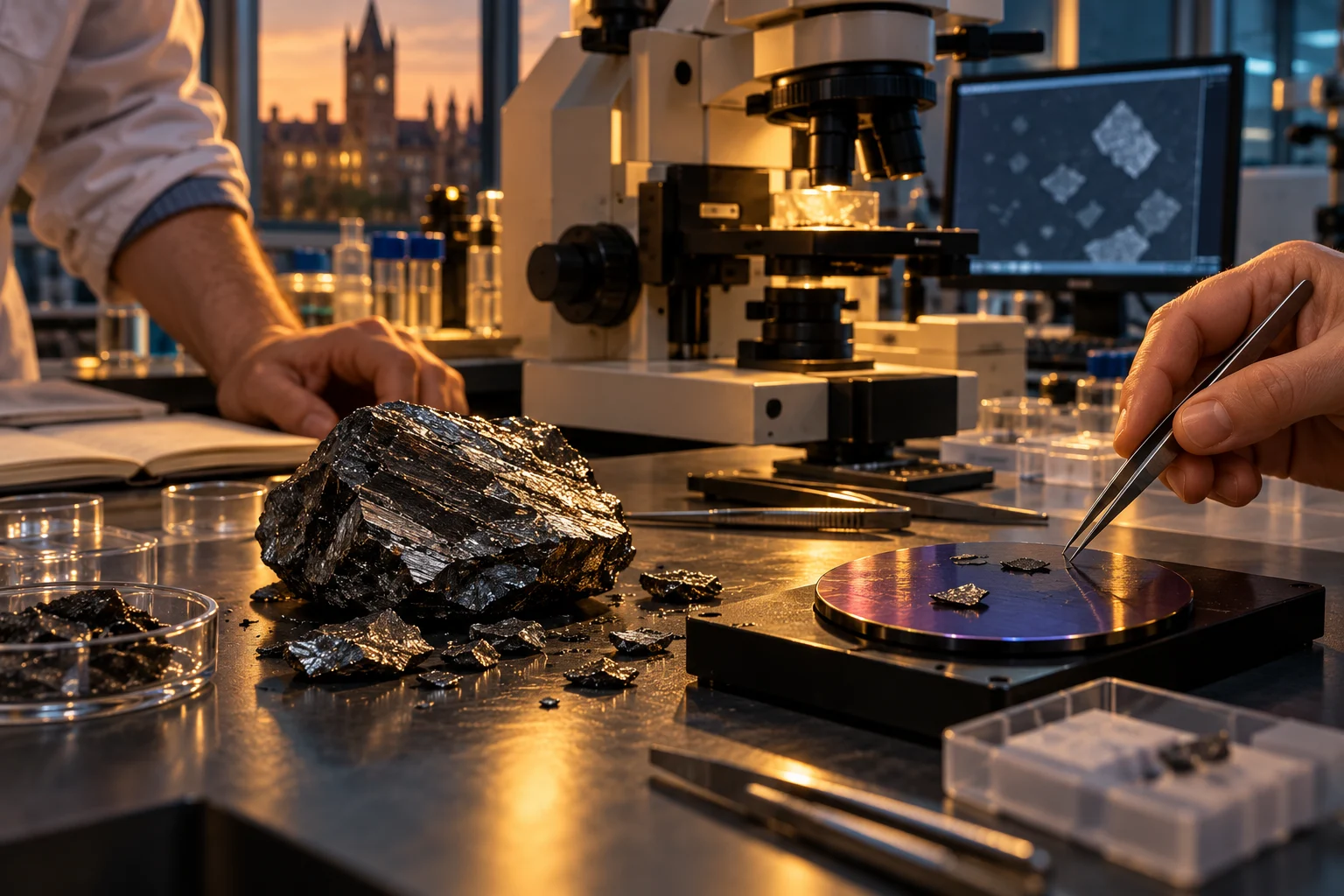
The Science Museum Group collection preserves a tape dispenser, graphene samples and early experimental circuits connected with the Manchester work. These objects make the story tangible: humble equipment sat within a sophisticated programme of measurement. They also show why the tape alone cannot explain the achievement; the circuits record the next experimental steps. The accompanying laboratory still life is an interpretive illustration, not a photograph of the original apparatus or the Nobel announcement.
New Order – Blue Monday (cover)
Jon Doschie
Doschie’s later cover of a song by Manchester band New Order connects the soundtrack to the city where the graphene work was done. It is a geographic cultural association, not music from the Nobel announcement.
Listen on SoundCloud ↗Follow the evidence.
- University of Manchester: Nobel announcement, 5 October 2010 ↗
- Graphene at Manchester: History and exfoliation method ↗
- Science Museum Group: Objects from graphene isolation ↗
- Blue Monday cover: artist upload ↗
AI-assisted writing, with institutional and primary sources. Illustration is a reconstruction, not an archival photograph. Published October 31, 2026; updated October 31, 2026. Our approach