The 8 June 2004 transit of Venus and the public measurement of the Sun’s distance
Venus’s passage across the Sun on 8 June 2004 became a worldwide observing event. An international education project combined measurements from students and amateur astronomers to repeat a historically important determination of the Earth–Sun distance.
A rare alignment becomes visible
On 8 June 2004, Venus appeared as a small dark disc crossing the bright face of the Sun. It was the first such transit since 1882. A transit requires the planet to pass between Earth and the Sun near the alignment of their orbital planes; it does not occur at every ordinary passage between them. NASA’s city-by-city predictions show how the visible circumstances depended on an observer’s location, including whether the Sun was above the horizon during each stage of the event.
Different viewpoints provide a ruler
Widely separated observers look toward Venus from slightly different angles. Against the distant Sun, its apparent track therefore shifts: an example of parallax. Observations of positions or of the moments when the planet meets the Sun’s apparent edge can be combined with known orbital relationships to determine the scale of the system. The ESO and IMCCE teaching material explains a simplified geometrical method and its assumptions. The principle connects an angular difference seen through telescopes with a very large physical distance.
A historic experiment repeated collectively
The VT-2004 programme invited schools, amateur astronomers and other observers to contribute timings. ESO later reported 4,550 contact timings from 1,510 registered observers. Their combined estimate placed the Earth–Sun distance at approximately 149.61 million kilometres, about 0.007 percent above the accepted value used in the project. These were observational results with uncertainty, not an exact new definition of the astronomical unit. The project’s retrospective presented them as a successful demonstration of what a coordinated public scientific effort could achieve.
Education rather than a newly discovered distance
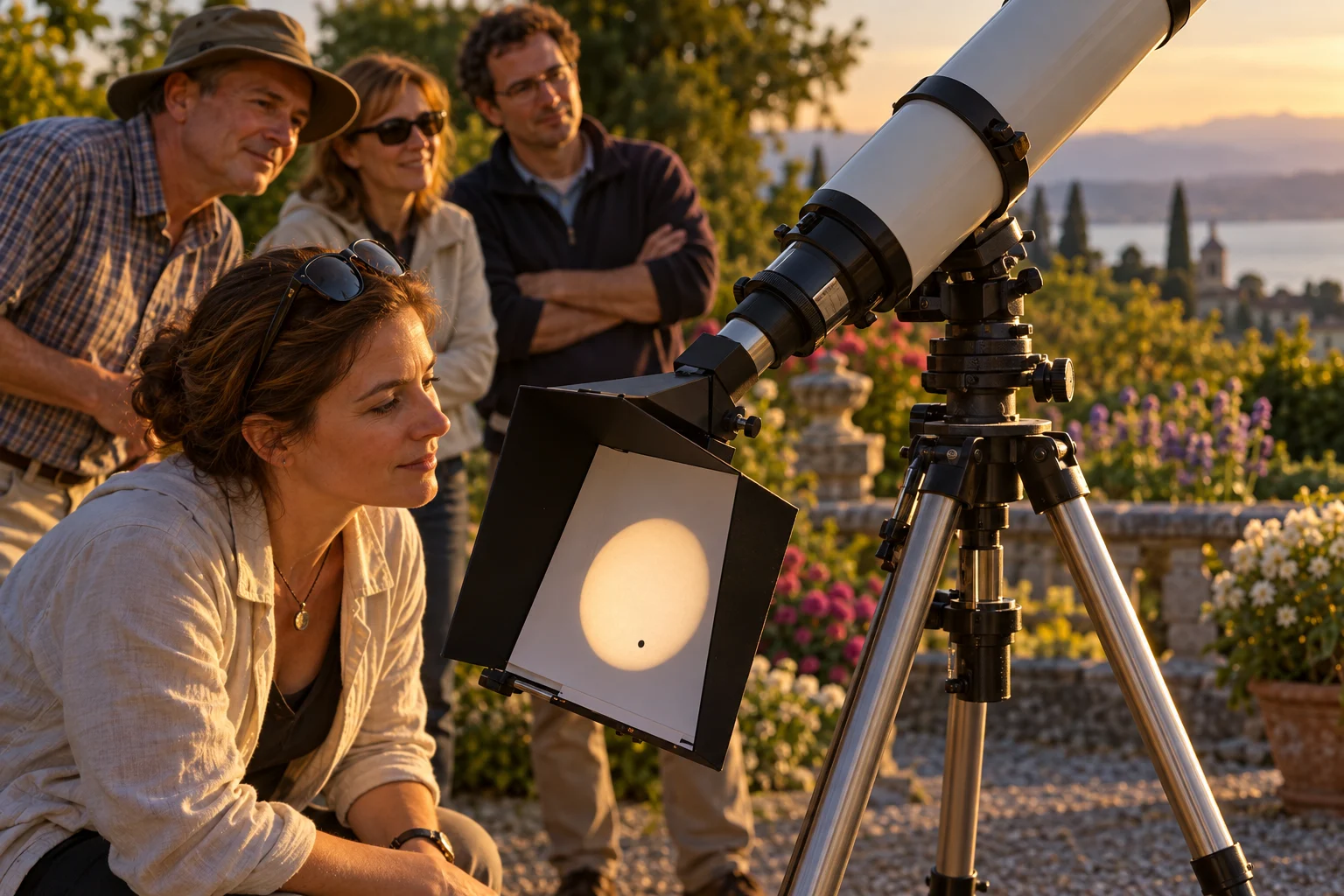
By 2004, more precise methods had already established the scale of the solar system. The campaign’s importance lay in participation and understanding, not in claiming that humanity had never measured the distance before. The Paris Observatory history contrasts modern electronic imaging and location information with the difficult expeditions of earlier centuries. The accompanying illustration shows an interpreted projection setup, where the solar image falls onto a card. It represents the act of observation without claiming to portray a particular registered group or its submitted measurements.
Venus, the Bringer of Peace — The Planets
Amarillo Symphony; conductor Jacomo Rafael Bairos
Holst’s Venus movement supplies a planetary association with the transit. The orchestra identifies this as a March 2014 performance in Amarillo, Texas; it is not music recorded during the 2004 observations.
Listen on SoundCloud ↗Follow the evidence.
- ESO: Summing up the Venus Transit 2004 programme ↗
- NASA: Transit of Venus, 8 June 2004, city circumstances ↗
- IMCCE, Paris Observatory: History of Venus transits ↗
- ESO/IMCCE: Venus Transit 2004 parallax method ↗
- Amarillo Symphony: Holst’s Venus ↗
AI-assisted writing, with institutional and primary sources. Illustration is a reconstruction, not an archival photograph. Published October 31, 2026; updated October 31, 2026. Our approach