Concorde retires from commercial service on 24 October 2003
Concorde’s last commercial day ended an era of scheduled supersonic passenger travel. British Airways’ final scheduled service flew from New York to Heathrow on 24 October 2003, leaving surviving aircraft to become museum exhibits.
The end of a scheduled service
British Airways withdrew Concorde from commercial service on 24 October 2003. Its final scheduled flight was BA002 from New York JFK to London Heathrow, operated by aircraft G-BOAG. British Airways’ historical account identifies the date, route and aircraft. The wording matters: commercial retirement was not the final movement of every Concorde. Later positioning and delivery flights took aircraft to preservation sites. Describing the October event simply as the aircraft’s last-ever flight would collapse those separate milestones.
What passengers were giving up
Concorde could cruise at around Mach 2, approximately twice the speed of sound, at altitudes up to sixty thousand feet. A typical London–New York trip took less than three and a half hours, compared with about eight hours on a subsonic flight in the airline’s comparison. The Museum of Flight emphasizes the striking time advantage: the aircraft could make an Atlantic return trip in roughly the time a conventional airliner needed for one direction. Speed was the defining passenger experience being retired.
A distinctive shape with practical reasons
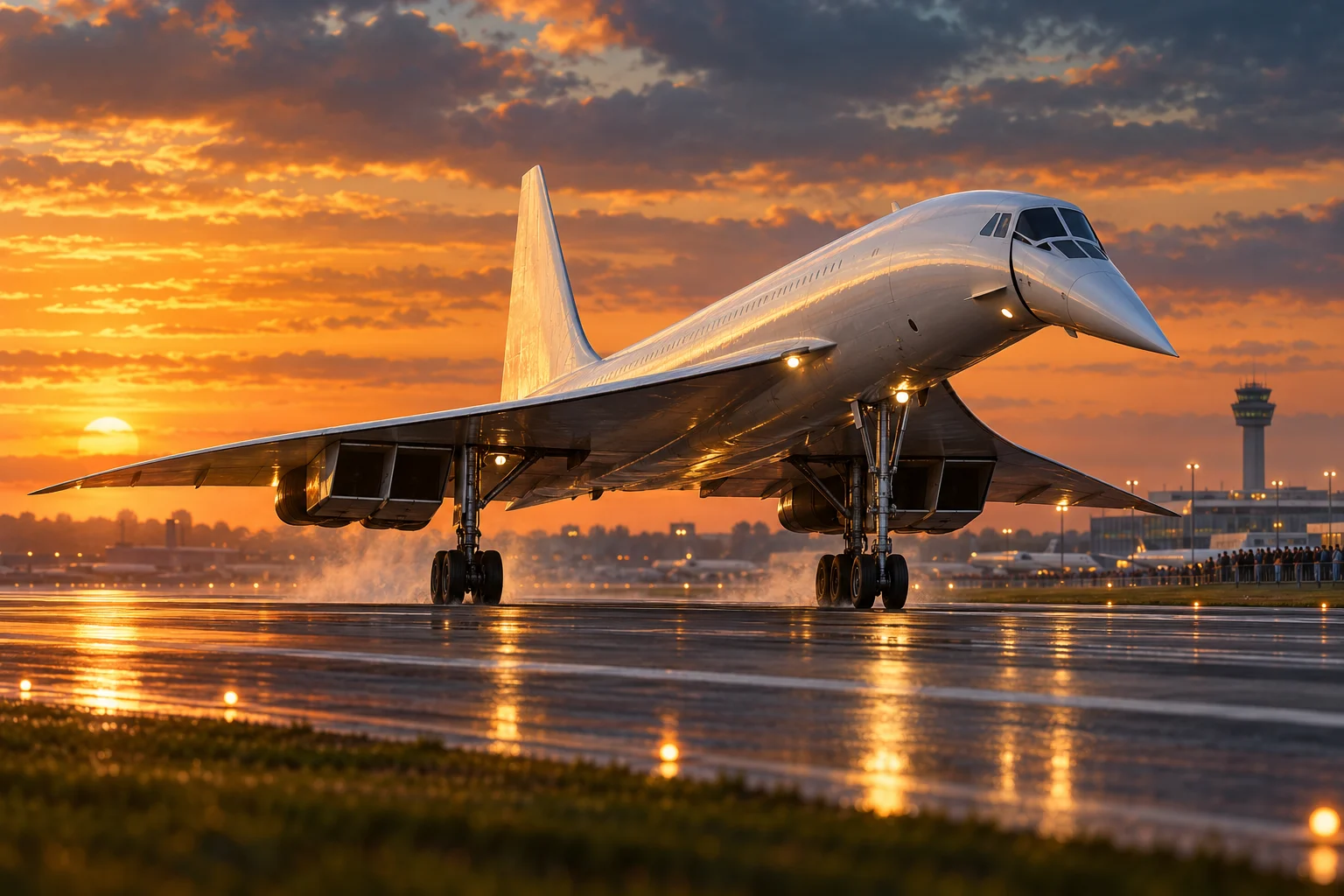
The slender fuselage, delta wing and pointed nose reflected the demands of high-speed flight. The nose could be lowered for take-off and landing, improving the pilots’ view when the aircraft flew at a nose-high attitude. University of Alabama in Huntsville’s archival description of droop-nose drawings explains the trade-off between aerodynamic shape and visibility. The moving nose was therefore an engineering solution, not a ceremonial bow invented for the farewell. It gives the illustration a recognizable and functional visual clue.
From operating aircraft to preserved object
Concorde was a joint British and French programme, with prototypes first flying in 1969 and passenger operations beginning in 1976. After retirement, aircraft were distributed to museums and other preservation locations. G-BOAG, the aircraft used for the final scheduled British Airways crossing, became part of the Museum of Flight collection in Seattle. That survival lets later visitors examine the physical design of a service they can no longer book. The illustration interprets the farewell landing atmosphere; it is not an archival photograph of a particular touchdown instant.
Leaving on a Jet Plane — John Denver cover
Nádia Schilling
Schilling’s own vocal and instrumental cover provides a farewell-to-flight theme. Uploaded in 2013, it is a later thematic association, not music played aboard Concorde’s final commercial service.
Listen on SoundCloud ↗Follow the evidence.
- British Airways: Celebrating Concorde ↗
- The Museum of Flight: Concorde ↗
- University of Alabama in Huntsville: Concorde droop-nose records ↗
- Nádia Schilling: Leaving on a Jet Plane ↗
AI-assisted writing, with institutional and primary sources. Illustration is a reconstruction, not an archival photograph. Published October 31, 2026; updated October 31, 2026. Our approach