Dennis Tito launches on a Soyuz taxi mission to the ISS
Dennis Tito began the first self-funded private orbital visit on 28 April 2001. His Soyuz journey also had a routine operational purpose: replacing the spacecraft kept at the International Space Station for an emergency return to Earth.
A private traveller joins the launch
American engineer and businessman Dennis Tito launched aboard Soyuz TM-32 on 28 April 2001 with Talgat Musabayev and Yuri Baturin. He became the first paying private citizen to make an orbital journey. NASA’s 2001 presidential report identifies the mission as both a crew-return vehicle replacement and the flight of the first commercial space tourist. The unusual passenger and the practical delivery were therefore parts of the same mission, rather than unrelated events that happened to share a launch date.
Why the station needed a taxi
During the early International Space Station programme, a Soyuz remained docked to provide a way home in an emergency. Its limited certified stay in orbit meant that it needed periodic replacement. A visiting crew could bring a fresh vehicle and return after a short stay in the older one. As NASA’s station history explains, these taxi missions created opportunities for short-duration visitors. Tito’s party left Soyuz TM-32 at the station and returned to Earth in TM-31 on 6 May, after about six days aboard the outpost.
A holiday required serious preparation
Tito’s trip was arranged through Space Adventures and Russian spaceflight authorities. In later interviews with Space.com, he described months of training in Russia and uncertainty about whether the flight would proceed. NASA had raised concerns about a nonprofessional visitor during a demanding period of station work. The widely reported price was about twenty million US dollars, but the exact personal transaction is less important than the model it demonstrated: a private individual could pay for a seat within an operational orbital mission.
An opening within existing infrastructure
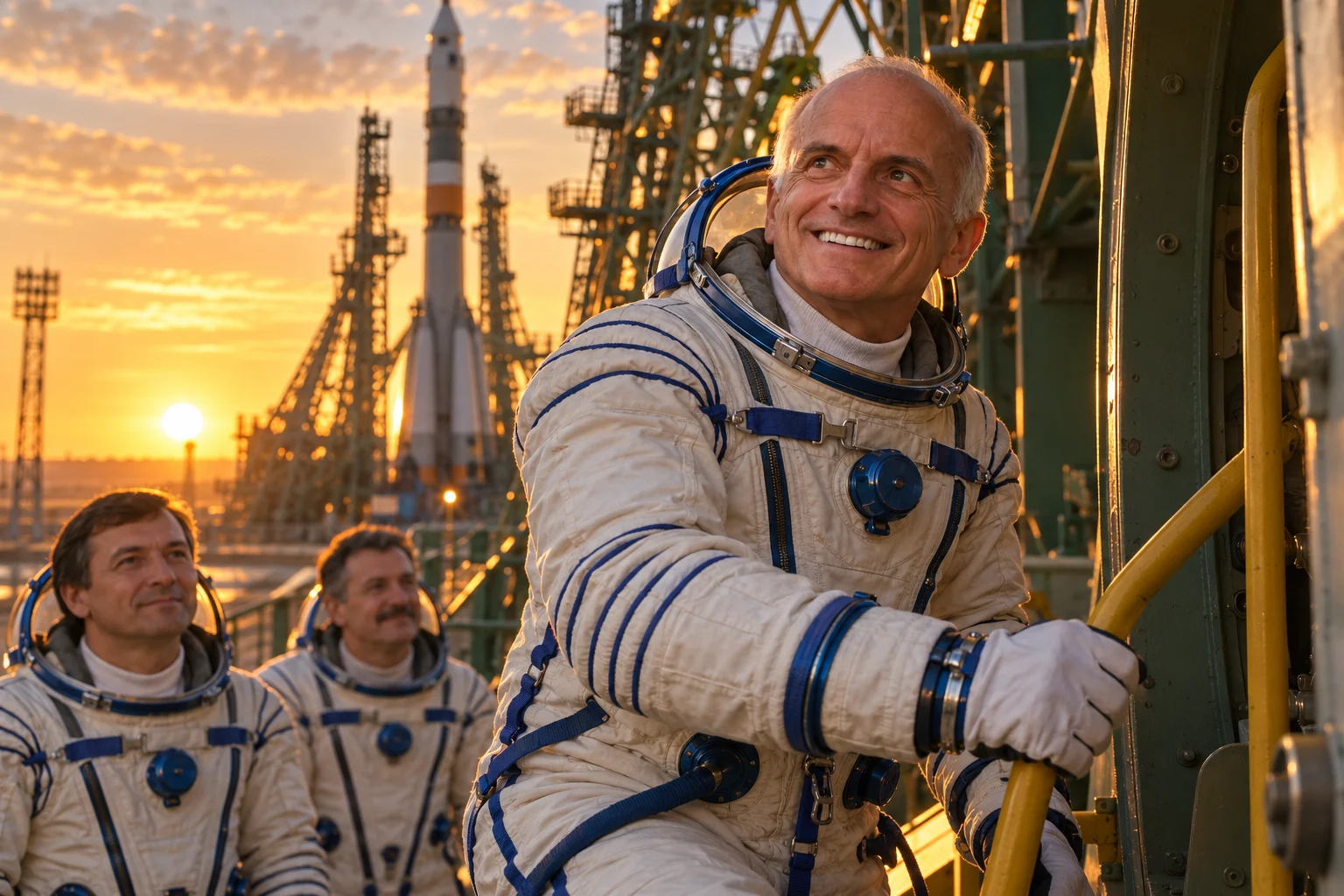
The flight did not introduce a purpose-built tourist spacecraft or a routine public ticket service. It used an established launch system, trained crews and an international research station, making the extra seat valuable within a larger operational schedule. This context explains both the achievement and its limits. The memorable spacecraft swap also shows how an exceptional personal journey can depend on mundane maintenance requirements. The illustration imagines preparations at Baikonur; its expressions and boarding arrangement are interpretive details, not a claimed archival record of the launch morning.
Space Oddity — David Bowie cover
Laurent
Laurent’s 2020 acoustic cover of Bowie’s fictional astronaut song supplies a space-travel theme. It is a later performance, not a recording from Tito’s 2001 mission.
Listen on SoundCloud ↗Follow the evidence.
- NASA: Space Station 20th — Space Flight Participants ↗
- NASA: Aeronautics and Space Report of the President, 2001 ↗
- Space.com: Dennis Tito and Space Adventures interviews ↗
- Guinness World Records: First male space tourist ↗
- Laurent: Space Oddity acoustic cover ↗
AI-assisted writing, with institutional and primary sources. Illustration is a reconstruction, not an archival photograph. Published October 31, 2026; updated October 31, 2026. Our approach