Eric Moussambani's lone Olympic heat at Sydney 2000
On 19 September 2000, Eric Moussambani swam an Olympic 100-metre freestyle heat alone after both opponents were disqualified. His finish became a memorable example of determination, while also illustrating the difference between winning a heat and qualifying for the next round.
An unfamiliar competitive setting
Eric Moussambani represented Equatorial Guinea at the Sydney Olympic Games after beginning swimming only months earlier. His preparation had taken place in a small hotel pool, far removed from the facilities available to established international competitors. Olympedia's athlete biography describes his limited training opportunities. The Olympic pool required two lengths for the 100-metre freestyle, placing him in an unfamiliar setting before a large crowd and a worldwide television audience. His entry into the same competition as established champions exposed a striking difference in preparation.
A heat reduced to one swimmer
The opening men's 100-metre freestyle heat on 19 September 2000 had three entrants. Both of Moussambani's opponents were disqualified for false starts, leaving him as the sole eligible competitor. He still had to complete the distance. The event record documents the disqualifications and his finishing time of 1 minute 52.72 seconds. What normally would have been a race among swimmers became a solitary effort, watched and encouraged by spectators throughout the arena.
Winning and qualifying are different
Moussambani won his heat because he was its only valid finisher. Advancement, however, depended on performance across the heats, and his time did not qualify him for a semifinal. World Aquatics preserves the result and its exact date. This distinction is essential to the story: a heat victory was neither an Olympic medal nor a place in the final. Race format can produce a locally winning result while the wider competition has a different outcome.
A sporting career beyond one moment
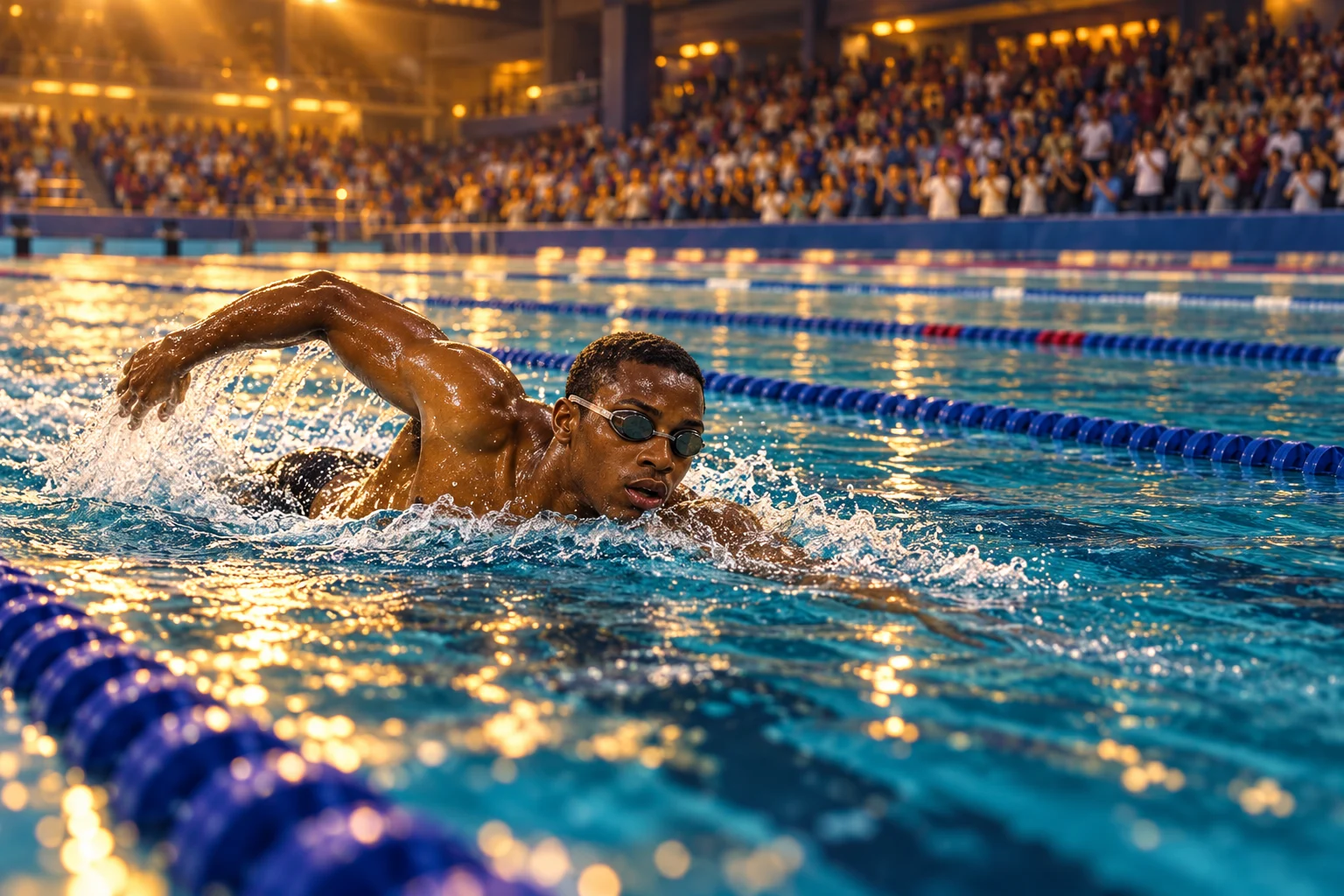
The performance attracted international attention and the nickname Eric the Eel. It also revealed the disparity in access to training facilities behind athletes who appear together at the Games. Moussambani continued swimming and substantially improved his times in later years, as Olympedia records. His story therefore extends beyond a single televised race. The illustration presents a determined lone swimmer and empty adjacent lanes; it is an artistic interpretation of the heat, not a photograph or a frame from the Olympic broadcast.
Olympic Fanfare and Theme — live organ transcription
Adam Cobb
Cobb performs his organ transcription of John Williams's Olympic music at Boardwalk Hall in June 2024. The Olympic association supplies the connection; this is not Sydney race audio or a recording from 2000.
Listen on SoundCloud ↗Follow the evidence.
- World Aquatics: Eric Moussambani results ↗
- Olympedia: Sydney men's 100 metres freestyle ↗
- Olympedia: Éric Moussambani biography ↗
- Guinness World Records: Slowest Olympic heat winner ↗
- SoundCloud: recording and performer credits ↗
AI-assisted writing, with institutional and primary sources. Illustration is a reconstruction, not an archival photograph. Published October 31, 2026; updated October 31, 2026. Our approach