Tate Modern’s public opening in the former Bankside Power Station
Tate Modern opened to the public on 12 May 2000, bringing international modern and contemporary art into a converted London power station. Its industrial scale helped redefine what a museum entrance and public space could be.
Two opening dates, different occasions
Tate Modern’s public opening took place on 12 May 2000. Queen Elizabeth II had performed the official opening on 11 May, which explains the neighbouring dates in accounts of the project. Tate’s contemporary memorandum to Parliament explicitly dates the planned public opening to 12 May. The museum stood at Bankside, on the south bank of the Thames opposite St Paul’s Cathedral, in a building with a much earlier industrial purpose: generating electricity for London.
Working with an industrial inheritance
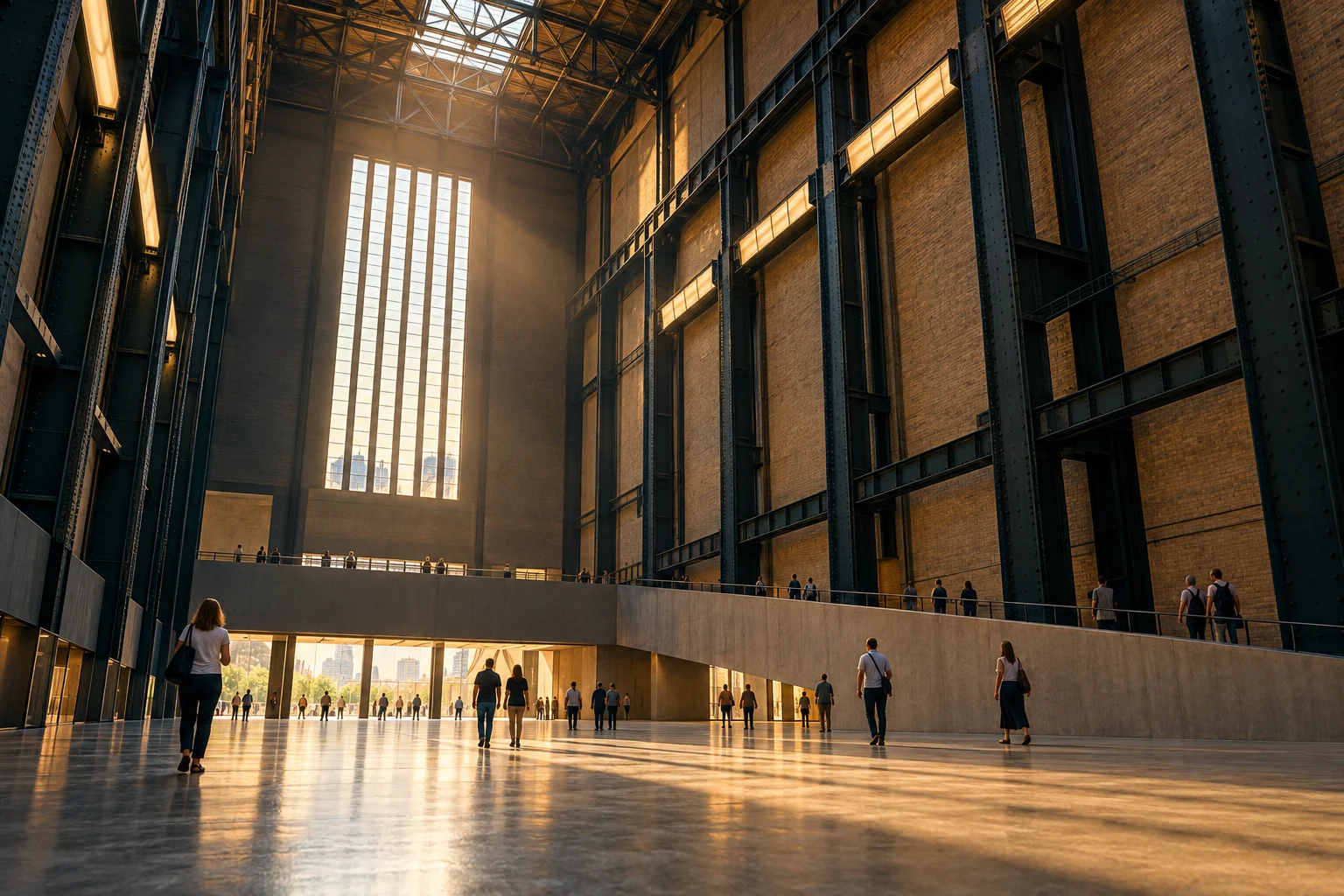
The conversion preserved the substantial shell of Giles Gilbert Scott’s Bankside Power Station while changing how it worked. The old arrangement included a boiler house, turbine hall and switch house. New galleries and supporting facilities were inserted into the boiler-house area, while the great Turbine Hall became an entrance space. The Royal Academy of Engineering’s account describes an approach that used the existing structure without treating every industrial feature as untouchable. Reuse required substantial new engineering inside the retained envelope.
A museum needs invisible machinery
Converting a power station into galleries did not mean simply clearing floors and hanging pictures. Works of art require stable environmental conditions, suitable light and floors capable of carrying heavy sculptures. The project incorporated adaptable display spaces and new structural support. Arup’s engineering journal documents the services and building work behind the transformation. The contrast is revealing: much of the new machinery was designed to remain discreet, helping visitors concentrate on art within a visibly industrial building.
A public destination on Bankside
The museum combined collection displays with exhibitions, educational workshops, an auditorium and other visitor facilities. Its early popularity exceeded expectations, and Tate described it as a catalyst for the changing Bankside area. Those early projections should not be confused with a guarantee about later attendance or neighbourhood benefits. The opening nevertheless provided a powerful example of adapting an existing building for cultural use. The illustration emphasizes the Turbine Hall’s scale and public access; its visitors and momentary arrangement are interpretive rather than a record of opening-day installations.
Numbers / Computer World — Kraftwerk cover
project s7even / electric astronaut
This later artist-uploaded cover explicitly references a Tate Modern mix. It connects to Kraftwerk’s subsequent performance programme at the museum in 2013, rather than to music played at the 2000 opening.
Listen on SoundCloud ↗Follow the evidence.
- Tate Modern memorandum to Parliament, May 2000 ↗
- Royal Academy of Engineering: Tate Modern ↗
- The Arup Journal, 2000, issue 3 ↗
- The Quietus: Kraftwerk to play Tate Modern ↗
- Electric astronaut: Numbers / Computer World cover ↗
AI-assisted writing, with institutional and primary sources. Illustration is a reconstruction, not an archival photograph. Published October 31, 2026; updated October 31, 2026. Our approach