King Kong’s 1933 release and the creation of its roar
King Kong’s American release on 7 April 1933 brought together miniature animation, live action, dramatic music and manufactured creature sounds. Murray Spivack’s transformed animal recordings helped give the animated ape a convincing voice.
A film assembled from different crafts
The American Film Institute records 7 April 1933 as the release date of King Kong, directed by Merian C. Cooper and Ernest B. Schoedsack for RKO. Earlier local premieres were separate events. Its giant creature depended on the integration of animated models, photographic processes and live performers. Sound supplied another layer of the illusion: the audience needed to hear a powerful animal whose size and dramatic behaviour exceeded anything that could simply be recorded in nature. The creature’s apparent scale was thus constructed through hearing as well as sight.
Transforming the recorded material
Sound-effects specialist Murray Spivack treated existing animal recordings as material to manipulate. The AFI’s production history describes long roars created by running an animal soundtrack backwards at slow speed, lowering it by an octave and re-recording the result. Related processes helped create breathing sounds. The voice audiences heard therefore depended on direction, speed, pitch and editing. A recognisable natural source could acquire an unfamiliar character through mechanical transformation.
Music and dramatic belief
Max Steiner’s score also helped make the creature and its world emotionally persuasive. Film historian Rudy Behlmer, interviewed for Fresh Air, stressed the combined effect of music and manufactured roars, grunts and other sounds. He placed Steiner’s extensive dramatic underscoring in an early sound-film industry where such continuous musical support was not yet routine. Music and effects served different purposes, but together they gave the photographed and animated action greater weight and continuity.
Reading the evidence carefully
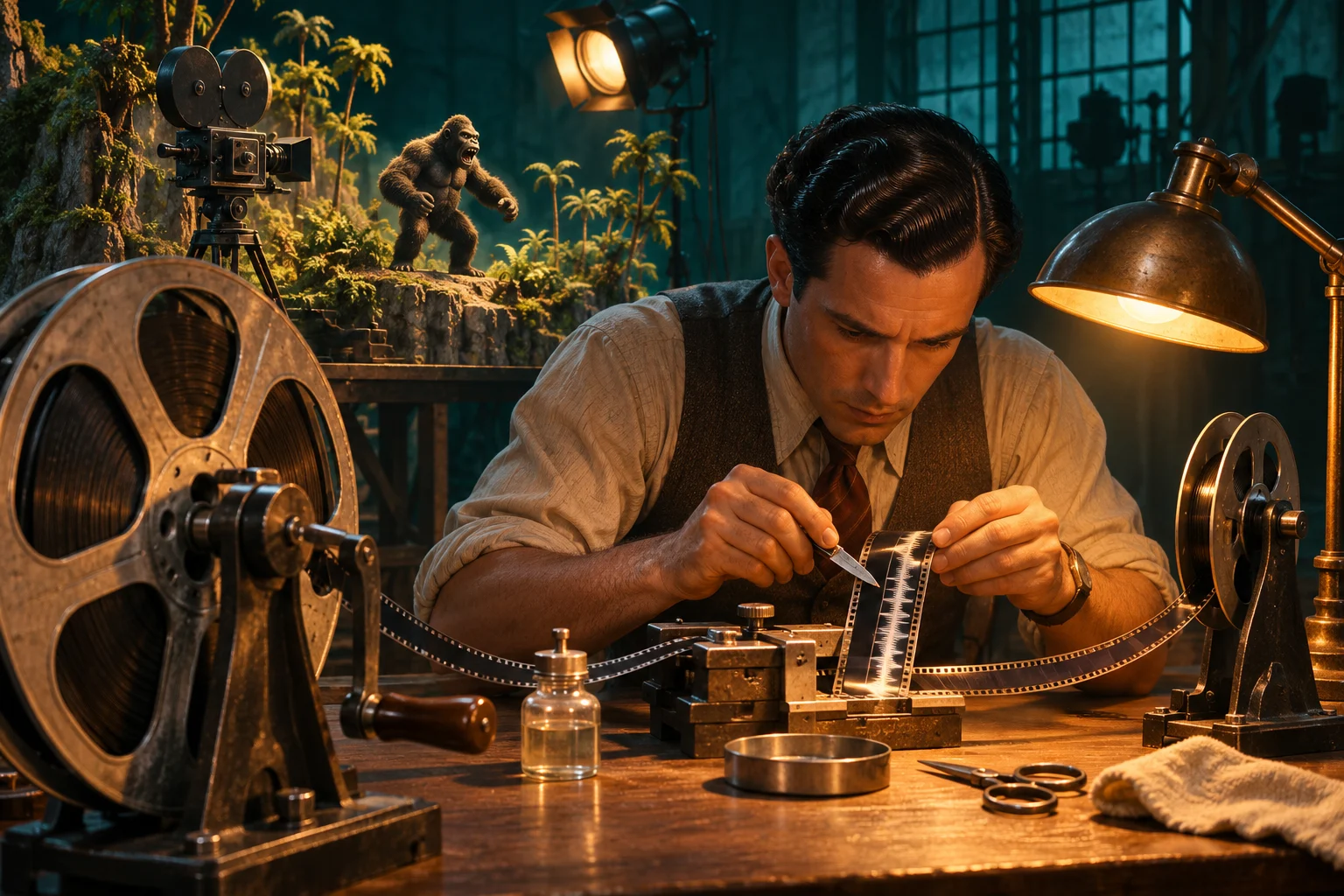
The AFI distinguishes studio files, contemporary reports and later recollections when explaining the production. Such distinctions matter when an iconic film accumulates repeated behind-the-scenes anecdotes. Its account provides a documented basis for the reversed-roar technique without implying that every creature sound came from exactly the same recipe. The accompanying workshop illustration brings together representative tools and a model for clarity; it does not reproduce a documented studio layout or a photograph of Spivack at work.
King Kong March
Jim Roseveare, pipe organ; music by Max Steiner
Roseveare’s later pipe-organ performance presents Steiner’s march from the 1933 film. It connects directly to the film’s music, while the question concerns a separate sound-effects process.
Listen on SoundCloud ↗Follow the evidence.
- AFI Catalog: King Kong, release and production history ↗
- Fresh Air Archive: Rudy Behlmer on King Kong ↗
- Library of Congress: King Kong film essay ↗
- SoundCloud: Jim Roseveare’s organ performance ↗
AI-assisted writing, with institutional and primary sources. Illustration is a reconstruction, not an archival photograph. Published November 5, 2026; updated November 5, 2026. Our approach