Elsa Schiaparelli’s trompe-l’oeil bowknot sweater, 1927
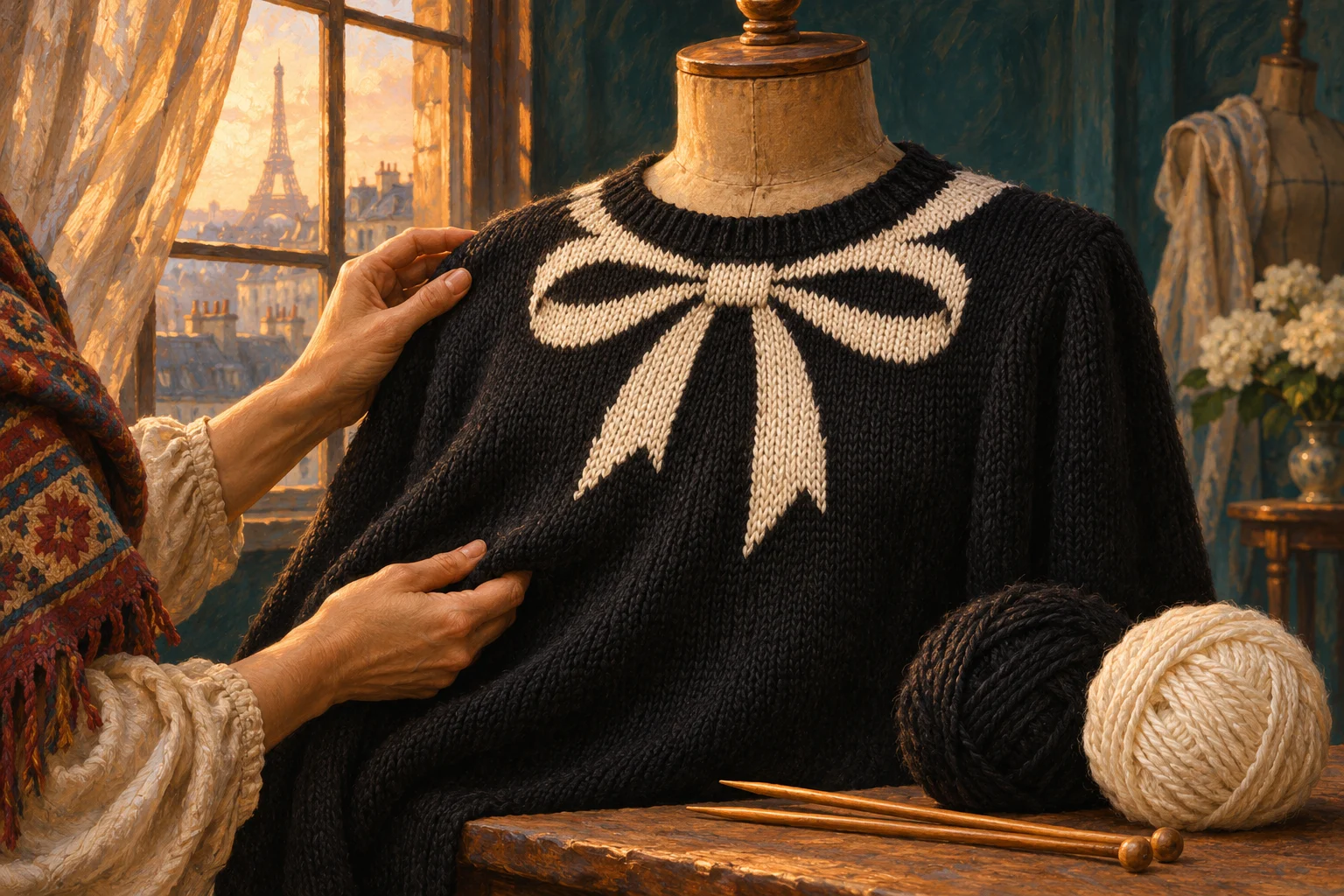
A knitted bow helped establish Elsa Schiaparelli’s reputation in 1927. Made with Armenian artisan Aroosiag Mikaëlian, the sweater applied a longstanding artistic illusion to practical modern knitwear.
A fashionable optical trick
In 1927 Elsa Schiaparelli introduced a sweater that appeared to carry a neatly tied cravat. Its white bow and hanging ends were actually incorporated into the knitted surface. The design used trompe l’oeil, a French term meaning to deceive the eye. A familiar sign of formal dressing became an image on an informal garment. The contrast made the sweater immediately understandable while rewarding a closer look at its construction. The device kept the garment physically simple while making its surface visually elaborate.
The maker behind the stitches
The V&A identifies Aroosiag Mikaëlian, an Armenian maker, as Schiaparelli’s collaborator in creating the illusion through an Armenian two-tone knitting technique. Crediting this craft expertise matters: the effect depended on how the contrasting yarns were worked together, rather than on attaching a conventional bow. The Metropolitan Museum describes the bold colour combinations and mottled effects of Schiaparelli’s early hand-knitted sweaters as an early expression of her interest in unusual fabrics.
The breakthrough collection
The V&A’s exhibition guide places the bowknot sweater in Schiaparelli’s November 1927 collection and describes its rapid success and extensive copying. The sources establish the collection month and year without supplying a precise launch day. The sweater helped make her name as a designer who could combine a simple silhouette with an unexpected idea. It also situated her work in an expanding market for sporty clothes that offered women an alternative to elaborate formal garments.
A lasting design approach
Visual illusion had a long history in painting, interiors and decorative objects before Schiaparelli adapted it to clothing. Her achievement was to make that tradition wearable, playful and commercially compelling. The bow invited the viewer to reconsider the boundary between decoration and construction. Museum examples and later recreations preserve the design, but their manufacture dates can differ from its introduction. The accompanying workroom illustration is an interpretation of the materials and process, rather than a photograph of the original collaboration.
Si toutes les femmes savaient
Fred Melé & Le Jazz du Moulin Rouge
This Paris recording is dated 8 November 1927 by its uploader. It evokes the city and year of the sweater’s success; no connection to Schiaparelli’s presentations is claimed.
Listen on SoundCloud ↗Follow the evidence.
- V&A: Schiaparelli and trompe l’oeil ↗
- V&A: Fashion Becomes Art exhibition guide ↗
- The Met: Schiaparelli sweater and her early knitwear ↗
- SoundCloud: Fred Melé recording details ↗
AI-assisted writing, with institutional and primary sources. Illustration is a reconstruction, not an archival photograph. Published November 5, 2026; updated November 5, 2026. Our approach