The Adventures of Prince Achmed and its musical planning, 1926
Lotte Reiniger’s 1926 silhouette feature was created frame by frame, with parts planned around music composed in advance by Wolfgang Zeller. Its history shows how closely image and live accompaniment could interact in silent cinema.
Making a feature from silhouettes
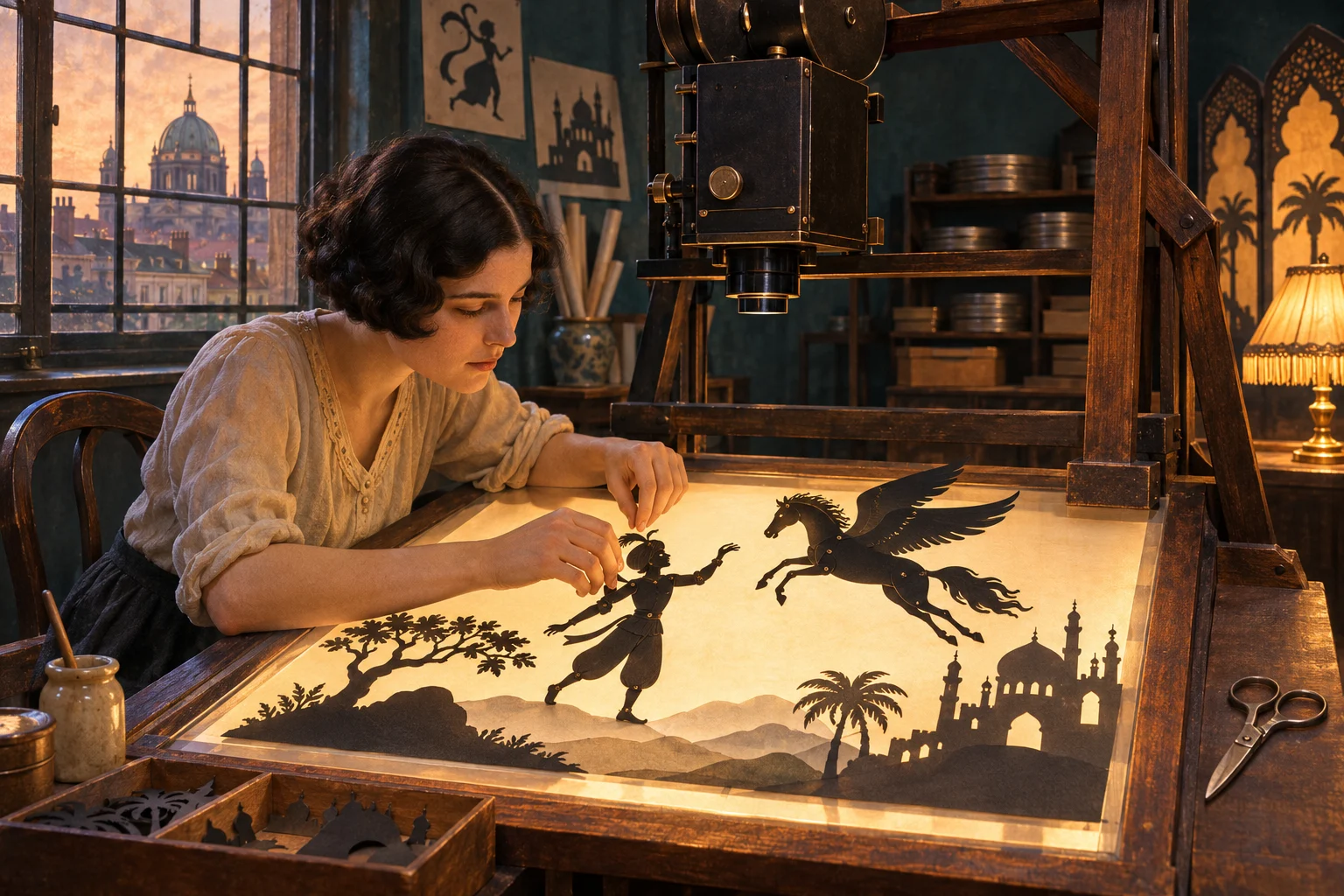
The Adventures of Prince Achmed reached its first audiences in 1926 after several years of production. Lotte Reiniger adapted material from the Arabian Nights into a feature-length animated fantasy. Its performers were jointed silhouettes, laid flat on glass, illuminated from below and photographed from above. Small adjustments between frames became flowing gestures when projected. The technique relied on highly controlled movement rather than photographing actors performing continuously before a camera.
A collaborative workshop
Reiniger’s recollection names a team including her husband Carl Koch, Alexander Kardan, Walter Türck, Walter Ruttmann and Berthold Bartosch. Their contributions included technical supervision, animation and visual effects for fire, magic and waves. The BFI’s account emphasises both her distinctive silhouette artistry and the experimentation made possible by the animation table. Multiple layers of scenery helped create spatial relationships within an image made from flat elements, expanding the expressive possibilities of the technique.
Music planned before the screening
Composer Wolfgang Zeller collaborated from an early stage. Reiniger explained that he supplied musical passages for particular effects and actions, and the filmmakers tried to animate in their rhythm. The aim was coordination with the orchestra that would accompany screenings. This is an important qualification to the term silent film: the absence of recorded spoken dialogue did not mean that music was absent from production decisions or from the intended audience experience.
Release, survival and later versions
Reiniger recalled early screenings in Berlin and Paris during 1926, followed by a Berlin commercial engagement. The film is recognised as the earliest surviving feature-length animation, a more careful description than calling it the first ever made. Its original negative was destroyed in 1945, while a tinted print preserved through Britain’s Film Society and the BFI allowed its survival. Later musical accompaniments reflect that continuing life. The workshop illustration is an interpretation of the animation process, not a production photograph. Tinting supplied colour even though the animation itself was photographed in black and white.
The Adventures Of Prince Achmed
Morricone Youth; composed by Devon E. Levins
A complete track from Morricone Youth’s later score for the 1926 film, recorded in 2014 after an initial 2012 live performance. This is a modern rescore, distinct from Wolfgang Zeller’s original music.
Listen on SoundCloud ↗Follow the evidence.
- BFI: Lotte Reiniger’s account of Prince Achmed ↗
- BFI National Archive: Prince Achmed centenary and preservation ↗
- SoundCloud: Morricone Youth’s later score ↗
AI-assisted writing, with institutional and primary sources. Illustration is a reconstruction, not an archival photograph. Published November 5, 2026; updated November 5, 2026. Our approach