Philip Parmalee’s 1910 silk delivery and the first commercial air freight
On November 7, 1910, Philip Parmalee flew silk from Dayton to Columbus for the Morehouse-Martens department store. A publicity delivery demonstrated a commercial use for aircraft, while pieces of its cargo became keepsakes attached to commemorative cards.
A shopkeeper’s proposal
Max Morehouse, president of the Morehouse-Martens department store in Columbus, saw commercial possibilities in the aircraft attracting crowds across the United States. After reading about Glenn Curtiss’s flight between Sandusky and Cleveland, he approached the Wright brothers about bringing fabric from a Dayton wholesaler to his store’s city. The Wright Company supplied the machine and pilot under a contract arranged by Roy Knabenshue. Morehouse paid $5,000, making this an expensive demonstration rather than an ordinary economical delivery. For the Wrights, it offered a chance to show that powered flight could serve purposes beyond exhibition and amusement.
The flight and its cargo
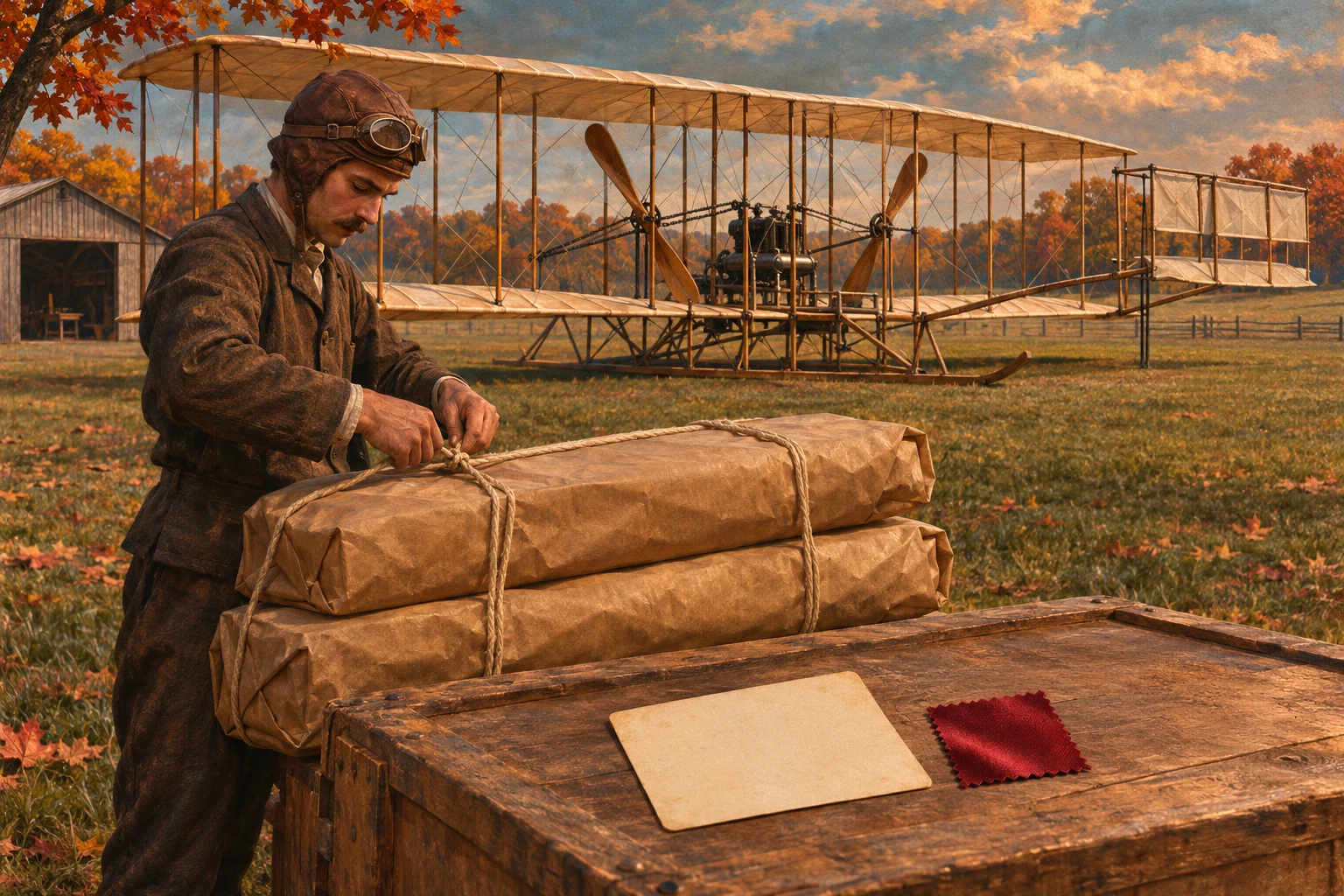
On November 7, 1910, Philip Parmalee departed from Huffman Prairie near Dayton in a Wright Model B and arrived at Columbus’s Driving Park. The biplane carried packages of silk instead of a passenger. Accounts differ over the load’s weight and the journey’s elapsed time, so those figures require care. The Ohio History Connection describes ten bolts divided between two packages; its account identifies one bolt as dark pink silk. The essential event is securely documented: a paid airplane shipment connected a wholesaler with a retail business. It is widely recognized as the first commercial air-freight flight.
A cargo people could keep
After the successful delivery, the pink silk was cut into small pieces and attached to commemorative cards. The Ohio History Connection preserves an example. These souvenirs transformed a transport demonstration into something tangible: a buyer could possess material that had actually traveled by air. The object connects technological history with everyday shopping and advertising.
Promise before routine service
The demonstration did not immediately make air freight commercially practical. Its significance lay in proving a possible service and generating attention for it. Later cargo networks depended on aircraft capacity, dependable operations and costs that early exhibition flying could not yet supply. The illustration accompanying this account interprets the setting and equipment; it is not a photograph of the departure or a facsimile of the surviving souvenir.
Come Josephine in My Flying Machine
Ada Jones and Billy Murray
This early Edison duet celebrates the flying-machine craze around the silk flight. Ada Jones and Billy Murray perform a separate period song; it is not audio of Parmalee’s delivery.
Listen on SoundCloud ↗Follow the evidence.
- Ohio History Connection: First Air Cargo Shipment ↗
- Transportation History: The 1910 silk airlift ↗
- Wright State University: Early aviation collection and silk flight history ↗
- SoundCloud: Ada Jones and Billy Murray recording ↗
AI-assisted writing, with institutional and primary sources. Illustration is a reconstruction, not an archival photograph. Published November 7, 2026; updated November 7, 2026. Our approach