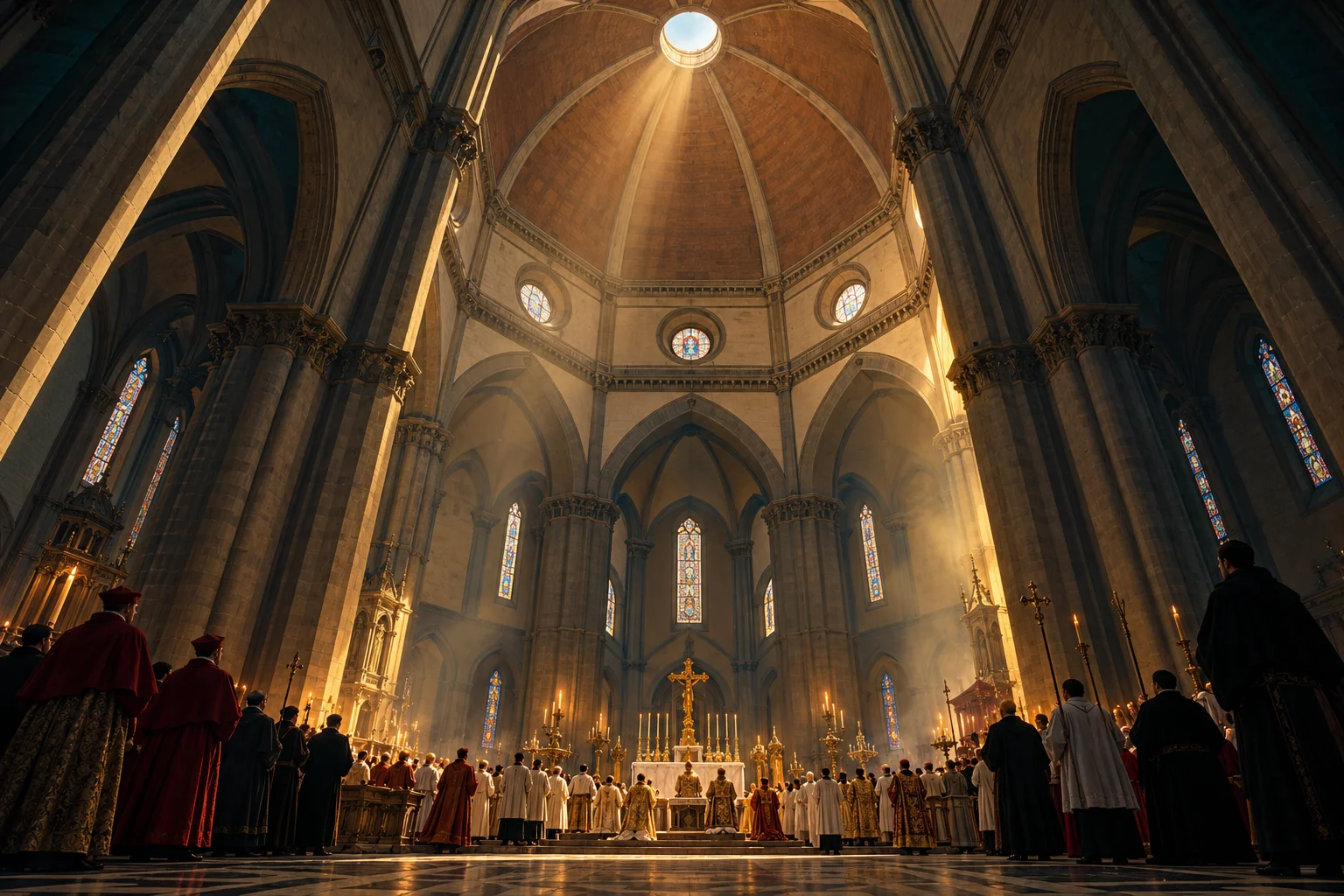
Magna Carta at Runnymede on 15 June 1215
King John accepted Magna Carta at Runnymede on 15 June 1215. Initially a contested settlement with rebellious barons, the charter acquired a lasting association with lawful government and limits on arbitrary power.

Negotiating with a troubled crown
In 1215, rebellious barons challenged King John's exercise of power. Their grievances concerned royal demands, penalties and the treatment of rights and property. The resulting settlement addressed practical problems within a medieval kingdom rather than designing a modern democracy. Its famous later reputation should not obscure that immediate setting. The charter was part of an attempt to resolve a conflict between the crown and powerful subjects, whose interests did not represent all the people living under royal authority. National Archives.
The charter dated 15 June
At Runnymede, beside the Thames, John accepted the agreement associated with the date 15 June 1215. Royal seals authenticated medieval charters; the familiar description of John signing Magna Carta is misleading. Copies communicated the agreement's terms beyond the meeting itself. The National Archives records that the terms were published four days later. The date therefore anchors a particular royal concession, while the process of issuing, distributing and enforcing it extended beyond a single encounter in a riverside field. Charter records.
The law and its unequal protections
Among the charter's enduring themes were protection against arbitrary imprisonment and the refusal to sell, deny or delay justice. These ideas contributed to a larger tradition in which royal government could be judged against law. Yet the social categories mattered: provisions concerning free men did not create equal rights for everyone. Women, unfree peasants and other groups did not receive a modern universal guarantee. Understanding those limits makes the charter's subsequent reinterpretation more historically significant, rather than less. National Archives.
Failure followed by a longer afterlife
The agreement soon collapsed. Pope Innocent III annulled it, and conflict continued. Later governments reissued versions of the charter, gradually changing its authority and role. The 1297 version entered England's statute rolls; it should not be confused with the original settlement. Magna Carta's fame comes partly from this long reuse as an argument about liberty and government. The illustration imagines the material setting of a charter and seal, not an authenticated scene showing exactly how the negotiations took place. Charter records.
Palästinalied — solo lyre arrangement
Michael Levy
Levy's modern lyre arrangement of Walther von der Vogelweide's early-thirteenth-century song supplies a near-contemporary European musical context. It is not a documented performance at Runnymede.
Listen on SoundCloud ↗Follow the evidence.
- U.S. National Archives: Magna Carta ↗
- UK Parliament: Magna Carta ↗
- The National Archives: Medieval Magna Carta records ↗
AI-assisted writing, with institutional and primary sources. Illustration is a reconstruction, not an archival photograph. Published October 31, 2026; updated October 31, 2026. Our approach