Hagia Sophia's dedication and the engineering of its dome
Hagia Sophia was inaugurated in Constantinople on 27 December 537. Its architects combined a vast domed space with a basilican plan, using curved pendentives and massive supports to create one of late antiquity's most influential interiors.
Rebuilding the capital's cathedral
The building dedicated on 27 December 537 was the third major church on Hagia Sophia's site. Its predecessor had burned during the Nika revolt of 532. Emperor Justinian ordered a new cathedral, designed by Anthemius of Tralles and Isidore of Miletus. The Metropolitan Museum of Art establishes the inauguration date and describes the designers' mathematical background. Their commission combined religious purpose with a conspicuous demonstration of the resources and ambition of the imperial capital.
Making different geometries meet
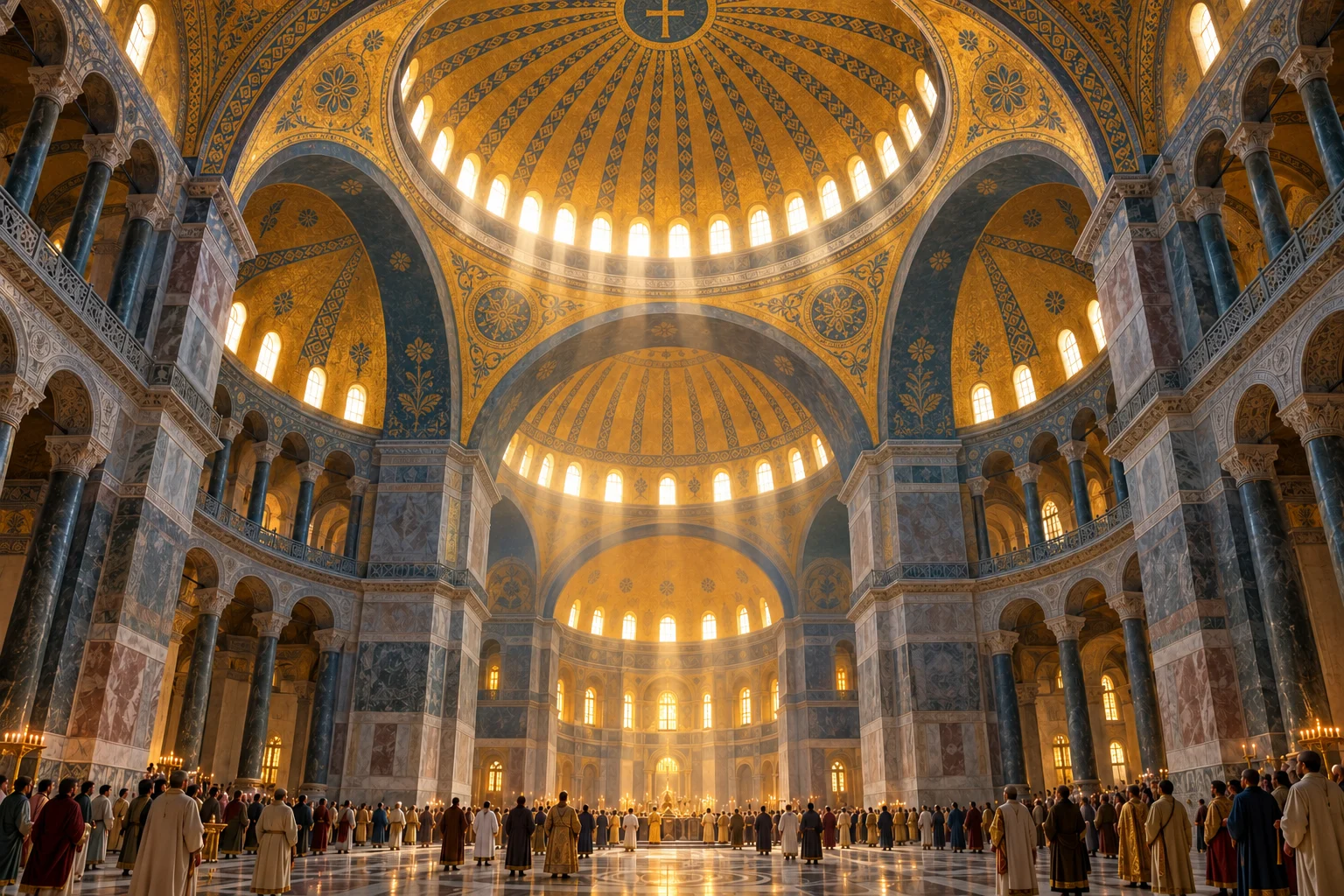
A circular dome cannot simply sit on the four corners of an open square room. At Hagia Sophia, curved triangular surfaces called pendentives mediate between the dome's circular base and the great supporting arches. The Met's architectural account identifies four of these concave triangles. They belong to a larger structural system of arches, piers, vaults and half-domes. Concentrating support in this system helped create the impression of an unusually open, unified interior.
Light, marble and imperial scale
The central dome spanned approximately 31 metres. Windows near its base and extensive gold decoration contributed to the impression of a luminous canopy. Coloured marble and ornamental stonework enriched the walls and arcades. The original decorative scheme was largely nonfigurative; many familiar images associated with the building belong to later periods. Understanding that sequence matters when imagining the dedication. The sixth-century congregation experienced a newly completed Christian cathedral, not the accumulated furnishings and alterations visible in subsequent centuries.
An achievement that needed repair
The first dome collapsed in 558 and was rebuilt at a greater height. The British School at Athens archive records that rebuilding and later repairs. The structure's survival therefore reflects continued maintenance and adaptation as well as the initial design. Its influence extended through Byzantine architecture and later Ottoman building. The accompanying illustration is an interpretation of the early interior, not a measured reconstruction or an archival image; details of the lost original dome remain matters for architectural scholarship.
Phos Hilaron
Assumption of the Theotokos Cathedral Choir, Denver; James N. Maniatis
This modern Greek Orthodox choir recording sets an ancient Christian evening hymn, connecting with Hagia Sophia's original liturgical world. It does not reconstruct the music of the 537 dedication.
Listen on SoundCloud ↗Follow the evidence.
- Metropolitan Museum of Art: Hagia Sophia, 532–37 ↗
- Metropolitan Museum of Art: Hagia Sophia and its pendentives ↗
- British School at Athens: Hagia Sophia architectural archive ↗
- Metropolitan Museum of Art: The Byzantine State under Justinian I ↗
- Matheson Trust: Phos Hilaron and its early Christian history ↗
- SoundCloud: recording and performer credits ↗
AI-assisted writing, with institutional and primary sources. Illustration is a reconstruction, not an archival photograph. Published October 31, 2026; updated October 31, 2026. Our approach