The total solar eclipse of 19 July 418 and its historical record
A total solar eclipse on 19 July 418 darkened part of the late Roman world. An ancient account reports visible stars and an unusual luminous object, creating a case in which a calculable astronomical event must be distinguished from interpretations of a historical text.
An event that can be calculated
A total solar eclipse occurred on 19 July 418. NASA's eclipse catalogue identifies the event through modern calculations of the Sun, Moon and Earth, independently of any particular ancient story. NASA's separate catalogue of eclipses visible from Rome also includes it among the city's total eclipses. The date follows the historical Julian-calendar convention used for events of this period; it is not a modern Gregorian anniversary calculated backwards.
Why stars can appear in daylight
Stars do not switch off when the Sun rises. Normally, sunlight scattered through Earth's atmosphere makes the daytime sky too bright for most of them to be visible. As NASA explains, during totality, the Moon covers the Sun's brilliant visible surface for observers within a narrow track. The resulting reduction in glare can reveal bright stars and planets. The effect is local: observers outside the path may see a partial eclipse without experiencing the same depth of darkness. The Sun itself continues shining; it is the observer’s view of its surface that changes.
An account with an unusual extra detail
An 1877 discussion in Nature examines the historian Philostorgius's account of the event. It describes such deep darkening that stars were visible, together with an unusual cone-shaped light. The nineteenth-century discussion relates that object to comet reports. These layers of evidence deserve separation: calculations establish that the eclipse occurred, while identifying an object described in a transmitted historical narrative requires interpretation of the wording, chronology and independent astronomical records.
The limits of an illustrated reconstruction
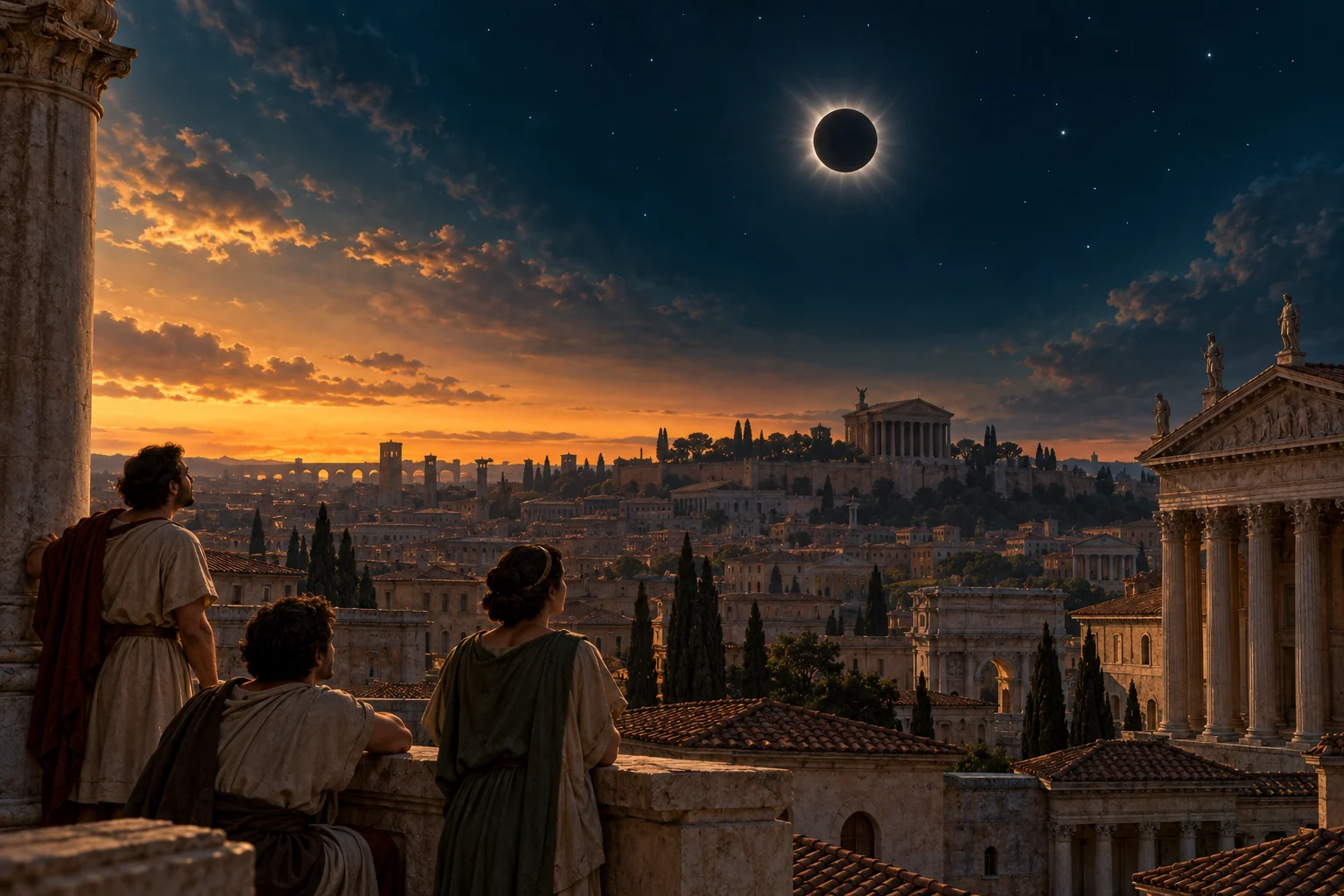
NASA's historical-eclipse page explicitly warns that including an associated story does not validate every detail of it. That distinction applies here. A secure eclipse date cannot automatically authenticate a particular observer, conversation or comet identification. The accompanying Roman scene illustrates a physically possible experience of totality in a region where the eclipse was visible. It is not an eyewitness image, and the figures do not represent people whose presence at that exact viewpoint has been established.
Clair de Lune
Michael Ottosson
Michael Ottosson's later piano performance of Debussy's Clair de Lune provides a thematic association with celestial light and sudden darkness. The composition and recording are many centuries later than the eclipse.
Listen on SoundCloud ↗Follow the evidence.
- NASA: Total solar eclipse of 19 July 418 ↗
- Nature, 1877: The ancient eclipse account ↗
- NASA: Major eclipses visible from Rome ↗
- NASA: Evaluating historical eclipse associations ↗
- NASA Science: Types of Solar Eclipses ↗
AI-assisted writing, with institutional and primary sources. Illustration is a reconstruction, not an archival photograph. Published October 31, 2026; updated October 31, 2026. Our approach